
Suahasil Appointed Finance Minister, Economist: Do Not Only Focus on Reducing Deficit
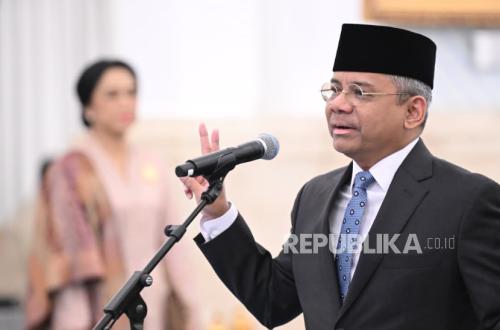
Finance Minister Suahasil Nazara faces the challenge of maintaining the health of the State Budget (APBN) while ensuring that state spending continues to support economic growth. Achmad Nur Hidayat, an economist and Public Policy Expert at UPN Veteran Jakarta, argues that fiscal health cannot be measured solely by the ability to keep the deficit below 3 per cent.
These remarks follow President Prabowo Subianto’s inauguration of Suahasil as Finance Minister, replacing Purbaya Yudhi Sadewa on Monday (14/09/2026). Following the inauguration, Suahasil ensured that the APBN deficit would remain below 3 per cent, stating, “The deficit will remain below 3 per cent.”
Achmad believes this commitment is vital for maintaining fiscal discipline and providing certainty to the markets. However, he maintains that the quality of budget management is also determined by how the government manages state revenue and expenditure.
“A deficit below 3 per cent does not automatically mean the APBS is healthy,” Achmad said in a brief message on Monday (14/09/2026).
According to Achmad, the government could record a deficit below 3 per cent but still face fiscal issues if this is achieved by reducing essential public spending, cutting regional transfers, or shifting fiscal obligations outside the state budget. Therefore, the quality of state spending and revenue requires as much attention as the deficit target. “This means fiscal quality should not be viewed solely through deficit figures,” he noted.
Achmad believes Suahasil’s experience within the Ministry of Finance serves as an asset in facing these challenges. Prior to becoming Finance Minister, Suahasil led the Fiscal Policy Agency and served as Deputy Finance Minister.
This experience means Suahasil understands APBN management and fiscal policy from the inside. However, this position also brings higher expectations regarding her ability to improve policies that currently face issues.
“Suahasil is not an outside technocrat coming to fix the old system. She is part of the system itself,” he said.
Consequently, Achmad hopes Suahasil can utilise her experience to improve the quality of fiscal management. He noted that while policy continuity is important, it must be accompanied by evaluations of programmes and spending that have yet to yield optimal results.
Achmad also highlighted the relationship between the management of state assets through Danantara and the APBN. He argued that the government must establish clear boundaries between investment activities, government mandates, dividends, and fiscal risks.
“Indonesia must not have two separate fiscal worlds operating independently,” he remarked.
Achmad noted that Danantara can still function as a national investment instrument. However, the relationship between investment activities and state finances must have clear governance and oversight mechanisms.
“The line between commercial investment, government mandates, public dividends, and fiscal risk must be very clear,” he said.
Achmad believes the 2027 Draft State Budget (RAPBN) will serve as one of Suahasil’s initial tests. The government must fund various priority programmes amidst limited fiscal space.
These programmes include Free Nutritious Meals (MBG), energy subsidies, food security, education, health, infrastructure, defence, and cooperatives. According to Achmad, limited fiscal space requires the government to determine priorities more precisely. “If everything is a priority, then in reality, nothing is a priority,” he said.
Therefore, Achmad requested that the Finance Minister ensure every programme has clear cost calculations and funding sources. He argued that the role of the Finance Minister is not just to provide a budget, but to ensure government policies can be funded sustainably.
“A Finance Minister is not merely a treasurer seeking funds for all the government’s political promises. They must be able to state the cost of every policy, who will pay, and which programmes must be delayed when funds are unavailable,” he emphasised.
On the other hand, Suahasil stated that the President has provided direction for the government to maintain the health and credibility of state finances. The APBN, she said, remains directed towards funding the government’s priority programmes.
“The specific direction from the President is to maintain state finances, which means maintaining the health and credibility of those state finances. Thus, the APBN, as part of state finances, must be able to execute the government’s priority programmes,” said Suahasil.
Suahasil also emphasised that budget efficiency is not merely about cutting spending. According to her, efficiency must ensure that available funds produce maximum outputs and provide benefits to the public.
“Therefore, efficiency is not just about cutting expenditure. Efficiency is about using existing spending to produce maximum output, where that output provides benefits to the community,” she said.
Achmad believes Suahability has the opportunity to prove her long experience in the Ministry of Finance through the improvement of fiscal policy quality. He noted that the main challenge ahead is not just maintaining the deficit figure, but ensuring every rupiah of the budget provides benefits and supports economic growth.
“Her long experience in the Ministry of Finance is both an asset and a burden. She knows the problems from the inside. Therefore, she has no reason to merely maintain the status quo,” said Achmad.
Source: jawawa.id (https://jawawa.id/newsitem/suahasil-appointed-finance-minister-economist-do-not-only-focus-on-reducing-deficit-1789397768)
Originally published by Republika (https://ekonomi.republika.co.id/berita/tlcqaz416/suahasil-jadi-menkeu-ekonom-jangan-hanya-tekan-defisit), translated from Indonesian