
Study Visit to Banten Customs Imitates WBBM, Boosting Integrity and Preventing Deviations
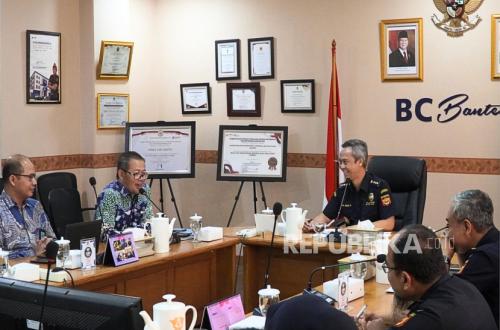
Efforts to prevent corruption and deviations in public services have become an urgent need amid demands for transparency and accountability. Strengthening the Integrity Zone (ZI) towards the Clean and Serving Bureaucracy Region (WBBM) is seen as a concrete step to ensure corruption-free public services while protecting society from the adverse effects of non-transparent governance. In this context, the Bureau of Inter-Parliamentary and International Organisations Cooperation (KSAP OI) of the House of Representatives of the Republic of Indonesia (DPR RI) carried out a study visit to Banten Customs on Tuesday (7/4/2026). The event, held in the Meeting Room on the 2nd Floor of the Banten Customs Office, aimed to learn best practices in developing the Integrity Zone towards the WBBM predicate. The visit was welcomed by Dwi Agus Prasodjo, Head of the Internal Compliance Division of the Banten Customs Regional Office, representing the Head of the Banten Customs Regional Office. This study visit is part of the KSAP DPR RI’s efforts in implementing the Integrity Zone development programme to strengthen a clean and service-oriented work system. Dwi explained that Banten Customs has held the WBBM predicate since it was confirmed by the Ministry of PANRB in 2023 and has managed to maintain it until 2025. He also outlined the journey of developing ZI towards WBK/WBBM in the Banten Customs environment as a reference for other agencies. “We are ready to support and share experiences (knowledge sharing) so that other agencies can achieve work units with WBK or WBBM predicates,” he said. In the discussion session, Agus explained the field assessment process by the Ministry of PANRB, the stages that have been passed, and various challenges in building towards a work unit with the WBBM predicate. In addition, strategies for development, service innovations, and changes made to ensure transparent, accountable services free from deviant practices were also presented. For information, the Corruption-Free Region (WBK) predicate is given to work units that can implement bureaucratic reform programmes and prevent corruption, collusion, and nepotism. Meanwhile, WBBM is an advanced level that not only emphasises the prevention of KKN but also ensures prime public services oriented towards community needs. The ZI Coordinator of the KSAP and OI Bureau, Saeful Anwar, expressed appreciation for the knowledge-sharing opportunity. “We have obtained many very valuable inputs. This will be formulated as a strategic step to encourage KSAP DPR RI to achieve the WBBM predicate,” he stated. Through this activity, strengthening bureaucratic integrity is expected not only to impact institutional performance improvements but also to provide real benefits to society. With a cleaner and more transparent system, the potential for deviations can be minimised, making public services more equitable, swift, and reliable.