
Study Reveals How ASEAN Can Cut the Cost of Emergency Oil Reserves
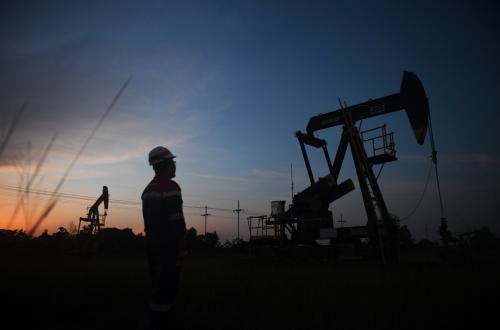
JAKARTA – Cooperation among ASEAN countries to provide emergency oil reserves could save up to US$610 million a year. A regional arrangement is estimated to cost US$2.19 billion annually, less than the US$2.80 billion required if each country relied on national reserves.
The findings were presented by the Economic Research Institute for ASEAN and East Asia (ERIA) at the 2nd East Asia Media Caucus in Jakarta on Friday (6 November 2026). The forum, which brought together researchers and journalists from several ASEAN countries, discussed the cost-effectiveness of emergency oil reserves and ways to improve industrial competitiveness through cleaner production.
ERIA Chief Operating Officer Takayuki Yamanaka said disruptions to global energy supplies showed the importance of cooperation between countries. He said stronger energy resilience needed to go hand in hand with green growth, digital transformation and regional economic integration.
“With the same amount of additional reserves, this regional cooperation scheme could save around 22 per cent, equivalent to US$610 million a year,” Yamanaka said in a statement on Saturday (7 November 2026).
ERIA Senior Energy Economist Han Phoumin explained that the calculations were based on a shared-reserve arrangement in which the reserves would remain owned by producers or partners. Participating countries would have the right to use the reserves under an agreement, while the costs of emergency delivery and replenishment would be calculated separately.
“This scheme is an ERIA recommendation that still requires consideration and approval by the governments concerned,” Han said.
According to Han, agreeing on the right to use reserves was only a first step. Each country would also need to establish procedures for releasing reserves, ensure the fuel types matched requirements, and provide the means to deliver supplies to locations in need.
“Through voluntary trials, governments and operators can test whether all of this works properly before supplies are disrupted,” Han said.
Alongside energy resilience, ERIA highlighted challenges to ASEAN’s industrial competitiveness as the global economy changes. ERIA Senior Policy Fellow Intan Murnira Ramli said the region’s ability to integrate green growth, digital transformation and regional cooperation would shape industrial development and investment.
“ASEAN’s future competitiveness will increasingly depend on the region’s ability to combine green growth, digital transformation and regional integration. Global changes offer us opportunities to develop new industries, attract investment, strengthen value chains and create better jobs across the region,” Intan said.
An ERIA survey of Japanese companies operating in ASEAN found that 53.3 per cent had taken steps to reduce carbon emissions. However, only 7.1 per cent reported switching to lower-emission suppliers or encouraging suppliers to cut their emissions.
A separate survey of local ASEAN companies also found that small businesses were less likely than larger firms to take emissions-reduction measures. Limited funding and technical capacity were among the constraints they faced.
Challenges were also evident in the adoption of digital technology. Among the Japanese companies surveyed, 70.8 per cent cited a shortage of workers with digital skills as an obstacle, while 64.7 per cent pointed to the high cost of implementing technology.
The findings point to a need for investment in skills development and technology, as well as wider access to finance, so that more companies, including small businesses, can adapt to industrial change.
To address these challenges, the forum also discussed aligning standards and strengthening connectivity between countries. One item on the agenda was the ASEAN Green Economy Framework Agreement (GEFA), which is expected to support investment and create business opportunities in the green economy.
“Implementing a shared agenda will be crucial in determining ASEAN’s ability to develop new industries, strengthen value chains and create better jobs,” Intan said.
Source: jawawa.id (https://jawawa.id/newsitem/study-reveals-how-asean-can-cut-the-cost-of-emergency-oil-reserves-1794041444)
Originally published by Republika (https://ekonomi.republika.co.id/berita/to4ef2416/studi-ungkap-cara-pangkas-biaya-cadangan-minyak-darurat-di-asean), translated from Indonesian