
Study records Raja Ampat's walking shark density as highest in the world
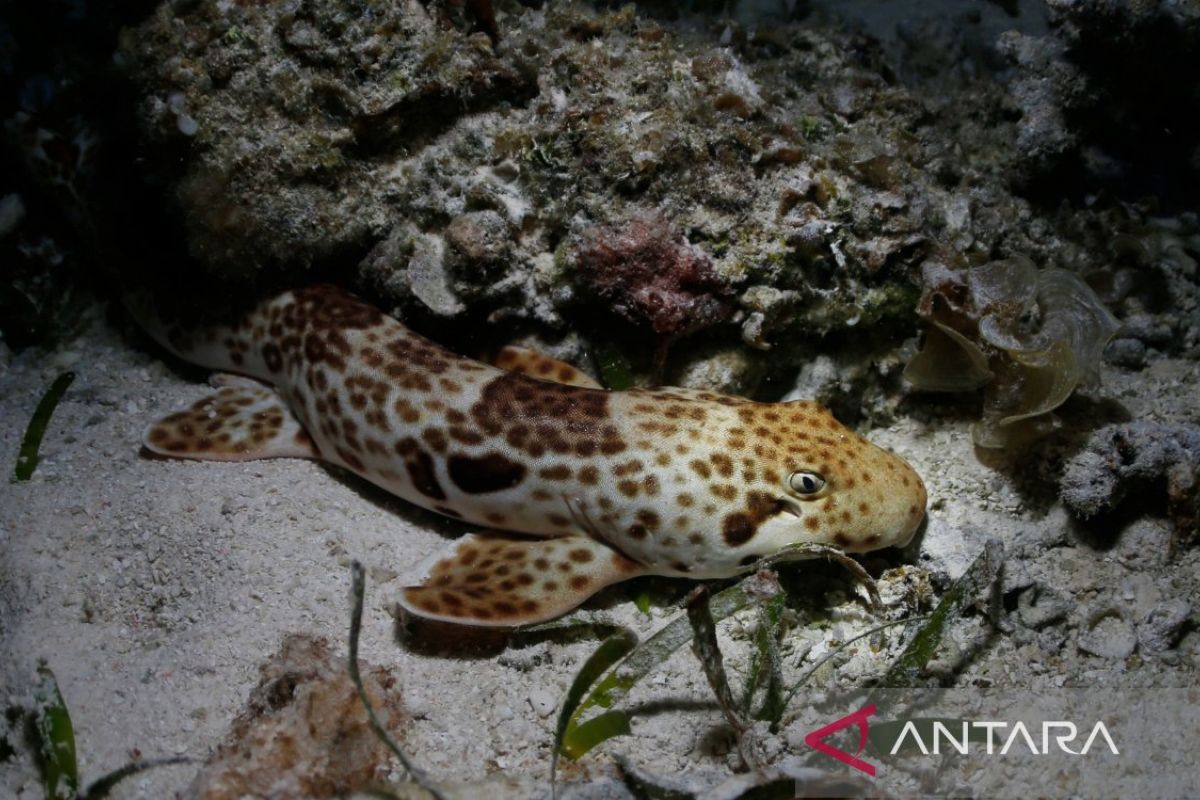
A scientific study has recorded that the endemic walking shark population (Hemiscyllium freycineti) around Gam Island, Raja Ampat Regency, Southwest Papua, has the highest density in the world, reinforcing the need to protect coral reefs as a critical habitat for the species.
Lead Conservation Scientist at the Elasmobranch Institute Indonesia, Edy Setyawan, stated that the 14-month study, published in an international journal, found the density of walking sharks reached 2,462 individuals per square kilometre.
“Walking sharks are highly dependent on coastal and shallow marine habitats, making them extremely vulnerable to local disturbances such as coastal development and pollution. The scientific data we collected serves as a foundation to ensure protection efforts are truly effective,” he said.
Between February 2024 and April 2025, researchers identified 736 unique individuals from 1,191 sightings over 64 survey nights at six locations, with the largest population concentrations around the islands of Arborek, Gam, Fam, Mansuar, and Batanta.
“Of the total identified individuals, the female population dominates with a ratio of 1.29 to 1, while the recorded body sizes ranged from 19.4 centimetres to 75 centimetres,” he added.
The study, conducted by a team from the Elasmobranch Institute Indonesia, the Regional Technical Implementation Unit for Marine Conservation Area Management of the Raja Ampat Islands, Konservasi Indonesia, the Arborek community, and Re:wild, also found that coral reefs play a vital role as nursery habitats for walking sharks.
Approximately 69 percent of juvenile individuals were found inhabiting coral reef ecosystems, whereas adult individuals were more commonly encountered in seagrass beds and sand flats, indicating a separation of habitats based on life stages. This makes the presence of coral reef ecosystems a crucial factor.
“We also discovered that walking sharks exhibit high site fidelity. During the study period, the maximum movement distance was only about 475 metres, and no individuals were found to have moved between islands,” Edy said.
Despite the high population density, researchers cautioned that threats to walking sharks persist, particularly from increasingly intensive tourism development, habitat degradation due to construction, and the impacts of climate change such as marine heatwaves.
The research recorded that juvenile sharks grew at an average rate of 7.8 centimetres per year, faster than adult sharks which grew approximately 2.8 centimetres per year. This growth data is important as a benchmark for monitoring population health in the future.
“Results from studies on closely related species to the walking shark indicate that rising water temperatures can reduce growth rates and increase mortality rates,” he noted.
Head of the Regional Technical Implementation Unit for Marine Conservation Area Management of the Raja Ampat Islands, Hasan Makasar, said the research results will become an important reference in formulating more measurable conservation area management strategies.
All information regarding population density and movement patterns of walking sharks assists area managers in regulating tourism activities and coastal development so as not to disturb the habitat of this endemic Raja Ampat species.
“The research team recommends long-term monitoring, expansion of surveys to other areas in Raja Ampat such as Misool and Kofiau, as well as genetic studies to understand connectivity between populations that exhibit high residency levels,” he said.