
Students Oust Ruling Power: What Comes Next?
Jakarta, CNBC Indonesia – Serbia’s student movement has ended the dominance of long-serving leader Aleksandar Vučić and his party in the election on Sunday (25 October 2026). The victory marks a major achievement for a protest movement that has held peaceful demonstrations over the past two years.
But its real challenge is only beginning: governing, something neither the students nor their chosen candidates have done before.
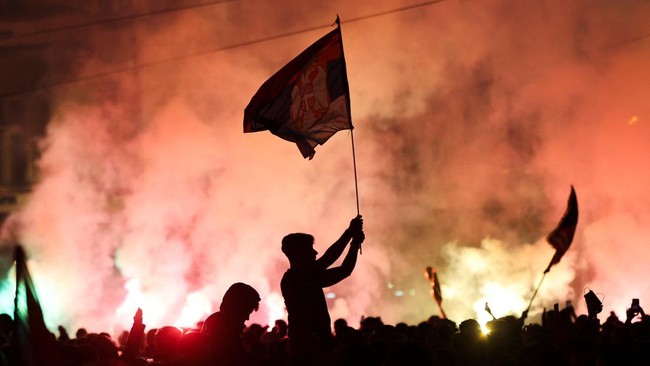
Tens of thousands of people took to the streets across Serbia to celebrate after Vučić conceded defeat on Sunday night. The historic election result also brought to a close two years of anti-government protests.
Amid celebrations marked by flares, fireworks, singing and dancing, questions began to emerge. Who will become prime minister for a movement without a single leader?
What policies will they pursue? And can figures relatively unknown in politics work together to improve the economy, tackle corruption and manage Serbia’s complex foreign relations?
The answers will determine political stability in Serbia, the largest economy in the Western Balkans, as well as the course of its relations with China, Russia and the European Union (EU), its biggest trading partner.
In a report on Monday, Teneo Global Research said the students’ victory could prompt major changes to state institutions and policy, particularly in tackling corruption, upholding the rule of law and improving public services.
“However, bureaucratic resistance to reform and the movement’s limited experience in government could make the transition difficult,” Teneo wrote.
Several names emerge
The student protest movement began after 16 people were killed when a canopy at a railway station in Novi Sad, northern Serbia, collapsed in 2024. Since then, student-led demonstrations have demanded accountability for the tragedy and called for action against corruption.
Although it has no single central figure, the movement has won broad public support. It then selected 250 people from a range of backgrounds, including academics, lawyers, doctors, actors, farmers and musicians, to represent it in the election.
The student movement and several of its leading candidates have outlined the agenda they want to pursue. One of their main priorities is to tackle corruption by reforming state institutions.
They do not recognise Kosovo, a former Serbian province in the south that declared independence in 2008. Nevertheless, the movement wants to hold a referendum on Serbia’s EU membership, amid worsening relations between the two sides in recent years.
Prominent figures in the movement include cardiologist Ilija Srdanović, who heads the student candidates’ list; former central bank governor Dejan Šoškić; and Radomir Šajčić, a professor at the University of Belgrade who spoke on behalf of the students after their victory.
It remains unclear whether these figures will take up ministerial posts. Another challenge will be to build a cohesive government, agree on policy priorities and maintain co-operation so that the movement can use its parliamentary majority to carry out reforms.
“We have witnessed a major change in Serbia’s political culture brought about by the student movement. Now we have to see whether that change will last,” said Katarina Popović, also a professor at the University of Belgrade, according to Reuters.
“We can only hope there are major goals that will keep them together long enough to dismantle the existing system,” she said.
Reforming state institutions
Under Serbia’s constitution, candidates from the student movement have 90 days to form a government after parliament convenes following the announcement of the final results by the country’s election commission.
Time is a critical factor, particularly because the government must pass a budget before the end of the year, as public and private debt levels continue to rise. Meanwhile, tackling corruption will require a sweeping overhaul of the police, intelligence services and judicial system.
Belgrade-based lawyer and former deputy interior minister Božo Prelević said state institutions needed to undergo a process of “detoxification” after 14 years of Vučić’s rule.
He also warned that Vučić’s Serbian Progressive Party (SNS) would be a powerful opposition force. The new government must therefore be prepared for political resistance as it pursues its reform agenda.
Vučić and the SNS have repeatedly denied allegations of repression and corruption.
Relations with Russia, China and the EU
The change of government in Serbia will also be watched by countries with strategic interests in the region.
Russia, Serbia’s traditional ally and main natural gas supplier, is monitoring the political developments. Kremlin spokesman Dmitry Peskov praised Vučić but did not directly congratulate the student movement.
Jovo Bakić, a sociologist and university lecturer representing the student candidates’ list, said relations with Moscow would not change. In an interview with the Russian-owned RT Balkan, he said: “We respect Russia as a great country and an historically important partner, and in many ways as our protector.”
Bakić added that Serbia would not change its foreign policy towards Russia, including by imposing sanctions on Moscow.
Ukraine is also following developments. It has indirectly benefited from Serbian arms supplies in its effort to repel Russia’s invasion, now in its fourth year.
Meanwhile, several European officials congratulated the student movement and said they were ready to help Serbia tackle corruption.
Savo Manojlović of the Move-Change movement, which supports the students, said he was confident the group would be able to choose the right person to lead the government.
“I am confident that the Student List will find a way, as it has so far, to choose someone capable of governing. That person will have the honour, but also bear the enormous responsibility, of leading Serbia through these reforms,” Manojlović said.