
Students Highlight Legal Violations in Army-Led Land Eviction in Lenteng Agung
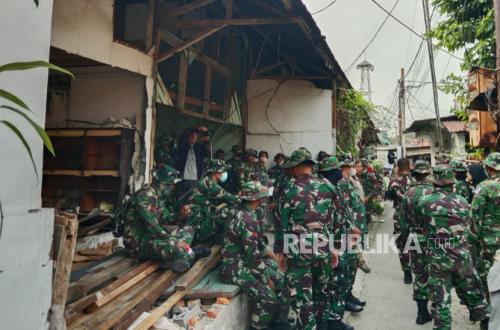
The land eviction conducted by the Indonesian Army (TNI AD) in the Lenteng Agung area, Jagakarsa District, South Jakarta, sparked chaos on Wednesday. Residents occupying houses on the land had still not agreed to vacate their homes. Mora, Head of the Strategic Studies Department at the University of Indonesia’s Student Executive Board (BEM UI), stated that the forced eviction attempts began on Tuesday. At the time, residents were completely unprepared for the execution process carried out by soldiers. “There were residents who were sick, some had to be carried out. Many were crying and screaming as the eviction took place,” he said. According to Mora, residents asked the soldiers to show the eviction order. However, the army did not provide it. Furthermore, residents chose to stay because there was still an ongoing lawsuit that had not been decided in court. Therefore, the disputed object should not have been executed before a court ruling. Mora added that several students who arrived coordinated with the residents and set up an aid post. However, a number of soldiers present did not permit the establishment of the post. Additionally, the army cut off the residents’ electricity supply in the area, even though the residents have a right to access electricity. “I also question the legal basis for the electricity disconnection. In the regulations used as the basis for the enforcement, there are no provisions regarding electricity disconnection. This means there have been legal violations in this enforcement,” Mora stated. He said that his team had requested clarification from the army. In that meeting, the army provided the legal basis for the enforcement, namely the Right of Use Certificate (SHP) Number 168 of 2016 and Defence Minister Regulation Number 13 of 2018, which state that the location is a category II state house, supposed to be occupied by active soldiers. Mora argued, however, that the area was originally a warehouse used by soldiers as a living quarters, which they subsequently renovated into houses up until today. “This means it is not official housing, but a warehouse that was turned into a residence. So it is unclear whether it used an SIP (usage permit) or another mechanism,” he concluded.