
Student Protest at Monas Closes Jl Medan Merdeka Selatan Towards Gambir
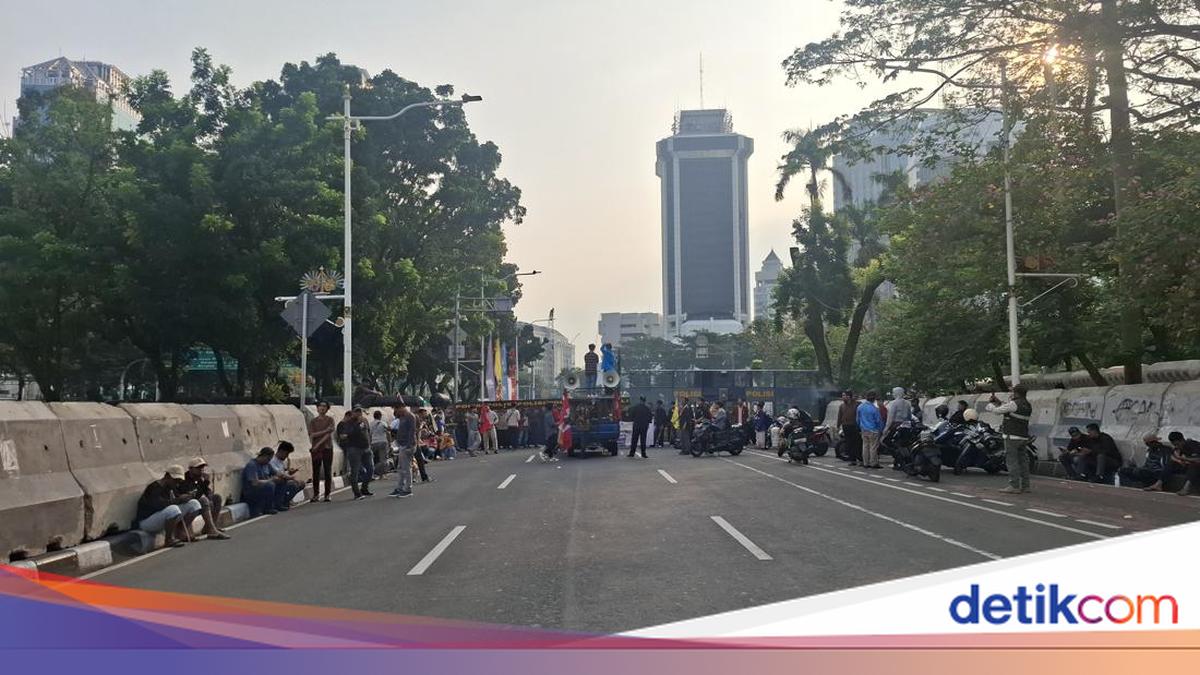
Students held a demonstration along Jalan Medan Merdeka Selatan in Central Jakarta on Wednesday afternoon, criticising the Free Nutritious Meal (MBG) programme and the issue of civil supremacy. Based on monitoring at the scene around 4.30 p.m. WIB, masses gathered on the section of Jalan Medan Merdeka Selatan heading towards the Gambir area. The student masses were part of the Gerakan Mahasiswa Nasional Indonesia Indonesia (GMNI) and Cipayung West Jakarta. Access to Gambir was temporarily closed during the protest, with vehicles from the MH Thamrin direction diverted to Medan Merdeka Barat. Participants took turns delivering speeches from a command vehicle, criticising a number of government policies, including the MBG programme. One speaker argued the MBG programme did not provide significant benefits compared to the large budget the government had disbursed, suggesting the funds should be redirected to the more urgent education sector. “This MBG is truly useless. This programme has already wasted a lot of state budget. MBG should not be necessary. Its budget could be diverted to education,” the speaker said. Ahmad Mixel Meyna Imtiyazi, Chairman of the GMNI West Jakarta Branch Executive Board, stated the protest not only highlighted the MBG programme but also brought a number of demands related to national policy. The demands included national economic recovery, evaluation of national strategic programmes, strengthening governance, improving teacher welfare, protecting democracy and civil supremacy, and oversight of the deliberation of the Police Bill (RUU Polri) and the TNI Bill (RUU TNI). According to GMNI, various government policies need to be evaluated to be more targeted and able to meet the needs of the people. In their statement, the protesters also stressed the importance of upholding the principle of civil supremacy, a key outcome of the 1998 Reformasi. “The 1998 Reformasi taught us that democracy is built not only through general elections but also through limiting state power so it is not concentrated in one institution or particular group,” Mixel said. GMNI asserted that in a constitutional democratic system, civilian institutions must remain the primary decision-makers in governance. They also reminded that military involvement in the civilian sphere must remain within constitutional corridors and not reduce the independence of civilian institutions. The masses considered the abolition of the Armed Forces’ dual function during the Reformasi era a crucial milestone in strengthening democracy and the professionalism of the TNI as a state defence tool. They noted that public discourse in recent years regarding the increasing involvement of military elements, both active and retired, in strategic civilian positions needs collective attention. While such involvement could accelerate government coordination, there are concerns about diminishing space for civilian bureaucratic professionalism and the weakening of the merit system in filling public positions. Therefore, GMNI West Jakarta urged the government and the House of Representatives to ensure the deliberation of the Police and TNI Bills is conducted transparently while upholding the principles of democracy, civil supremacy, and public accountability.