
Student Alliance Urges Constitutional Court to Accept Judicial Review of Military Court Law
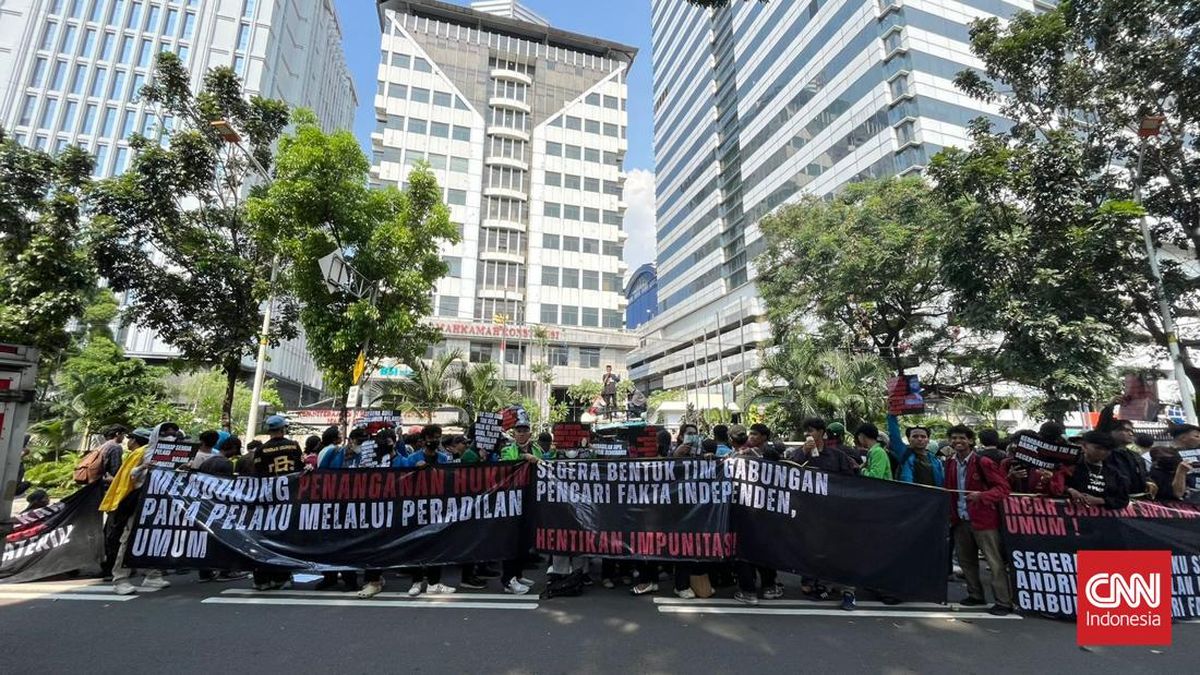
A student alliance is pressing the Constitutional Court (MK) to approve the petition for judicial review of Law No. 31 of 1997 on Military Justice. The demand was voiced by Social Activists Concerned with Democracy and Law during a protest held at the MK building on Tuesday (28/4). Action coordinator Faldo stated that the substantive review in Case Petition No. 260/PUU-XXIII/2025 must be granted because certain articles in the Military Justice Law actually obscure legal jurisdiction. He then highlighted the principle of equality before the law as enshrined in Article 1 paragraph (3), Article 24 paragraph (1), Article 27 paragraph (1), and Article 28D paragraph (1) of the 1945 Constitution. In those articles, Faldo reminded that all citizens are equal before the law. However, he said, those provisions contradict the rules in Article 9 numeral 1, Article 43 paragraph (3), and Article 127 of Law No. 31 of 1997 on Military Justice. “There is no firm norm that can clarify that TNI soldiers suspected of committing general criminal offences must be tried by general courts,” he stated. “The uncertainty and the resulting legal polemic regarding absolute competence have created ambiguity in legal jurisdiction and law enforcement processes, as well as providing loopholes for exceptions,” he added. Faldo assessed that there must be a clear and measurable separation of elements that fall under military criminal offences and the legal jurisdiction that tries them. According to him, if negligence occurs while TNI soldiers are carrying out duties, it constitutes a military criminal offence. This is because there is an order from superiors or official duties, and it is being carried out without civilian involvement in the criminal act. However, if TNI members are not on duty or not conducting military operations, whether war or non-war, then the criminal act committed falls under general criminal elements. Therefore, he said, the jurisdiction of the General Court is authorised to try it. “In fact, there has been inconsistency and lack of clarity regarding court jurisdiction, making everything obscure or blurred from the meaning of the principle of equality before the law,” he explained. “This creates legal uncertainty, inconsistency, and inaccuracy in applying absolute competence or court jurisdiction,” he added. On the other hand, he highlighted the case of the acid attack on Deputy Coordinator of KontraS Andrie Yunus, which should serve as a momentum for reforming the military justice system by revising Law No. 31 of 1997 on Military Justice. Faldo said this is also important so that military courts are no longer burdened with cases of violations by members that should be tried by general courts. In this way, military courts can focus on handling cases of violations related to military service and violations related to military ethics codes. “With the increasing prevalence of criminal cases involving military personnel, including murders which are general criminal offences, the government and DPR must immediately take concrete steps by accelerating the revision of Law No. 31 of 1997 on Military Justice,” he concluded.
Source: jawawa.id (https://jawawa.id/newsitem/student-alliance-urges-constitutional-court-to-accept-judicial-review-of-military-court-law-1777398677)
Originally published by CNN Indonesia (https://www.cnnindonesia.com/nasional/20260428221555-12-1353213/aliansi-mahasiswa-desak-mk-kabulkan-uji-materi-uu-peradilan-militer), translated from Indonesian