
Strong El Niño to Hit Indonesia from Early September to October, Government Warns of Expanding Forest Fires
The government is wary of the threat of a strong El Niño expected to hit Indonesia from early September through early October 2026. The weather phenomenon is considered likely to accelerate and expand forest and land fires (karhutla), which to date have reached around 107,000 hectares.
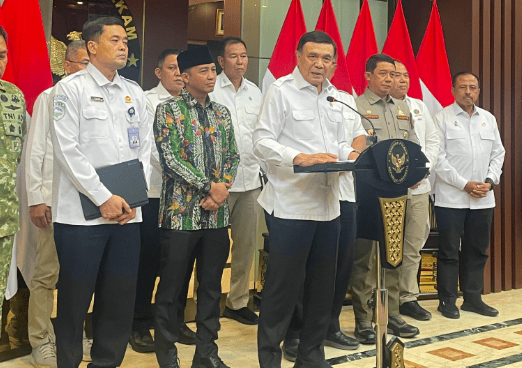
Coordinating Minister for Political and Security Affairs (Menko Polkam), Djamari Chaniago, stated that increasingly dry weather conditions are one of the factors that could worsen the handling of forest and land fires in several regions of Indonesia. “The very harsh situation or weather we are facing now is usually called a strong El Niño, which has been in effect and is starting to take hold now until early September, early October to come,” Djamari said during a press conference on forest and land fire management at the Menko Polkam Office on Monday (10/8).
According to Djamari, these conditions will accelerate the occurrence of forest and land fires. Therefore, the government is strengthening various firefighting efforts, both through air and ground operations. “As of today, the burned forest area in our territory in Indonesia amounts to 107,000 hectares,” he said.
Djamari stated that the government has deployed substantial resources to anticipate the spread of forest and land fires. In air operations, the government has operated around 43 helicopters, plus aircraft that can be used to support firefighting efforts. “In conducting air operations, we have deployed around 43 helicopters as of today,” he said.
He assessed that air operations through weather modification are one of the most effective ways to help tackle forest and land fires. This technology allows the government to induce rain in areas that need water supplies to wet fire-prone regions. “Air operations are actually very effective, creating artificial rain and carried out by BNPB. That is the most effective,” said Djamari.
However, the implementation of weather modification operations (OMC) faces obstacles because it requires the presence of rain clouds that can be seeded. Without adequate clouds, the operation cannot be carried out optimally. “We need to find rain clouds. As long as those rain clouds cannot be found, do not exist, we will not be able to make artificial rain,” he said.
On that basis, the government will continue to monitor weather changes, no matter how small, to determine the momentum for implementing OMC. Djamari also mentioned that based on weather forecasts, there is a chance of rain clouds appearing in the coming days up to 18 August. “Based on current forecasts, in the coming weeks until 18 August, there are three or four days where rain clouds are likely to appear,” he said.
He hopes this opportunity can be utilised to conduct weather modification operations, especially ahead of the Indonesian Independence Day commemoration on 17 August. “Perhaps ahead of 17 August, hopefully those rain clouds will emerge,” said Djamari.
Nevertheless, the government is not solely relying on air operations. Various ground firefighting strategies are also being prepared to address water source limitations in several locations. Additionally, Djamari said the government is preparing flexible tanks that can be moved to fire locations. The construction of wells in certain areas is also an alternative to ensure water availability for firefighters. “We are doing everything we can,” he said.
Djamari also stressed that the El Niño threat must be taken seriously because these conditions can cause longer droughts and increase the vulnerability of areas to fires. “The strongest El Niño is a condition that makes us very dry and prone to burning. The dry season will be longer,” he said.
Given these conditions, the government will strengthen coordination across ministries, agencies, regional governments, BNPB, the Indonesian National Armed Forces (TNI), the Indonesian National Police (Polri), and other relevant elements to prevent forest and land fires from developing into a larger disaster. “This work cannot be done by a single agency. Various elements in our society are needed,” Djamari said.