
Strong Dollar: Rupiah and Yen Collapse, While Won and Peso Remain Stable
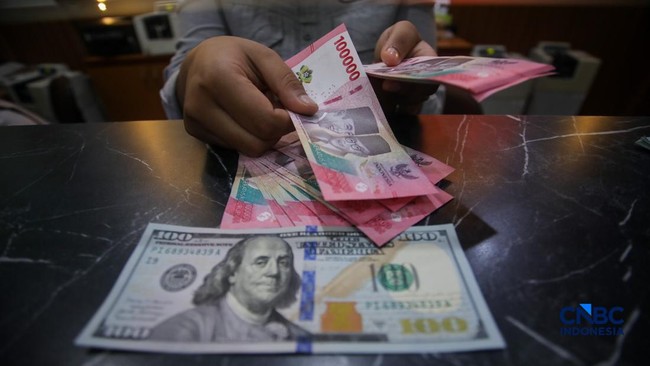
Asian currencies were divided against the US Dollar in this week’s trading. The US Dollar strengthened throughout the week and remained at high levels following a surge in previous trading sessions.
According to Refinitiv data, five out of ten monitored Asian currencies strengthened against the US Dollar, while the remainder weakened. The South Korean Won was the strongest currency in Asia this week, appreciating by 2.3% to 1,353.68 won. This was followed by the Philippine Peso, which rose 0.69% to 62.395, and the Malaysian Ringgit, which increased by 0.25% to 4.07.
The Vietnamese Dong and Taiwan Dollar also saw gains of 0.17%, reaching 25,974 dong and 31.709 respectively. Conversely, the Indonesian Rupiah experienced the deepest pressure in Asia this week, with the ‘Garuda’ currency weakening by 0.85% to a position of Rp17,880/US$.
Following the Rupiah, the Japanese Yen, Thai Baht, Chinese Yuan, and Singapore Dollar each weakened by 0.26%, 0.24%, 0.23%, and 0.12% against the US Dollar. Pressure on Asian currencies this week was largely influenced by US Dollar dynamics, with the US Dollar Index (DXY) observed to have strengthened by 0.75% to 100.971.
The strengthening of the US Dollar gained momentum from growing expectations that the US central bank (The Federal Reserve) has not yet finished raising interest rates. Since the Fed raised interest rates by 25 basis points to the 3.75%-4.00% range last week, several US central bank officials have reopened the possibility of further hikes if inflation does not subside.
The dollar’s strength is a continuation of the market’s response to the Fed’s hawkish interest rate hike last week. Comments from several Fed officials also indicate that further tightening remains on the agenda. The US Dollar received additional boosts from strong economic data, as the S&P Global US Composite PMI rose to 58.4 in September—the highest since July 2021—from 56.0 in August, supported by a surge in new orders.
This data has once again increased expectations for a Fed rate hike in October. According to LSEG data, the probability of at least a 25 basis point hike jumped to approximately 70%, up from around 53% before the data was released.
Oil prices have also returned to the spotlight. Hopes for peace in the Middle East had briefly pressured oil prices, but sentiment reversed after Iran expressed doubt regarding the progress of negotiations. Rising energy prices have reignited inflation concerns. Chicago Fed President Austan Goolsbee even warned that the central bank needs to be cautious, as current energy shocks have the potential to become a source of more persistent inflation.