
Strengthening Incentives, BI Maintains Interest Rate at 5.75 Percent
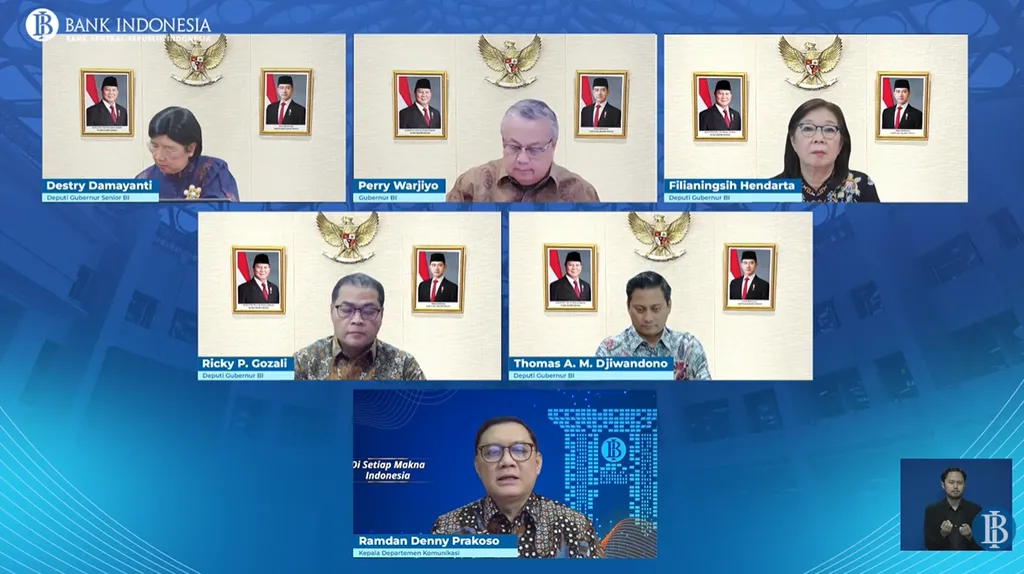
Although BI maintains the benchmark interest rate at 5.75 percent, stability continues to be reinforced, among other things, through the expansion of incentive policies.
TANGKAPAN LAYAR
By Agustinus Yoga Primantoro
22 Jul 2026 15:46 WIB · Ekonomi & Bisnis
JAKARTA, KOMPAS – Bank Indonesia or BI has finally decided to maintain its benchmark interest rate at 5.75 percent. Instead of maintaining stability through policy interest rates, BI has chosen to strengthen incentives to enhance the flow of foreign capital.
The decision was taken after BI held its monthly Board of Governors Meeting (RDG) on July 21-22, 2026. In line with the benchmark interest rate, BI also maintained the deposit facility and lending facility interest rates by 25 basis points (bps), to 4.75 percent and 6.5 percent, respectively.
Bank Indonesia Governor Perry Warjiyo stated that global uncertainty has increased again due to the rising intensity of the conflict between the United States and Iran in early July 2026. This situation has resulted in a shift of capital flows from developing countries to the US financial markets.
“The uncertainty in the global economy and financial markets that has risen again necessitates the strengthening of responses and synergy between fiscal and monetary policies to enhance external resilience, maintain stability, and encourage domestic economic growth,” he stated during a press conference held online on Wednesday (22/7/2026).
Therefore, BI is expanding incentive policies and several other measures to enhance the inflow of foreign portfolio investment and strengthen the stability of the rupiah exchange rate, accelerate the deepening of the money market and foreign exchange market (PUVA), as well as improve liquidity and reduce liquidity segmentation in the money and banking markets.
In this regard, BI increased the incentive for Swap Selling Hedging (Swap Buying Hedging to BI) from 10 percent to 12.5 percent. This incentive expansion was also extended to 15 percent for Domestic Non-Deliverable Forward (DNDF) Selling Hedging.
Furthermore, the provision of incentives is also aimed at increasing local currency-based transactions (LCT) with partner countries, through the addition of Hedging Swap Buy premiums and a reduction in Hedging DNDF Sell premiums, both of which are 10 percent.
The decision to maintain the benchmark interest rate and the expansion of incentive policies is an integrated part of BI’s policy mix that remains consistent in further strengthening the stability of the rupiah exchange rate amid ongoing high global uncertainty.
Bank Indonesia recorded that foreign portfolio investment in the second quarter of 2026 showed a net purchase of 8.5 billion US dollars, primarily from the government securities market and Bank Indonesia’s Rupiah Securities (SRBI) instruments. The influx of foreign portfolio investment continued into the third quarter of 2026 (up to July 20, 2026), particularly from government securities, which recorded a net purchase of 0.1 billion US dollars.
As a result, the exchange rate of the rupiah tended to strengthen by approximately 1.06 percent over the past week to a level of Rp 17,885 per US dollar on July 21, 2026. This strengthening occurred after the rupiah had weakened since the end of June 2026 due to the renewed escalation of conflict in the Middle East and the strengthening of market expectations regarding an increase in US interest rates.
Perry explained that the decision to maintain the benchmark interest rate and the expansion of incentive policies is an integrated part of BI’s policy mix, which remains consistent in further strengthening the stability of the rupiah exchange rate amid ongoing high global uncertainty.
In addition, monetary policy remains directed at maintaining stability (pro-stability), in order to keep the inflation rate anchored within the target range of 1.5-2.5 percent set by the government in 2026 and 2027.
“Meanwhile, macroprudential and payment system policies remain geared towards promoting pro-growth,” he said.
Previously, economist and researcher at the Institute for Economic and Community Research of the Faculty of Economics and Business, University of Indonesia (LPEM FEB UI), Teuku Riefky, argued that Bank Indonesia should indeed maintain its benchmark interest rate while evaluating the impact of the latest policy tightening on the exchange rate, inflation, and domestic economic activity.
“Further monetary tightening may only provide limited additional support for the Rupiah, while imposing greater costs on domestic credit, investment, and economic activity,” he said.
Since May 2026, BI has cumulatively raised its policy interest rate by 100 basis points to a level of 5.75 percent. This policy aims to strengthen the stability of the rupiah and enhance the attractiveness of financial assets denominated in rupiah amid increasing global uncertainty.
However, it appears that the rupiah still tends to weaken, despite higher interest rates and foreign exchange interventions. According to Riefky, this indicates that monetary measures have contained volatility, but have not reversed the underlying pressures.
“The demand for US dollars from global investors, the foreign exchange needs of companies, as well as concerns regarding fiscal commitments and financing needs have offset some of the benefits from the wider interest rate differential,” he stated.
On the other hand, inflation is expected to remain within the Bank Indonesia target range, although the risk of an increase is rising following the renewed geopolitical tensions in the Middle East, which could potentially raise global energy prices and contribute to import inflation.
However, he continued, this inflationary pressure is largely driven by the supply side. Therefore, the risk is likely to be unable to be effectively addressed solely through additional monetary tightening.
Writer:
Agustinus Yoga PrimantoroEditor:
FX Laksana Agung Saputra