
Strengthening Impactful Campus Initiatives, Unisba Promotes Waste Bank Development in Arcamanik
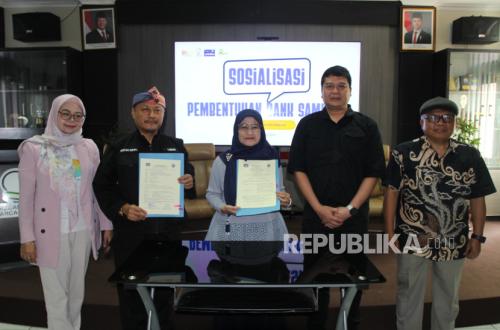
Universitas Islam Bandung (Unisba), through its Zero Waste Team, organised a socialisation session for the Arcamanik District Waste Bank on Thursday (4/6/2026) at the Arcamanik District Office Hall, Bandung. This activity serves as a manifestation of the university’s commitment to implementing an ‘impactful campus’ model to address increasingly urgent environmental issues.
The event was attended by representatives from the West Java Provincial Environmental Agency, the Bandung City Environmental Agency, officials from the Arcamanable District and Sub-districts, as well as dozens of RW (community unit) heads and prospective waste bank managers from various areas within the Arcamanik District.
This initiative is part of a community-based waste management strengthening programme conducted by Unisba through a participatory approach. The socialisation marks the initial step in forming and developing waste banks in several RW units which, based on mapping and community needs analysis, still require assistance in waste management.
The session featured two experts in waste management. The first speaker, Mohamad Satori, a lecturer in the Industrial Engineering Study Programme at the Unisba Faculty of Engineering and Chairman of the West Java Waste Bank Forum, presented on the topic ‘One RW, One Waste Bank: An Alternative for Waste Management at the Micro Level’. The second speaker, Brandon D. Tjiandra, Head of Analytics & Visualization at Smash.id, discussed ‘Driving Digital Transformation: A New Era of Waste Management from Upstream to Downstream’.
Addressing the urgency of the issue, the Head of the Institute for Research and Community Service (LPPM) at Unisba, Neni Sri Imaniyati, emphasised that the current waste problem has reached a worrying state and requires a rapid response from all elements of society. She noted that the limited capacity of landfill sites serves as a warning that waste management can no longer be delayed. Consequently, community members involved in waste banks are considered environmental warriors contributing significantly to overcoming this crisis.
Neni explained that waste banks function not only to reduce and control waste volume but also to provide economic benefits to the community. Properly managed waste can serve as a source of income while fostering social and environmental awareness. She further emphasised that the greatest challenge in waste management is not technology, but rather a change in societal culture. According to her, the success of waste management depends heavily on the habits and awareness of residents in sorting, reducing, and managing waste sustainably.
‘Technology will not be of much help if the culture of waste management has not been established. Therefore, what we are building is not just a waste management system, but also a community culture that cares for the environment,’ she stated.
Neni concluded by stating that the Zero Waste programme implemented by Unisba aims to build a structured, participatory, and sustainable waste management system. Through collaboration with district and sub-district governments, RW and RT officials, and the wider community, it is hoped that this programme will continue to thrive even after the university’s formal mentoring period has concluded.
Source: jawawa.id (https://jawawa.id/newsitem/strengthening-impactful-campus-initiatives-unisba-promotes-waste-bank-development-in-arcamanik-1780822789)
Originally published by Republika (https://news.republika.co.id/berita/tg3yqi368/perkuat-kampus-berdampak-unisba-dorong-pengembangan-bank-sampah-di-arcamanik), translated from Indonesian