
Strengthen the Research–Policy Synergy to Address the Middle-Income Trap Challenge and Promote Community Empowerment
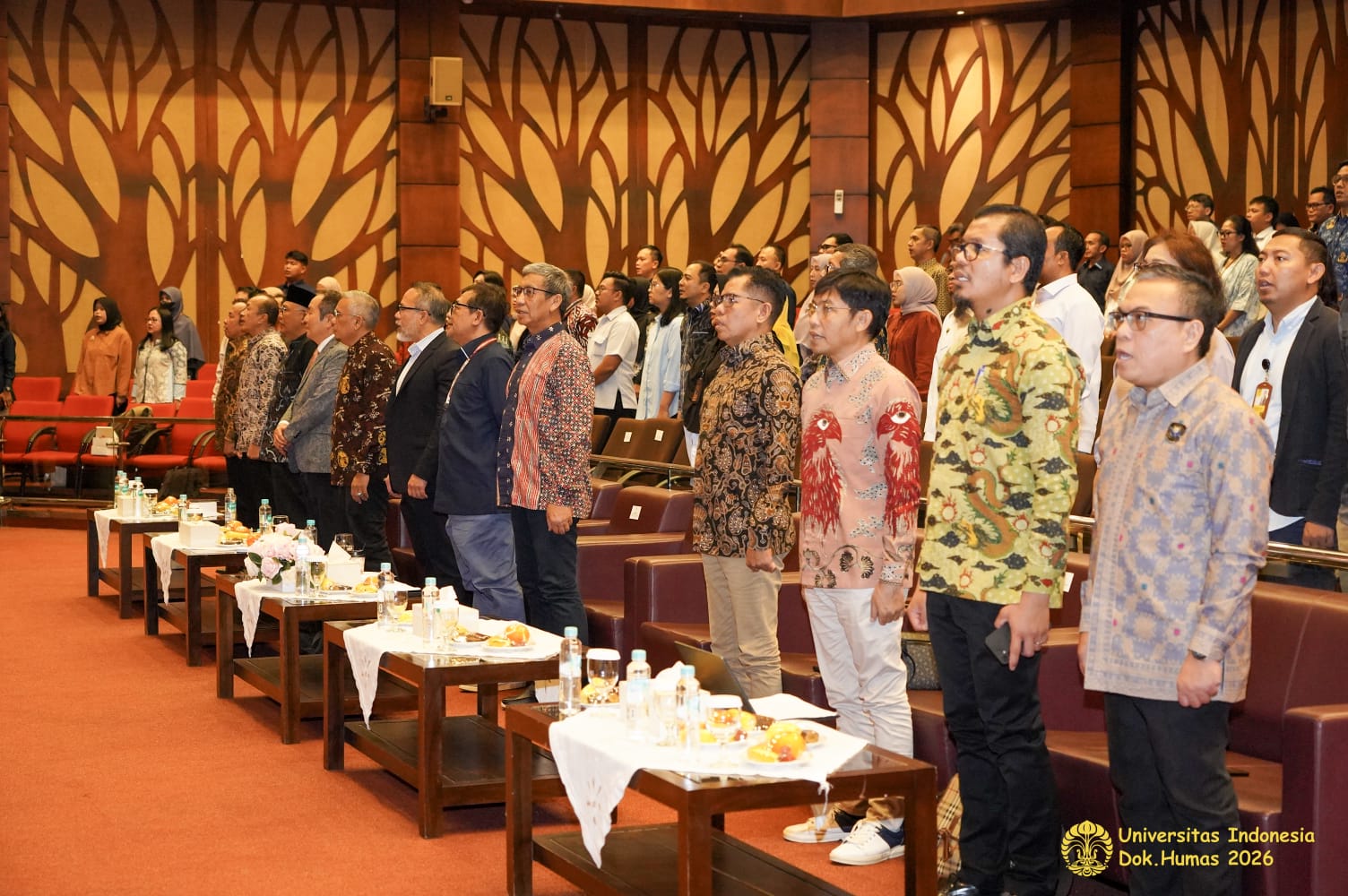
The Coordinating Ministry for Human Empowerment (Kemenko PM) and the University of Indonesia (UI) joined forces to bridge policy makers and the academic world through the National Seminar “Challenges of Community Empowerment in Facing the Middle-Income Trap in Indonesia” held at the UI Campus Balai Sidang, Depok, on Wednesday (20/05/2026). About 300 participants from 44 ministries/agencies and national universities attended, turning the forum into a cross‑sector strategic discussion space to formulate responses to the nation’s biggest challenge: how Indonesia can escape the middle-income trap toward inclusive prosperity.
In a statement today, the Rector of the University of Indonesia, represented by the Vice Rector for Research and Innovation, Prof. Dr. Hamdi Muluk, M.Si., expressed UI’s responsibility as an educational, academic, and research institution in supporting the government’s policy formulation to escape the Middle-Income Trap.
Similarly, the Deputy for Coordination of Community Empowerment of Villages, Disadvantaged Regions, and Border Areas, Prof. Dr. rer. nat. Abdul Haris, in a message delivered by the Expert Staff for Economic Development and Digitalisation at the Kemenko PM, conveyed the policy context with clear data.
Although Indonesia’s economy grew 5.61% in the first quarter of 2026—the highest in 13 years—the World Bank’s Indonesia Economic Prospects December 2025 notes that real wages of Indonesian workers declined by an average of 1.1% per year from 2018 to 2024. Much of the growth stimulus remains anchored in seasonal consumption and short-term fiscal stimulus rather than productive, structural investment.
“Salah satu hambatan terbesar pembangunan kita adalah gap antara riset dan kebijakan, terlalu banyak kebijakan yang dibuat tanpa fondasi penelitian yang memadai, dan terlalu banyak temuan akademik yang berakhir di laci arsip tanpa pernah mempengaruhi keputusan nyata di lapangan. Seminar ini—dan kolaborasi antara Kemenko PM dan Universitas Indonesia—adalah upaya nyata untuk menutup celah tersebut,” tegasnya.
In the discussion session, two speakers, Prof. Elwin Tobing, Ph.D., and Prof. Kiki Verico, Ph.D., presented complementary perspectives based on best practices in several advanced countries.
The seminar aligns with Presidential Instruction No. 8 of 2025 on Accelerating Poverty Reduction and the Elimination of Absolute Poverty, and the mandate of Law No. 59 of 2024 on the National Long-Term Development Plan 2025–2045. The forum is expected to produce concrete policy recommendations: to foster solid cross-ministerial/agency coordination so that the community empowerment ecosystem in villages, lagging regions, and border areas becomes a real driver of Indonesia’s economic transformation toward Indonesia Emas 2045. (H-2)
UI urban planning observer Muh Azis Muslim assessed that the waste-sorting programme in Jakarta will only be effective if supported by education, infrastructure, and management systems from upstream to downstream.
Her hard work paid off at last, as Kalya was admitted to seven prestigious universities worldwide.
UniRanks released the list of the 15 best universities in Indonesia 2026. UI leads in first place, followed by UGM and Unair. See the full list here.
That assessment responds to findings by the Corruption Eradication Commission (KPK), which has recorded at least 371 politicians entangled in corruption cases since the reform era.
Times Higher Education (THE) ASEAN University Rankings 2026 – Top 20: Only one Indonesian university featured; full positions and analysis follow.