
Strengthen National Economic Downstreaming, Afi Kalla Urges UI Students to Create Innovations
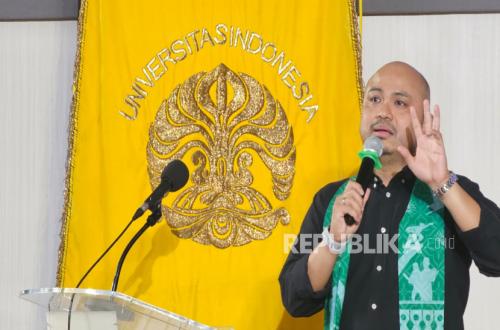
Depok – Afifuddin S Kalla, the candidate for Chairman of the Central Board of the Indonesian Young Entrepreneurs Association (BPP HIPMI) for the 2026-2029 term, stressed the importance of students’ role in promoting downstreaming through the development of small and medium industries (IKM).
He conveyed this during a public lecture before the academic community of the Faculty of Administrative Sciences at the University of Indonesia (FIA UI), Depok, on Friday (8/5/2026).
In the event, which was part of the series of the 18th National Deliberation (Munas) of HIPMI, the figure familiarly known as Afi Kalla explained that synergy between the academic world and business practitioners is essential to ensure that downstreaming programmes run optimally down to the smallest industrial level.
He encouraged students not to merely be spectators in the whirl of the global economy, but to actively create breakthroughs capable of converting raw materials into high-value products through technological and creative touches.
“We must discuss how important the development of small and medium industries is for Indonesia’s economic growth. Students must be able to produce innovations that drive downstreaming so that our economy becomes stronger and more independent,” said Afi Kalla while delivering material in front of hundreds of participants at the Auditorium of the Old Building of FIA UI.
On that occasion, the CEO of Bukaka Group also explained the fundamental difference between SMEs and IKM, where IKM focuses more on creating added value through the process of processing raw materials into finished goods.
He provided an overview of the success of the processing industry in South Korea, which has surpassed Indonesia’s GDP due to its focus on added value, despite not having abundant natural resources like Indonesia.
Afi Kalla reminded that although Indonesia has big targets to build giant industries, the main foundation still starts from a small scale. According to him, large industries such as nickel or palm oil must be supported by a strong IKM ecosystem as absorbers of labour and drivers of productivity.
“We must have dreams for big industries, but we must start from small ones because all big industries in Indonesia originate from small industries that may have started from a garage or a narrow rented space,” said the alumnus of the Faculty of Economics UI class of 2003.
Furthermore, Afi Kalla identified four main challenges facing young entrepreneurs today, namely capital, research that often stops at the academic desk, market access, and connections.
As a solution, he brought five flagship visions for HIPMI going forward, encompassing digitalisation, ease of funding, economic independence, improvement of entrepreneur quality, and strengthening of organisational networks.
Meanwhile, the Chairman of HIPMI PT UI, Gafi Nasution, stated that downstreaming is a flagship government programme to boost national economic growth to achieve the 8 percent target in line with the vision of President Prabowo and Vice President Gibran.
He sees great opportunities in the IKM sector, which currently has a significant contribution to the national GDP.
“Through this public lecture, we hope that fellow students gain in-depth education on the processing industry so they are ready to become young entrepreneurs who are at the forefront of Indonesia’s economy,” said Gafi Nasution.
The event, which ran interactively, was also attended by representatives of BPP HIPMI Febriananda Damu, General Chairman of BPD HIPMI Jaya Sreeraman Haroon along with his ranks, as well as several founding figures and mentors of HIPMI PT UI.
The event concluded with a discussion session and the distribution of educational facilities for the attending students.