
Stray Shark Captivates Millions in South Korea: Will It Return to the Sea?
When a large shark was spotted in a canal in Busan, a busy port city and seaside destination in south-eastern South Korea, marine biologist Kim Hyun-woo was immediately asked to lead efforts to rescue it.
He received the call in mid-September while returning from a job monitoring mackerel shoals to help fishing vessels.
Although Kim is known as one of South Korea’s leading shark experts, he had never expected the coastguard to ask him to rescue a shark in person.
South Korea is no stranger to sharks. But one this large appearing in a shallow, concrete-sided canal, right next to the world’s seventh-busiest port, was unprecedented.
With curious crowds beginning to gather along the canal, Kim’s team from the National Institute of Fisheries Science had to act quickly.
Their first task was to identify the species. Some sharks are more dangerous than others. The great white shark, made famous by the 1975 film Jaws, is known to have attacked and killed people.
The shark found in Busan was identified as a female dusky shark, a species linked to only two fatal attacks on humans.
Even so, Kim was worried that someone in the crowd might jump or fall into the canal. The shark had to be returned to the sea.
The dusky shark was first spotted in the canal in mid-September.
A small coastguard boat initially tried to drive the shark away using an electrical deterrent that emits a weak current, a type of technology sharks usually avoid. Such devices are generally used after reports of shark sightings near popular beaches.
But after five hours, officials concluded that the shark was too large and too fast to be guided with the device.
Kim then changed his strategy. He decided to wait for the shark to find its own way out of the canal. But that never happened.
As authorities looked for ways to guide the shark back to the sea, the trapped animal became a viral phenomenon.
Just hours after it appeared, the city government sent an emergency alert to all residents, asking pedestrians and local people to “take care for their own safety”.
The park along the canal had previously attracted few visitors. After the alert was sent, however, the area quickly filled with people hoping to see the shark up close.
Fans gave it the name Bukangi, derived from “bukhang”, the Korean name for the port near the site.
Within days, a company had registered the name as a trademark. Pins, soft toys and T-shirts bearing Bukangi’s image began appearing online.
The city government also capitalised on the shark’s popularity, livestreaming Bukangi and making it an official city mascot.
A banner at the canal entrance invited people to sign a petition “on behalf of Bukangi”, calling for central government support to build a new 30,000-seat baseball stadium in the area.
Monitoring the shark became a shared activity for local residents and visitors.
An unwritten rule emerged that children got places at the front, and anyone who spotted Bukangi first was expected to point it out to newcomers.
Some residents who volunteered as self-appointed guardians of Bukangi patrolled the canal at night to make sure no one shone torches or lasers at the shark.
In the end, more than 1.6 million people visited the canal.
Busan’s mayor said the shark had given the port city “publicity that billions of dollars could not buy”.
“It’s very rare for people to come together these days,” said Kim Joo-eun, who came to see the shark with her two nieces and nephews.
“I feel Bukangi has brought us all together, supporting it as a group. It’s been so much fun.”
But officials could not allow Bukangi to remain in the canal.
By late September, the shark had gone several days without feeding. It also had bloody abrasions on its snout from repeatedly hitting the canal’s concrete walls.
Marine biology professor Choi Yoon, a familiar figure in South Korea, told local media that experts were particularly concerned about a “critical” injury around the shark’s eyes.
At the end of September, Kim’s team launched another rescue attempt.
The marine biologist referred to an incident in Massachusetts, US, in 2004, when a jet of water was used to guide a great white shark out of a shallow pond.
But when the same method was tried on Bukangi, the shark kept circling and returning to the canal.
On 2 October, the rescue team decided to install a net across the canal to prevent it from re-entering.
However, Bukangi swam around the net and returned to the canal just a few hours later.
At this point, Kim began to suspect that the shark might have a problem with the electromagnetic sensors in its snout, which it normally uses to navigate.
Another possibility, Kim said, was that Bukangi had become disoriented by noise from ships in the port.
South Korea’s Ministry of Oceans and Fisheries suggested that the shark’s appearance in the canal could be a sign of rising sea temperatures.
The ministry said Bukangi may have followed an abundant shoal of fish into warmer waters.
During the first half of the year, around 50 large sharks were recorded in South Korea’s eastern coastal waters, four times as many as in the same period last year.
After repeated rescue attempts failed, some of Bukangi’s new fans began calling for the shark to be left alone in the canal.
On Thursday, several of them arrived with posters and chanted slogans such as “Let Bukangi live in peace” and “Take down the net”. When a security guard asked them to stop, a man shouted: “I love you, Bukangi!”
“I’m obsessed with it,” said Jeong Yo-won, a woman in her forties.
She called the shark a “source of hope and happiness” and insisted: “I don’t think we should drive it away so mercilessly like this.”
Others believed it was time for Bukangi to return to its habitat.
“I could watch it for hours because I’m so fascinated by it,” said a woman who finally managed to see the shark on her third attempt.
“I hope Bukangi can stay, but I want it to live a long and healthy life even more.”
Shin Seungmin said many people had even joked that the city government should “make Bukangi an official identity card and give it a pension”.
“It has brought us so much joy,” he said. “But Bukangi should leave and live its normal life as a shark.”
Remaining in the canal would be very dangerous for Bukangi as temperatures fell with the arrival of autumn, Kim said.
Under normal conditions, sharks migrate to warmer waters in the south.
“This canal is far from what you could call a habitat,” he added. “Wild animals cannot continue living in a space built entirely for humans.”
As public attention to Bukangi’s fate grew, the Ministry of Oceans and Fisheries took over the rescue operation from the National Institute of Fisheries Science.
Around 40 personnel were deployed, including divers from Busan Aquarium. A vet was also on standby, along with an ambulance in case the divers were attacked by Bukangi.
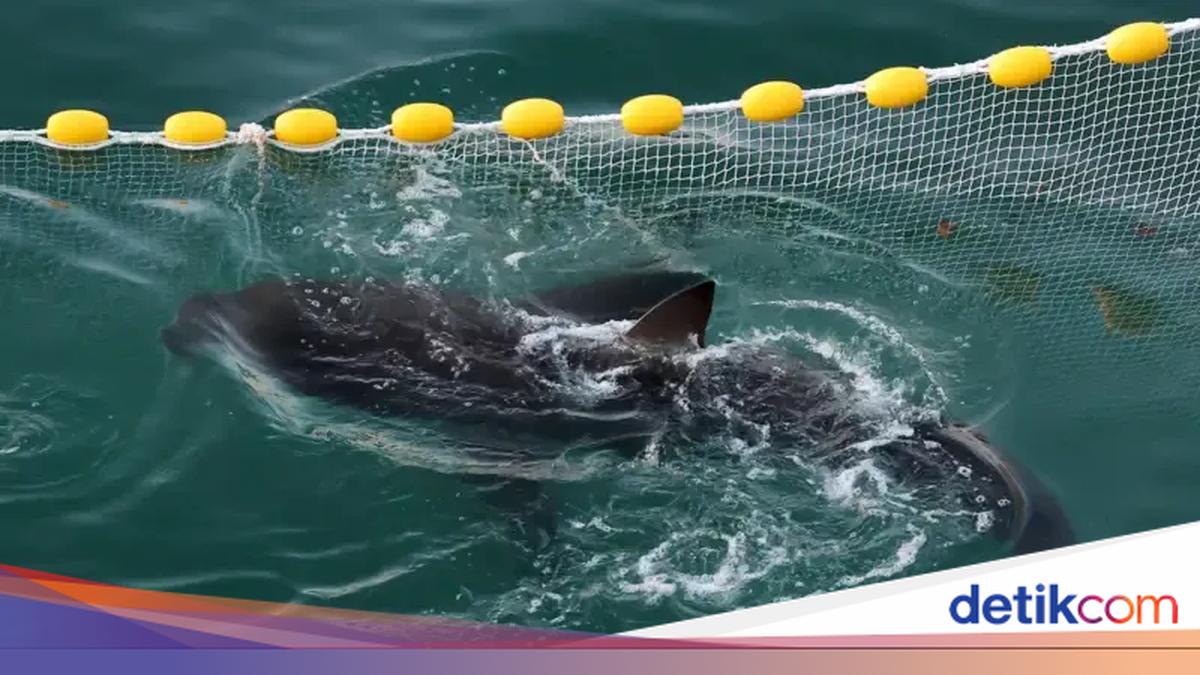
On Wednesday, divers installed two layers of netting and managed to guide Bukangi out of the narrow canal into open water.
That evening, however, the shark swam back into the canal after diving beneath the outer net.
As a result, Bukangi was trapped between the two layers of netting.
On Thursday, the rescue team removed the outer layer. Bukangi was then seen swimming farther out to sea.
Although it occasionally turned back towards the canal, the rescue operation was eventually declared complete.
Bukangi has not been seen for the past few days, which experts regard as a positive sign.
Professor Choi believes the shark is probably adapting to wider, deeper waters.
He said Bukangi may not yet have travelled far and could reappear within the next week.
Choi remains concerned, however, about injuries the shark may have sustained while trapped in the canal.
He told local media that Bukangi had repeatedly rubbed against the canal walls, causing “the skin on its snout, and even its pectoral fins, to come off”.
For now, South Koreans are waiting anxiously, hoping Bukangi can find its way home to its natural habitat in the open sea.
Source: jawawa.id (https://jawawa.id/newsitem/stray-shark-captivates-millions-in-south-korea-will-it-return-to-the-sea-1793011989)
Originally published by detikcom (https://news.detik.com/bbc-world/d-8724906/hiu-tersesat-curi-perhatian-jutaan-warga-korsel-akankah-kembali-ke-laut), translated from Indonesian