
Strategic Partnerships Key to Indonesia Mastering Mineral Technology
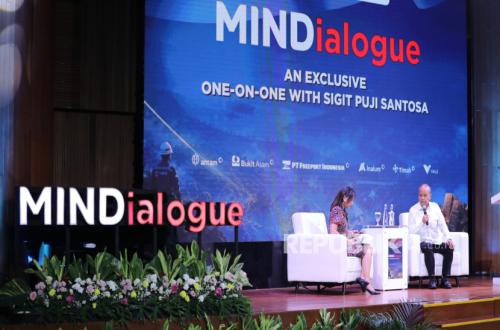
Efforts to create strategic partnerships are a key to advancing Indonesia’s mineral sovereignty. Through such collaboration, Indonesia is expected not only to become a supplier of raw materials, but also to master technology and strengthen the value chain of the national mineral industry.
Chief Technology Officer (CTO) of Danantara Indonesia, Sigit Puji Santosa, explained that Indonesia’s technology gap in a number of mineral sectors is actually not too far behind compared to other countries. According to him, Indonesia has so far still exported many raw materials such as alumina and aluminium, while derivative products are still manufactured abroad.
He cited the example that Indonesia has been processing bauxite into alumina or aluminium ingots for export to other countries such as Japan. However, for extruded aluminium products used in the aerospace, automotive and defence sectors, Indonesia still has to wait five to six months for supply.
Sigit assessed that the technology to develop derivative aluminium and steel products is still within Indonesia’s reach. However, a greater challenge lies in semiconductor-based minerals and a number of special minerals currently controlled only by developed countries.
“But that is not a problem; we have a strategy where we carry out strategic partnerships. So strategic ministries, where we have a share of our minerals, you have technology, but if you cannot get minerals from us, then it cannot work. We do strategic partnerships, we build R&D collaboration, we invite all universities,” said the Danantara CTO at MINDialogue in Jakarta, quoted on Friday (21/8/2026).
According to Sigit, strategic partnerships can be a way for Indonesia to bring together the strength of its mineral resources with the technological advantages of its partners. The collaboration is also directed at building domestic research and development capabilities.
In line with that, Deputy Minister for Investment and Downstreaming/Deputy Head of the Investment Coordinating Board (BKPM), Todotua Pasaribu, acknowledged that strategic partnerships are still needed to accelerate technology transfer to Indonesia. According to him, foreign investment remains necessary because Indonesia still has weaknesses in research and development (R&D).
“Indeed, why do we also need investment from outside? We also need technology partners because, frankly, we are also very weak in research and development. So that is a big homework,” said Todotua.
He cited the development of the electric vehicle battery industry, which still faces challenges in the middle of the supply chain. In fact, Indonesia already has nickel resources and high pressure acid leaching (HPAL) processing facilities.
Currently, Indonesia is carrying out strategic cooperation in the electric vehicle battery project. This is marked by the collaboration between a subsidiary of MIND ID, Indonesia Battery Corporation (IBC), and Contemporary Amperex Technology Co Ltd (CATL) to adopt electric vehicle battery cell manufacturing technology.
The two are building an electric vehicle (EV) battery factory in Karawang, West Java, which will soon be inaugurated by the government. The initial production capacity of the plant is estimated to reach 6.9 gigawatt hours (GWh) per year.
The project is being worked on by a consortium of Ningbo Contemporary Brunp Lygend Co Ltd (CBL) together with PT Aneka Tambang Tbk (Antam) and IBC. CBL is a subsidiary of CATL, while the consortium has formed a new company named PT Contemporary Amperex Technology Indonesia Battery (CATIB).
President Director of MIND ID, Maroef Sjamsoeddin, stressed that strategic partnerships must provide greater benefits for Indonesia. He assessed that so far much of the nation’s mineral wealth has been utilised more by other parties that have technological and funding advantages.
According to Maroef, this condition means Indonesia has not fully enjoyed the benefits of its mineral resources. In fact, mineral management should be able to provide optimal added value for the nation and state.
“MIND ID views the need for comprehensive improvement efforts involving cross-institutional synergy. We have identified that the transformation of national mineral reserve governance must be carried out at every key node of the mining business process, namely from the upstream, midstream to downstream sectors,” said Maroef.
Strengthening strategic partnerships is expected to ensure Indonesia does not stop at mastering mineral resources, but is also able to master processing technology and the development of derivative products. Thus, downstreaming can generate greater added value while strengthening the sovereignty of the national mineral industry.