
Strategic Environmental Assessment identifies 104 strategic issues in East Java North Coast management
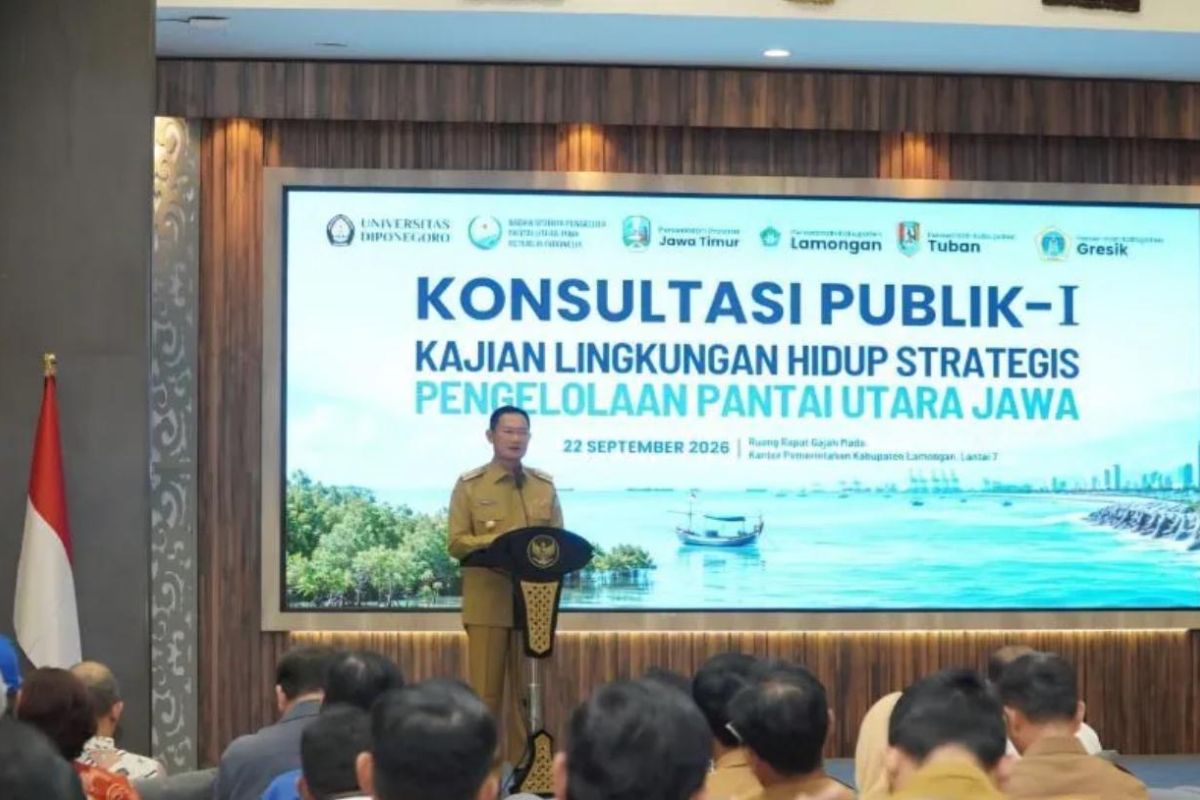
Lamongan, East Java (ANTARA) - A Strategic Environmental Assessment (KLHS) has identified 104 strategic issues regarding the management of the North Coast of Java (Pantura) in the East Java region, encompassing Tuban, Lamongan, and Gresik.
Sudarwanto Dwi Atmoko, a representative of the North Coast of Java Management Authority (BOPPUJ) RI, stated that the results of this study will serve as the foundation for developing integrated and sustainable management directions for the north coast.
“The KLHS is a vital instrument for formulating the direction of north coast development in an integrated and sustainable manner,” he said during the first Public Consultation for the KLHS of Java North Coast Management in Lamongan on Tuesday.
He explained that the 104 issues in the East Java region consist of 52 environmental issues, 24 economic issues, 19 social issues, and nine governance issues. Based on the study’s regional division, Segment 14, which includes Tuban and Lamongan, accounts for 57.7 per cent of the issues, while Segment 15 in the Gresik area accounts for 42.3 per cent.
Overall, the KLHS identified 657 strategic issues in the management of the Java North Coast, categorised into environmental, economic, social, and governance aspects.
“Coastal development must be comprehensive, ensuring the environment is preserved, the community is protected, and the economy continues to grow,” he said.
He noted that Lamongan’s 47-kilometre coastline possesses significant potential for fisheries, agriculture, tourism, and other economic activities, meaning its development must take environmental conditions into account.
He also highlighted a sea-level rise of approximately 2.26 centimetres per year, which has the potential to increase the vulnerability of coastal areas, particularly in the Paciran and Brondong regions.
Furthermore, he added that plans for the construction of a Giant Sea Wall must be aligned with spatial planning and community interests, and must be coordinated between the local governments of Tuban, Lamongan, and Gresik.