
Strange Phenomenon Emerges in Motorcycle Workshops: What Is Happening with the Indonesian Economy?
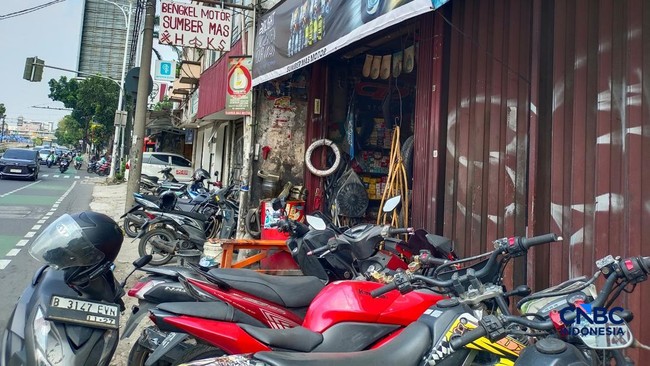
The weakening purchasing power of the public is becoming apparent in places many people rarely notice: roadside motorcycle workshops. In several workshops in the Mampang area of South Jakarta, mechanics and business owners say they have felt a decline in customer numbers in recent months, coinciding with rising prices for oil and other spare parts. They are witnessing a similar phenomenon: people are starting to postpone vehicle maintenance, extending oil change schedules, and waiting until components are truly broken before replacing them.
This scene was observed at a workshop in Mampang. When met by CNBC Indonesia, a mechanic named Ilyas (a pseudonym) appeared to be asleep behind a workshop cabinet. However, upon hearing a customer call to pump up a motorcycle tyre, he immediately rushed to serve them.
According to Ilyas, the workshop has been quiet compared to several months ago. “Yes, it has been quite quiet lately. It seems the workshop has been getting quieter for the past two months,” Ilyas told CNBC Indonesia at the location on Friday (5/6/2026). He suspects people are starting to hold back on spending due to economic pressures and rising prices for various necessities, including vehicle oil. “Perhaps people are starting to brake on their spending, because we know the economy is chaotic now, plus prices of goods are rising, most noticeably oil, it has gone up quite a bit,” he said.
The increase in oil prices, he said, has caused service costs to rise. Whereas a few months ago a customer could get an oil change including the labour fee for around Rp60,000, that figure is no longer possible. “Usually, about three to four months ago, it was around Rp60,000 including the labour for an oil change. Now, Rp60,000 is only the cost of buying the oil from the shop. I cannot buy it for Rp60,000 and sell it at the same price; there is a service fee. So now I set it at Rp75,000,” he explained. The price increases often trigger customer complaints. However, according to Ilyas, he does not have many options because the price from suppliers has also risen. “Many complain, asking ‘why has it gone up?’ or ‘why has it become expensive?’ I just tell them it has gone up at the source; whether they want to change the oil or not, if they check another workshop, the price will be the same,” he said.
He has also observed a change in people’s behaviour regarding vehicle maintenance. “Yes, since these last two months. Maybe because of the war, and the dollar is reportedly getting more expensive. That is the main thing, so people are probably being more frugal, perhaps switching to public transport or walking more,” said Ilyas.
Similar complaints were voiced by Johan, the owner of a motorcycle workshop in the same area. According to him, the rise in oil and spare part prices in recent months has started to have a direct impact on business turnover. “Yes, it is true,” Johan said when asked about the phenomenon of people coming to the workshop less frequently just for an oil change. He noted that oil prices, which were previously around Rp50,000, have now exceeded Rp70,000. “Of course, people are tightening their belts; the dollar has risen, so oil prices must have gone up significantly. Oil that usually cost Rp50,000 is now Rp70,000,” he stated. He claimed the price increases are not limited to oil but also affect various other vehicle components. “It keeps going up. Every month there are continuous increases for oil prices and for spare part prices,” he said.
As a result, workshop turnover has declined over the last three months. “In terms of turnover, over these last three months, it has dropped by 20 to 30 per cent,” said Johan. He added that many customers now delay oil changes until the oil is completely depleted. “There are people who want to change their oil but they keep delaying until the oil runs dry. When the oil is dry, only then do they finally refill it, not just replace it,” he said. This delay extends to other components, which are often left until they are truly broken. “Like this gentleman here, his drive belt snapped before he replaced it,” he remarked. Ideally, according to Johan, motorcycle oil should be changed every month. Now, however, many customers only return after two months or even longer. “Motor oil, especially for automatic scooters, should ideally be changed once a month. Now they only change it once every two months,” he explained. He views this behavioural shift as inseparable from the public’s weakening purchasing power. “A setback; purchasing power has indeed fallen,” he said. The decline in customers is quite noticeable at his workshop. “Customer numbers have dropped by around 50 per cent. Where normally ten people would come, over the last three months it has been five at most,” said Johan. Although goods prices are rising, Johan admitted he is still holding back on increasing service labour rates for fear of burdening customers further. “Labour charges have not gone up so far. If I raise labour charges, people will feel sorry for themselves and start shouting; it is already very expensive. The goods are already pricey, and if labour charges are also raised, that means increasing costs twice over,” he said.