
Stock Market Trembles, Tycoons Smirk
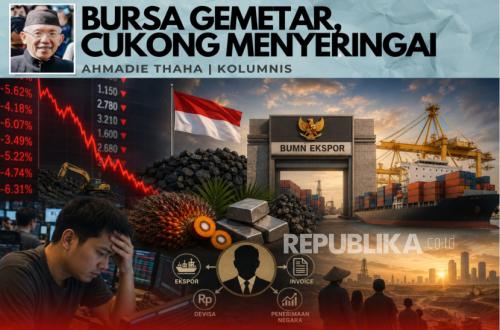
When President Prabowo Subianto announced that coal, palm oil, and other strategic commodities would pass through a single doorway via state-owned enterprises, the stock market monitor immediately turned red, like the face of a trader who realises an instalment loan is due tomorrow morning.
Mining, minerals, and palm-oil stocks tumbled. Groups of stock suddenly crowded like coffee shops after a fuel-price hike. Some people panicked: “Waduh, pasar tidak suka!” Others laughed softly while sipping coffee: “Kalau pasar panik, berarti ada yang terganggu.”
And there is where the real drama began. For the stock market is not the guardian of efficiency that economic television pundits often portray.
The market also has interests. It has fear. It has rent-seeking networks. And sometimes it has the capacity for collective tantrums, like a child losing Wi‑Fi.
The market read Prabowo’s policy with one simple sentence: the state intends to go deeper into the kitchen of commodity trade (SDA).
To global investors, terms like: “sole exporter”, “foreign exchange control”, “invoice oversight” sounded like a fire alarm in a hotel of capitalism.
Because for a long time, one of the great strengths of commodity conglomerates has existed in the grey area of global trade. Prices can be manipulated through foreign affiliations. Margins can be shifted through transfer pricing. Foreign exchange can be parked in other countries while intermittently returning home when the rupiah is under the weather.
So when the state says: “From now on I hold the export door,” the market immediately starts calculating: who loses the space to play?
And at this point the public must distinguish between: “market panic” and “people lose money.” For the two are not necessarily the same.
If shares of palm-oil or coal issuers fall, who is most affected? The tycoons who control the shares? Not necessarily.
Many large conglomerates were already wealthy before their shares listed on the exchange. IPO prices can already be several times above nominal value.
They have already enjoyed large capital gains, own cross-sector assets, and have access to capital that smaller investors do not.
What often bears the brunt are retail investors: FOMO-driven youngsters learning about shares from TikTok while eating hellishly spicy seblak, margin traders with little capital but nerves as thick as a dormitory wall, and office workers hoping for quick gains to resign and open an industrial minimalist coffee shop.
When shares fall, they face margin calls. They are forced to sell. Portfolios red as a Martian weather forecast. And the market is cruel to late-arriving small players.