
Stock Exchange Trading Was Briefly Halted: The Rules and History
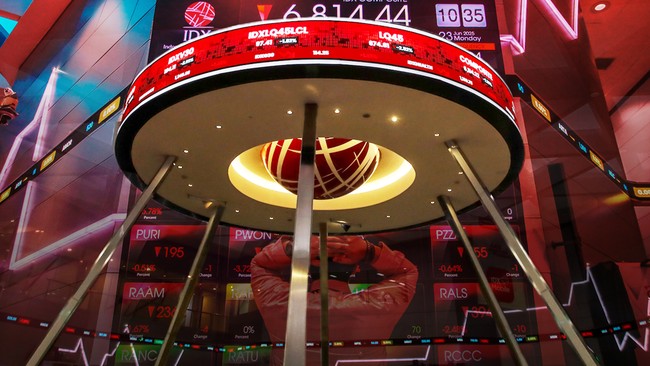
Jakarta, CNBC Indonesia — Indonesia’s stock market fell on Friday (16 October 2026), triggering a trading halt shortly after the opening bell.
The Jakarta Composite Index (JCI) plunged 8.01% to 5,393.92 at the start of trading on Friday (16 October 2026). The sharp decline prompted the Indonesia Stock Exchange (IDX) to suspend share trading for 30 minutes. At 9.59am Western Indonesia Time (WIB), the JCI stood at 5,250.432, down 10.45%.
The pressure on the JCI followed MSCI’s consultation on a proposal to downgrade Indonesia’s stock market from Emerging Market to Standalone Market status.
This was the third trading halt in 2026, following suspensions on 28 and 29 January.
What is a trading halt?
A trading halt is a temporary suspension of share trading by the exchange when the JCI falls to a specified threshold. The policy is intended to keep trading orderly, fair and efficient, while giving market participants time to assess conditions before trading resumes.
Trading halts are currently governed by IDX Board of Directors Decree No. Kep-00002/BEI/04-2025, concerning amendments to the guidelines for handling the continuity of trading on the Indonesia Stock Exchange during emergency conditions. The rules have been in force since 8 April 2025.
Under the rules, the IDX has three stages for suspending trading if the JCI falls during the same trading day:
A decline of more than 8%: the IDX imposes a 30-minute trading halt.
A further decline of more than 15%: the IDX again suspends trading for 30 minutes.
A further decline of more than 20%: the IDX suspends trading until the end of the session, or for more than one trading session, following approval or an order from the Financial Services Authority (OJK).
Previously, the threshold for the first trading halt was a 5% fall in the JCI. The IDX later raised it to 8% to give investors more room to assess liquidity and determine their investment strategies.
The history of JCI trading halts
Trading suspensions are not unprecedented in Indonesia’s stock market. In recent years, the IDX has introduced trading halts several times when the JCI has come under sharp selling pressure.
There were seven trading halts in 2020, most of them in March, when the Covid-19 pandemic shook global financial markets.
After four years without a similar incident, trading was halted again on 18 March 2025, when the JCI fell by more than 5%. Less than a month later, the IDX suspended trading again on 8 April 2025, after the index plunged by more than 9% at the market open.
In 2026, trading halted again on 28 and 29 January, when the JCI fell by more than 8% on two consecutive trading days.
The latest incident took place on Friday (16 October 2026), bringing the number of trading halts this year to three.
According to records from 2020 to 16 October 2026, there have been 12 trading halts: seven in 2020, two in 2025 and three in 2026.
MSCI proposes downgrading Indonesia to Standalone Market status
The pressure on the JCI on Friday (16 October 2026) followed MSCI’s announcement the previous day that it was consulting on the possible reclassification of Indonesia’s stock market from Emerging Market to Standalone Market status.
Indonesia is currently classified as an Emerging Market, alongside countries such as China, India and Brazil. This status allows eligible Indonesian shares to be included in the MSCI Emerging Markets Index, which serves as a benchmark for global investors.
A Standalone Market, by contrast, is classified separately and is no longer grouped with other countries in either the MSCI Emerging Markets or MSCI Frontier Markets indices.
If Indonesia were reclassified as a Standalone Market, domestic shares would be removed from the MSCI Emerging Markets Index and calculated in a separate index.
The change could prompt investment funds tracking the MSCI Emerging Markets Index to sell Indonesian shares to realign their portfolios, potentially increasing selling pressure in the domestic stock market.
The proposal comes as MSCI continues to raise concerns about the transparency of share ownership and alleged coordinated trading practices in Indonesia’s capital market. MSCI said measures announced by domestic authorities to address the issues had not yet produced adequate results.
However, no final decision has been made on Indonesia’s market status. MSCI’s consultation remains open until 30 April 2027, and it is scheduled to announce its decision by 30 June 2027 at the latest.