
STKIP Taman Siswa Bima Lecturers Empower Primary School Teachers to Develop Mbojo Local Wisdom-Based Worksheets
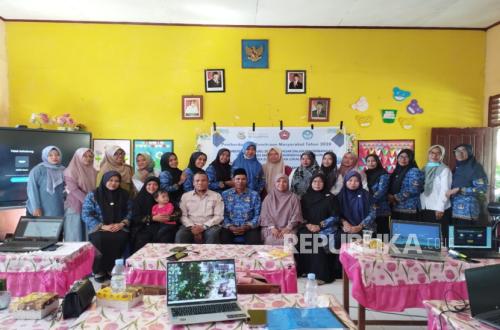
A team of lecturers from STKIP Taman Siswa Bima has carried out a community service programme (PKM) to empower primary school teachers in developing problem-based Student Worksheets (LKPD) oriented towards the Merdeka Curriculum and local Mbojo wisdom. The activity targeted 19-21 teachers at SDN Inpres Kananga 1 and was conducted in two main stages: training and the application of learning technology.
The first training session took place on Saturday, 13 June 2026, using a learning-by-doing approach so that teachers directly practised preparing LKPD according to the subjects and classes they teach. The training was divided into two focuses: strengthening teachers’ understanding of problem-based learning (PBL) and technical training in preparing LKPD.
In the workshop session, teachers were equipped with an understanding of the concept and characteristics of problem-based learning in primary schools, the teacher’s role in facilitating active learning, and the importance of LKPD as an activity-based learning tool. In the LKPD preparation session, teachers were trained to formulate contextual problems, understand the characteristics of quality LKPD according to the Merdeka Curriculum, and arrange problem-based learning syntax. They also learned to formulate indicators and assessments, and to integrate local Mbojo wisdom as an authentic problem context for students.
The head of the community service team, Abdul Haris, M.Pd, who is also a permanent lecturer in the Mathematics Education Study Programme at STKIP Taman Siswa Bima, explained that the training was designed to answer the real needs of teachers in the field.
“Many teachers actually understand the concept of problem-based learning, but still have difficulty translating it into LKPD that are applicable and suited to students’ conditions. Through this training, we want teachers not only to understand the theory, but also to be able to produce their own LKPD that are contextual with local Mbojo wisdom,” said Haris.
The second series of activities was held on Wednesday, 17 June 2026, in the form of assistance in applying appropriate educational technology to support the preparation and digitalisation of LKPD. The technologies used were Canva and Liveworksheets, chosen because they are easily accessible and relevant to the partner school’s conditions.
In the first stage, teachers were assisted in designing problem-based LKPD layouts to be more attractive and communicative using Canva. Teachers were also trained to prepare LKPD pages containing contextual problems, problem-based learning steps, and student reflections, with designs adapted to the local cultural context and the characteristics of primary school students.
In the second stage, teachers were guided to convert the LKPD designed in Canva into Liveworksheets format so that they could be used interactively, not only in printed form. In this stage, teachers prepared interactive problem-based learning activities such as fill-in-the-blank, multiple choice, and drag-and-drop, as well as utilising the automatic assessment features available in Liveworksheets.
A member of the community service team, Nur Fitrianingsih, S.Kom., M.M, a permanent lecturer in the Information Technology Education Study Programme, said that the application of this technology aims to make it easier for teachers to manage LKPD without having to depend entirely on printed versions.
“With Canva, the LKPD made by teachers become more visually attractive. Then with Liveworksheets, the LKPD can be converted into interactive versions that students can work on digitally, complete with automatic assessment. This greatly helps teachers, especially for schools that are becoming accustomed to digital-based learning,” said Nur Fitrianingsih.
Another team member, Hairunisa, M.Pd, a permanent lecturer in the Primary School Teacher Education Study Programme (PGSD), added that the gradual assistance made teachers more confident in developing LKPD independently.
“The teachers were very enthusiastic in following each stage, from understanding the concept, practising preparing LKPD, to digitalising them. The hope is that the LKPD produced can be directly applied in the classroom and become routine teaching materials, not just training products,” said Hairunisa.
This community service activity is part of the STKIP Taman Siswa Bima lecturers’ efforts to encourage the improvement of learning quality in primary schools through strengthening teacher competence. Based on evaluation results, teachers’ understanding of problem-based learning increased from an average of 70.7 to 82.4, a rise of 11.7 points after attending the workshop.
In terms of products, 18 out of 21 teachers (85.7 per cent) successfully produced a draft of problem-based LKPD. Meanwhile, 15 teachers (71.4 per cent) produced LKPD that met the structural criteria according to the established assessment rubric.
Teachers’ ability to utilise learning technology also increased significantly. The average ability to use Canva rose from 63.3 per cent to 83.4 per cent, while the use of Liveworksheets increased from 22.2 per cent to 68 per cent, given that most teachers were using the platform for the first time.
As a follow-up to the programme, a teacher learning community was also formed at SDN Inpres Kananga 1, established through a Decree of the School Principal. The community serves as a forum for teachers to continue sharing good practices and developing problem-based LKPD sustainably.
The lecturer team hopes that community service activities of this kind can continue and be expanded to other schools. This is to support the implementation of the Merdeka Curriculum that is contextual and based on local wisdom, particularly in the Bima region.
This community service activity is part of a programme funded by the Directorate of Research, Technology, and Community Service (DRTPM) of the Ministry of Higher Education, Science, and Technology.