
Step Aside Hormuz! Iran Threatens to Block the 'Lifeline' Strait of Global Trade
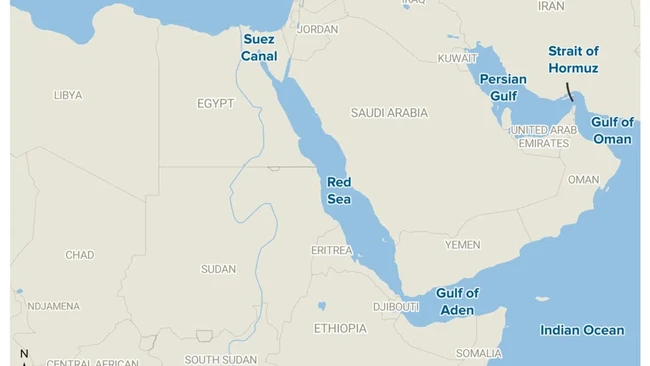
Escalation of tensions in the Middle East has reached a new boiling point after Iran’s allies threatened to close the strategic Bab al-Mandeb shipping route. This move follows Tehran’s previous action that crippled the Strait of Hormuz, potentially severing the world’s energy lifeline.
The threat came from Mojtaba Khamenei’s chief advisor on Monday (06/04/2026). Citing an Al Jazeera report, Ali Akbar Velayati, Iran’s former Foreign Minister and influential senior diplomat, issued a stern warning via his post on social media platform X.
“The integrated command of the Resistance Frontline views Bab al-Mandeb the same as Hormuz. If the White House dares to repeat its foolish mistake, they will soon realise that global energy and trade flows can be disrupted with just one move,” wrote Velayati.
Velayati’s statement was subsequently confirmed by Iran’s state media, Press TV. The threat emerges as a response to US President Donald Trump’s bluff planning to bomb power plants and bridges in Iran starting this Wednesday if the Strait of Hormuz is not immediately reopened. Iran insists that Hormuz is only open to countries negotiating safe passage, excluding the United States and Israel.
Where is Bab al-Mandeb Located?
Geographically, the Bab al-Mandeb Strait is located between Yemen to the northeast and Djibouti and Eritrea in the Horn of Africa to the southwest. This route connects the Red Sea with the Gulf of Aden, which then extends to the Indian Ocean.
The strait is only 29 kilometres wide at its narrowest point, limiting ship traffic to two lanes for incoming and outgoing shipments. The area is effectively controlled by the Iran-backed Houthi group in Yemen. This group forms a central part of Iran’s “Axis of Resistance,” a coalition ideologically and tactically aligned with Tehran.
Why is Bab al-Mandeb Important for Energy Trade?
The importance of Bab al-Mandeb has surged dramatically since the closure of the Strait of Hormuz, a route that typically carries 20% of the world’s oil and gas supply. Bab al-Mandeb is a vital route for Saudi Arabia to ship its oil to Asia.
If the Strait of Hormuz and Bab al-Mandeb are closed simultaneously, 25% or a quarter of the world’s oil and gas supply will be completely blocked. 2024 data shows approximately 4.1 billion barrels of crude oil and refined oil products passing through this strait, equivalent to 5% of the global total. Besides energy, 10% of global trade, including containers from China and India to Europe, also relies on this route.
Saudi Arabia itself has diverted its oil exports via the Yanbu port in the Red Sea using the East West Pipeline to avoid the Hormuz bottleneck. By the end of March, Aramco’s 1,200-kilometre pipeline had been operating at full capacity of 7 million barrels per day (bpd), the highest figure ever recorded.
How Can Iran and Its Allies Close It?
The Houthi group has proven its capability to disrupt this route. Nabeel Khoury, a former US diplomat, explained to Al Jazeera that the Houthis’ missile attacks on Israel are currently still symbolic participation.
“They have fired several missiles as a warning due to talks about potential escalation. There are US forces heading to the area. There are discussions that if no agreement is reached, there might be a full-scale attack on Iran unlike anything seen before,” said Khoury.
Khoury emphasised that the Houthis’ main weapon if they truly engage in war would be a blockade of Bab al-Mandeb.
“All they need to do is shoot at a few passing ships, and that will cause the entire commercial shipping through the Red Sea to stop. That would be a red line, and then you would see attacks on Yemen from the US and Israel very quickly,” stated Khoury.
What Would the Closure of Bab al-Mandeb Mean for the World?
The world now stands on the brink of a deeper economic crisis if this threat materialises. Elisabeth Kendall, a Middle East specialist and President of Girton College at the University of Cambridge, described the situation as the worst-case scenario for global trade.
“Because if you have restrictions in the Strait of Hormuz at the same time as escalating restrictions in Bab al-Mandeb, you will truly disrupt, if not cripple, trade to Europe. So this is really on a knife’s edge, depending on what happens next,” Kendall told Al Jazeera.
Kendall added that while this position benefits the Houthis, the group may still consider the risks of not provoking a broader response from Saudi Arabia or other global powers. If a blockade occurs, its economic impact will be felt directly in factories, household kitchens, and fuel stations worldwide.
Source: jawawa.id (https://jawawa.id/newsitem/step-aside-hormuz-iran-threatens-to-block-the-lifeline-strait-of-global-trade-1775616743)
Originally published by CNBC Indonesia (https://www.cnbcindonesia.com/news/20260406234027-4-724368/hormuz-minggir-iran-ancam-blokir-selat-urat-nadi-perdagangan-dunia), translated from Indonesian