
Steel Investment Slumps in Q2 2026 as Imports and Low Utilisation Bite
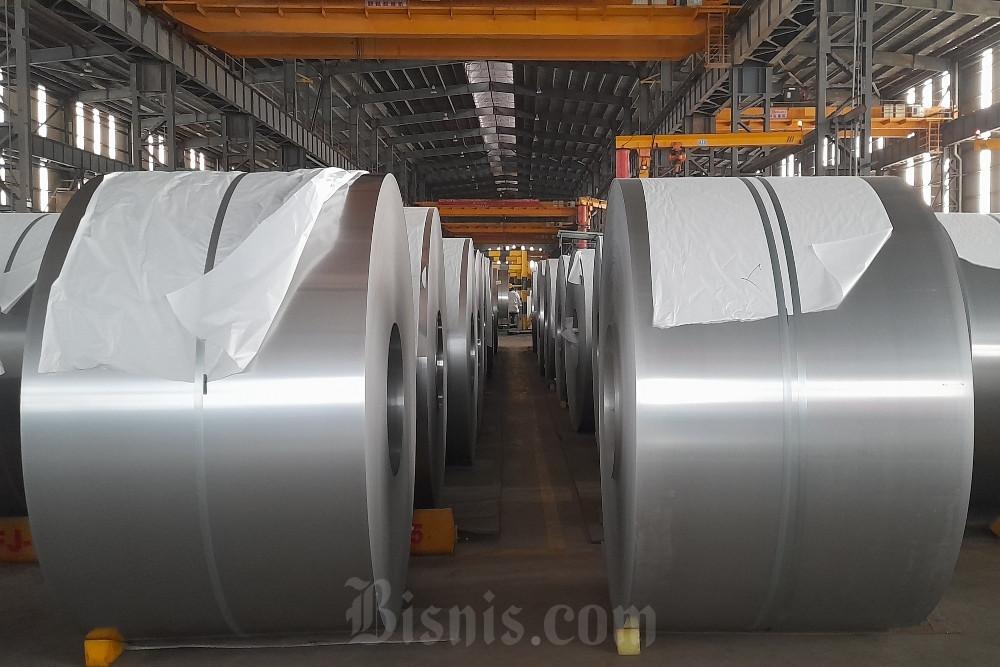
Bisnis.com, JAKARTA — The decline in investment realisation in the steel industry in Q2/2026 is judged to have been triggered by the low utilisation of national plants and a flood of imported steel that continues to pressure domestic producers.
According to a report from the Ministry of Investment and Downstream Industry/BKPM released last weekend, investment realisation in the iron and steel sector stood at Rp13.2 trillion in Q2/2026. This figure was down compared with Q1/2026, which reached Rp17 trillion.
Yusuf Rendy Manilet, an economist at the Center of Reform on Economics (Core) Indonesia, explained that the fall in investment realisation in this sector was not merely influenced by the investment cycle of large projects, but rather reflected fundamental problems that made investors reluctant to add production capacity.
He noted that the utilisation rate of national steel plants remained at around 52%, far below the ideal level of 80%. At the same time, imported steel is estimated to have captured more than half of the domestic market, squeezing the room available for local producers.
“In a situation like this, investors will certainly hold back expansion because even the existing capacity has not been optimally utilised,” he told Bisnis on Monday (20/7/2026).
Yusuf said the main cause of weakening investment stemmed from a combination of global pressures and domestic problems. On the global side, the steel industry still faces excess production capacity in China amounting to around 1 billion tonnes per year.
The sheer scale of that production has kept world steel prices under pressure, making imported products far cheaper. For Indonesia, which has a production capacity of around 18 million tonnes per year, even a small share of China’s exports is enough to shake the domestic market.
Yusuf said the pressure could grow even greater when countries such as the European Union tighten their steel import policies. That situation could push the overspill of Chinese steel products towards countries with looser trade protection, including Indonesia.
Meanwhile, on the domestic side, Yusuf assessed that weak investment was not caused by an absence of demand. National steel consumption has in fact continued to rise in step with infrastructure development and the government’s downstreaming programmes.
However, that additional demand has not been fully enjoyed by the national industry because most of it is still met by imported products. “This is where the paradox lies. It means the market is actually there, but it is not yet a market for local producers,” he explained.
The government, Yusuf continued, has indeed applied various instruments such as anti-dumping import duties, import regulations, and national standards. Yet their implementation is still not strong enough to give certainty to investors.
“From a business perspective, no company will build a new plant when the facilities already operating are still running far below their economic capacity,” he added.
Yusuf added that weakening investment in the steel industry would also affect other manufacturing sectors that depend on steel supply, such as construction, automotive, heavy equipment, shipbuilding, and machinery manufacturing. Dependence on imported raw materials could also rise, so that the added value that should be created domestically flows abroad instead.
Therefore, he judged the most urgent step was to strengthen protection of the domestic market through faster and more consistent trade instruments. Once industry utilisation improves, the government needs to raise competitiveness through logistics and energy cost efficiencies, strengthen the implementation of TKDN (local content requirements), and encourage the transformation of the steel industry towards low-emission production in order to remain competitive in the global market.
“In my view the sequence is clear: protect the domestic market first so that plant utilisation improves, then raise industry competitiveness, and subsequently push the transformation towards a more sustainable steel industry,” Yusuf asserted.
Source: jawawa.id (https://jawawa.id/newsitem/steel-investment-slumps-in-q2-2026-as-imports-and-low-utilisation-bite-1784620214)
Originally published by ekonomi.bisnis.com (https://ekonomi.bisnis.com/read/20260720/257/1989457/investasi-baja-lesu-pada-kuartal-ii2026-faktor-ini-jadi-biang-kerok), translated from Indonesian