
Steel Industry Investment Slows Amid High Interest Rates and Import Pressure
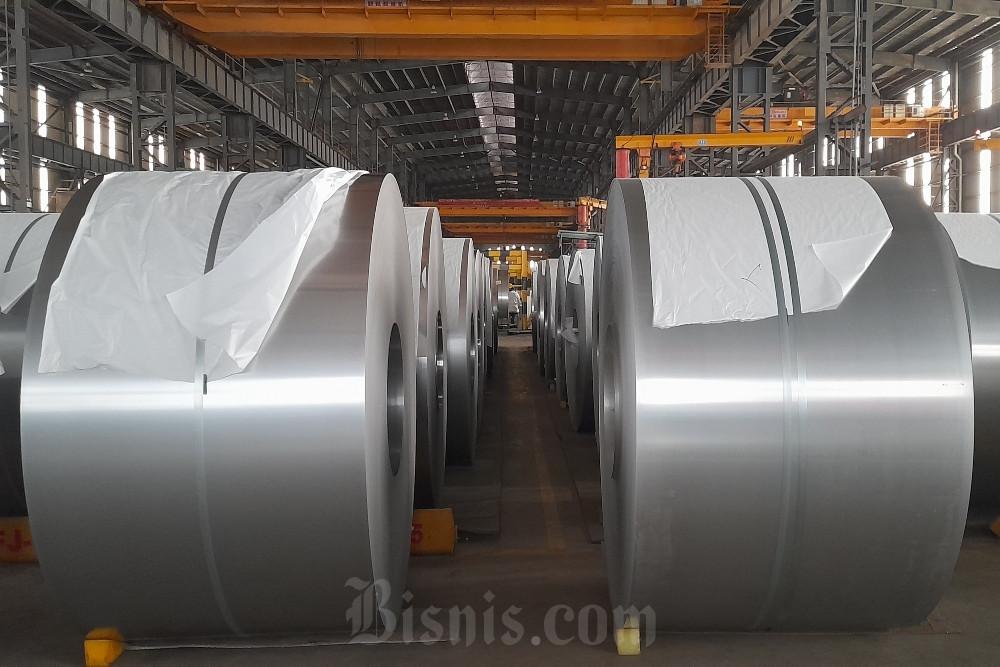
Investors in the iron and steel industry appear to be holding back on expansion in the second quarter of 2026, affected by rising capital costs due to high interest rates, rupiah exchange rate volatility, low national factory utilisation, and a flood of imported steel that continues to pressure domestic producers.
Indeed, iron and steel remain a mainstay for investment realisation. However, a report from the Ministry of Investment and Downstreaming/BKPM at the end of last week noted that investment realisation in the iron and steel sector was Rp13.2 trillion in the second quarter of 2026, a decline from Rp17 trillion in the first quarter.
Economist Yusuf Rendy Manilet from the Center of Reform on Economics (Core) Indonesia assessed that the decline in steel investment cannot be viewed merely as a cyclical correction. He explained that national factory utilisation is currently around 52%, far below the ideal level of approximately 80%. At the same time, imported steel is estimated to have captured more than half of the domestic market. This situation means investors are choosing to hold back on expansion because existing production capacity is not being fully utilised. “So, in my view, this investment weakening reflects a structural problem rather than just a short-term fluctuation,” he told Bisnis on Monday.
Yusuf explained that the pressure on the steel industry stems from a combination of global and domestic factors. Globally, the steel industry is still overshadowed by excess production capacity in China, which reaches around 1 billion tonnes per year. With Indonesia’s national production capacity at only about 18 million tonnes, a small fraction of Chinese steel exports is enough to put significant pressure on the domestic market. This is exacerbated by global steel prices that continue to weaken, making imported products increasingly competitive.
From the domestic side, Yusuf noted that steel demand has not fully recovered. However, the main issue is not just weak demand, but the lack of optimal protection for the domestic market, forcing local producers to compete directly with cheap imports. He pointed out that while the government continues to push downstreaming and infrastructure development, which increases national steel consumption, this additional demand is largely being met by imported products. “This means the market actually exists, but it has not yet become a market for local producers. That is the paradox,” he stressed.
Yusuf acknowledged that the government has implemented various instruments such as anti-dumping import duties, import regulations, and national standards. However, he argued that their implementation has not been strong enough to provide certainty for investors.
Bank Permata Chief Economist Josua Pardede added that investment is also being pressured by high financing costs. He noted that Bank Indonesia raised the BI Rate in June 2026 to 5.75% to maintain rupiah stability and control inflation, while the structure of Bank Indonesia Rupiah Securities (SRBI) was kept attractive to maintain capital flows. “When interest rates are still high and the rupiah is volatile, the feasibility calculation for projects becomes heavier,” he said.
Josua also highlighted that the weakening rupiah increases investment costs because most machinery, technology, and raw materials for the steel industry still rely on imports. Global economic uncertainty is also making investors wait for clearer signals on steel prices, energy costs, and demand prospects before committing to expansion. He noted that the pressure from funding costs is already visible in the banking sector, with the rupiah third-party fund rate rising from 2.65% in April to 2.70% in May 2026, which could lead to higher lending rates and further narrow the space for investment financing.
Despite the current challenges, Josua assessed that the medium-term prospects for the steel industry remain positive. Demand is expected to come from mineral downstreaming projects, infrastructure development, industrial estates, and the energy sector.
Source: jawawa.id (https://jawawa.id/newsitem/steel-industry-investment-slows-amid-high-interest-rates-and-import-pressure-1784616643)
Originally published by ekonomi.bisnis.com (https://ekonomi.bisnis.com/read/20260721/257/1989655/investasi-di-industri-baja-melambat-di-tengah-ambisi-hilirisasi), translated from Indonesian