
Stealth Internet Cables Reappear in Badung, Unruly Providers Face Sanctions
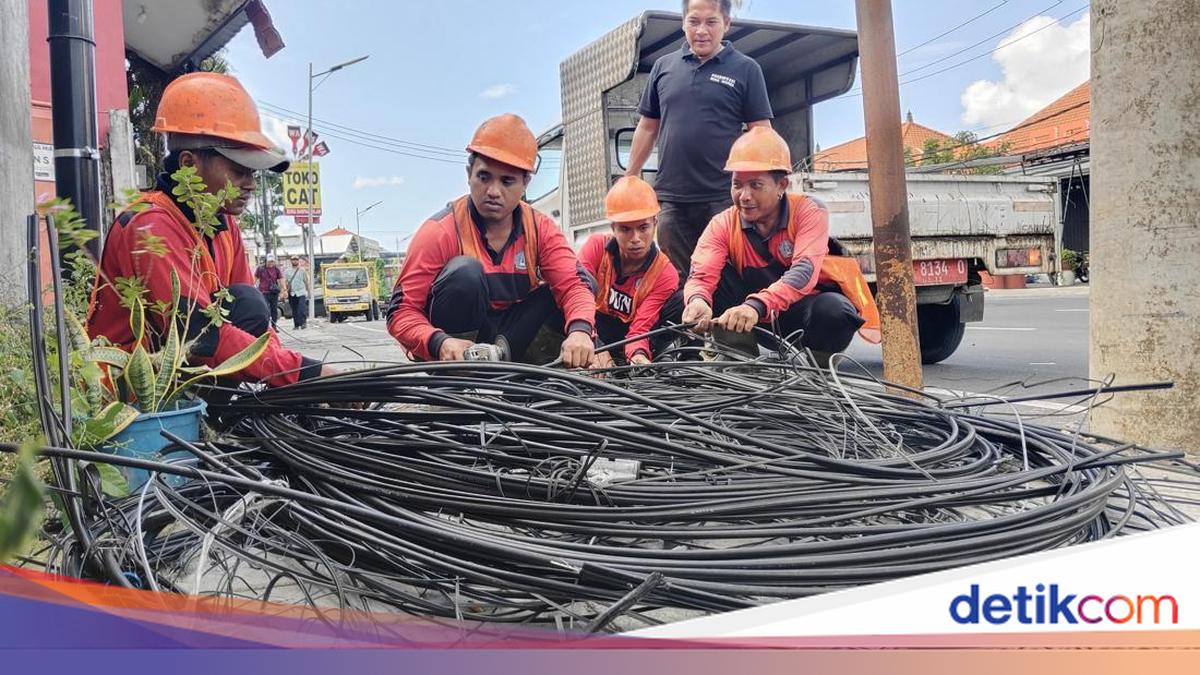
The Bali chapter of the Association of Telecommunication Network Operators (Apjatel Bali) has again found several illegal, ‘stealth’ cables belonging to unscrupulous providers still mounted on utility poles, despite repeated clearances by the Badung Regency’s Integrated Utilities Task Force. The cables were found on Pantai Berawa Street and Jalan Dewi Sri in Kuta and were still installed despite enforcement having been carried out several years previously. To anticipate further violations, Apjatel joined forces with the Regency’s Civil Service Police Unit (Satpol PP) during the enforcement, to tighten supervision and enforcement in the field. ‘The cables up there have already been cut, so they are not in operation. Sometimes, even after cutting, a few cables are still found installed overhead. We suspect the unscrupulous operators,’ he said. ‘We cut those as well. Later, Satpol PP or Dinas PUPR will report to us, and we will ask colleagues to check who owns it, then cut it again,’ said Dodi Simanjuntak, Regional Coordinator of Apjatel Bali, on Friday (22 May 2026). The operation is part of a routine programme with the Public Works and Public Housing Service (Dinas PUPR) Badung scheduled twice a month, specifically the second and fourth weeks. Before execution, all operators were given deadlines to relocate their networks underground and migrate active customer channels to prevent network disturbances. According to Dodi, the proliferation of illegal above-ground cables in public spaces is believed to be carried out by small internet service providers. Most of them embed aerial cables because they do not have official permission from the Ministry of Communications and Digital Affairs, and budget constraints limit underground cabling. ‘Yes, many are pulling cables themselves. Some may not know about the SJUT (Integrated Utility Network Facilities) programme in Badung Regency or perhaps budget constraints, so they still go overhead. But we, together with Dinas PUPR, have agreed that if there are still cables overhead, we will identify who owns them and summon that provider,’ he insisted. By mid-2026, the joint team had recorded at least five to six hotspots in Badung’s tourist, industrial and other densely populated areas that had been cleared of messy cables. Yet some areas previously cleared, such as Jalan Pantai Berawa and Jalan Dewi Sri, have again been infiltrated by new overhead cabling. ‘For example, on Jalan Pantai Berawa we see early signs again; sometimes on Jalan Dewi Sri, we cut cables in 2025 and now they are reappearing one by one. We will identify which provider owns them,’ Dodi noted. Apjatel emphasises that the ongoing daily oversight is ultimately down to each network operator’s management. If violations are found, Dinas PUPR will summon the company’s top management for strict sanctions to ensure compliance down to technicians in the field. ‘This programme is good; it improves aesthetics and the city becomes less chaotic. It will also avoid issues during Bali’s Ngaben and Ogoh-ogoh parades,’ said Dodi. As of now, 38 telecom providers are officially listed as Apjatel Bali members. However, the actual number of operators on the ground is believed to be higher because many do not join after being hindered by Local Network (Jarlok) and Network Layer (Jarlap) permits from the central government. Meanwhile, Badung’s Kasatpol PP I Gusti Agung Ketut Suryanegara said enforcement of optical cable tidying in the coming months would prioritise strategic areas. The routes already have integrated underground cable duct infrastructure. ‘This year, 2026, this is the fifth enforcement operation; 12 locations remain. It is conducted every Friday; if not Friday, then weekly or every two weeks. Priority is given to places where the road facilities already provide underground cable ducts,’ Suryanegara said. Regulationally, enforcement against non-compliant telecom operators is based on Badung Regency Regional Regulation No. 19 of 2016, a decade old. The local government is only able to intensify on-field action in the past three years because it must ensure underground facilities are ready before forcing networks to relocate. ‘So far, five operations have run smoothly. Apjatel also supports this; there has been no public resistance. All is going well,’ Suryanegara said. The current street-cleaning operation also took place on Friday morning along Teuku Umar Barat to the north. The joint team aims to clear 2.5 kilometres of aerial cables. The scale of the cleanup is staged region by region to align with the availability of underground utility pipes provided by Dinas PUPR Badung.