
State-Owned Miner Begins Exploring Rare-Earth ‘Treasure’ That Could Be Used in Defence Equipment
One of Indonesia’s state-owned mining companies has secured a mining business permit to explore rare earth elements (REE), a critical mineral now being sought after around the world. Limited supply and its use in advanced technology have prompted countries to compete for REE. Processed rare earths can also be used as raw materials in the modernisation of defence systems, or major weapons systems (alutsista).
The state-owned miner holding an REE exploration permit from the Ministry of Energy and Mineral Resources is PT Perusahaan Mineral Nasional (Perminas). It is exploring for REE in Mamuju, West Sulawesi, where it has begun work to reassess the resource and reserve potential of its concession.
Perminas Technology and Business Development Director La Ode Tarfin Jaya said the exploration permit was issued in July 2026, followed by approval of the exploration Work Plan and Budget (RKAB) in August 2026.
Exploration is currently focused on two blocks, each covering 100 hectares, for a total of 200 hectares.
“For Mamuju, we have received an exploration permit from the government, in this case the Ministry of Energy and Mineral Resources through the Directorate General of Minerals and Coal. The permit was issued in July, and the RKAB for exploration followed in August. We are exploring around two blocks of approximately 100 hectares each, or 200 hectares in total,” he said on the sidelines of the 2026 Minerba Convention and Exhibition (Convex) at JIExpo on Tuesday (3 November 2026).
Infill drilling in Mamuju has so far reached about 10%, with work completed at 72 of the 200 planned drill sites, spaced 50 metres apart in a 50-by-50-metre grid. The close-spaced drilling is intended to refine and expand on the results of earlier scout drilling by the Geological Agency.
“We are carrying out close-spaced infill drilling across the 200 hectares. We have completed about 10%, at 72 drill sites, on a 50-by-50-metre grid. This is necessary to provide more detail on the work previously carried out by the Geological Agency,” he added.
Official estimates of the REE resources and reserves are expected to be completed next year, once all 200 drill sites have been completed and assessed. The Mamuju deposit is classified as primary ion-adsorption clay, similar in type to deposits at Bayan Obo in China, Myanmar and Caldeira in Brazil.
“In Mamuju, the REE is of the ion-adsorption clay type. It is the same type as, for example, Bayan Obo in China, or deposits in Myanmar and Caldeira in Brazil. These are primary rare-earth deposits,” he said.
Perminas manages a total of 7,300 hectares of REE concession in Mamuju, divided into two blocks.
Alongside the Mamuju project, Perminas, which is under the Danantara Investment Management Agency (BPI Danantara), is coordinating closely with PT Timah and conducting joint research into recovering REE from processing residues and tin slag.
“We are waiting. What is clear is that Mamuju covers 7,300 hectares in two blocks. If the government assigns us another task, our team is ready; that is our principle,” he said.
Prabowo’s support
President Prabowo Subianto supports REE mining and processing. On several occasions, he has said Indonesia should be grateful to possess critical minerals that are sought after around the world.
In a speech on the 2026 State Budget Bill and Financial Note at a plenary session of the House of Representatives on 15 August 2025, Prabowo said Indonesia was fortunate to have a “super-rare treasure” in the form of rare earth elements. He said the critical minerals could be used to modernise the country’s defence systems.
He stressed that the country’s natural resources must be managed as well as possible, given Indonesia’s REE potential.
“We must take control of, defend and manage all of Indonesia’s wealth. To that end, we must modernise our defence systems, strengthen our reserve components, empower our national strategic industries and improve the welfare of our soldiers. Thank God, the Almighty has bestowed a gift upon us: we have minerals called rare earths; we possess all the rare earths in the world,” he said in his address on the 2026 State Budget Bill and Financial Note at the House plenary session on Friday (15 August 2025).
“Rare earths are vital to high-technology and modern life, as well as modern defence,” he said.
“Ladies and gentlemen, we must create a highly skilled workforce so that all our natural resources can be put to use as soon as possible,” he added.
Rare earth elements are strategic critical minerals comprising 17 elements: scandium (Sc), lanthanum (La), cerium (Ce), praseodymium (Pr), neodymium (Nd), promethium (Pm), samarium (Sm), europium (Eu), gadolinium (Gd), terbium (Tb), dysprosium (Dy), holmium (Ho), erbium (Er), thulium (Tm), ytterbium (Yb), lutetium (Lu) and yttrium (Y).
Some defence materials use REE as alloying elements. These include Terfenol-D, an alloy of terbium (Tb), iron (Fe) and dysprosium (Dy), used in sonar-wave dampers, as well as yttrium aluminium garnet (YAG) for optical material in night-vision rifle scopes, among other applications.
Indonesia’s REE potential
According to the Ministry of Energy and Mineral Resources’ 2020 Rare Earth Elements booklet, Indonesia’s REE potential comes from by-products of processing minerals including tin, gold, alumina, zircon sand and nickel. Most deposits are located in Bangka Belitung, West Kalimantan and Sulawesi.
Of the 28 identified REE mineralisation sites, only about nine (30%) have undergone preliminary exploration, while 19 (70%) have not been explored or have not been explored sufficiently.
The following are some of Indonesia’s rare-earth minerals:
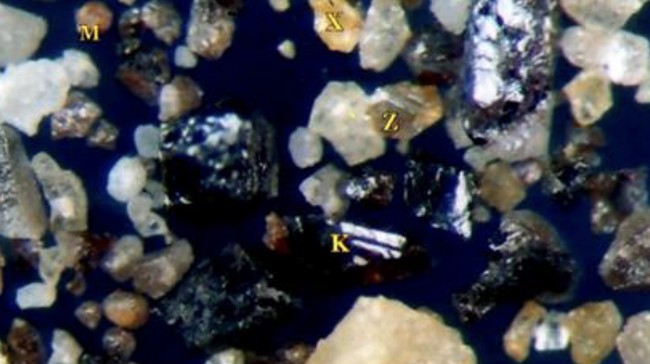
Monazite and xenotime are by-products of tin-ore processing. They are found in tin mines in Bangka Belitung.
Monazite: Indonesia has 185,179 tonnes of monazite resources, which could be further developed into reserves. Analysis of monazite concentrate in tin found 31.5% CeO2, 13.2% La2O3, 11% Nd2O3, 3.9% Y2O3, 2.98% Pr6O11, 1.98% Gd2O3 and 1.96% Sm2O3. Three provinces have REE potential: Riau Islands, with 2,268 tonnes of resources; Bangka Belitung Islands, with 181,735 tonnes; and West Kalimantan, with 1,175 tonnes.
Xenotime: Indonesia has 20,734 tonnes of xenotime resources that could be further developed into reserves. The deposits are in the Bangka Belitung Islands.
Zirconium silicate is a by-product of tin- and gold-ore processing and is also found in zircon sand. It is potentially present in zircon-sand mines in Kalimantan. Its REE include yttrium (Y) and cerium (Ce).
Ferrotitanates are residues from processing bauxite into alumina. They are potentially present in red mud in West Kalimantan.
Laterite nickel ore can yield REE as a by-product of hydrometallurgical processing at high-pressure acid leaching (HPAL) nickel-cobalt smelters. It is potentially present in limonite nickel mines in Sulawesi. Its REE include scandium (Sc), neodymium (Nd), praseodymium (Pr) and dysprosium (Dy).
Granite rocks.
Coal ash/FABA (monazite).
REE resources by region:
Sumatra: Weathering-type REE deposits, with theoretical estimates of 19,917 tonnes of REE (Ce, La, Nd, Pr, Sm, Gd and Y).
Bangka Belitung: Tailing-type REE deposits, with theoretical estimates of 383,239.8 tonnes of REE (Ce, La, Nd, Pr, Sm, Gd and Y).
Kalimantan: Laterite-type REE deposits, with theoretical estimates of 219 tonnes of REE (Ce, La, Nd, Pr, Sm, Gd and Y).
Sulawesi: Laterite-type REE deposits, with theoretical estimates of 443 tonnes of REE (Ce, La, Nd, Pr, Sm, Gd and Y).
Tin mining permits in Bangka Belitung and the Riau Islands, on land and at sea: Alluvial deposits, with theoretical estimates of 180,323 tonnes of REE (Ce, La, Nd, Pr, Sm, Gd and Y).
Source: jawawa.id (https://jawawa.id/newsitem/state-owned-miner-begins-exploring-rare-earth-treasure-that-could-be-used-in-defence-equipment-1793803846)
Originally published by CNBC Indonesia (https://www.cnbcindonesia.com/news/20261104192846-4-782385/bumn-tambang-ini-mulai-gali-harta-karun-langka-bisa-untuk-alutsista), translated from Indonesian