
State-Owned Food Enterprises to Control Minyakita Distribution, Directly Appoint Retailers
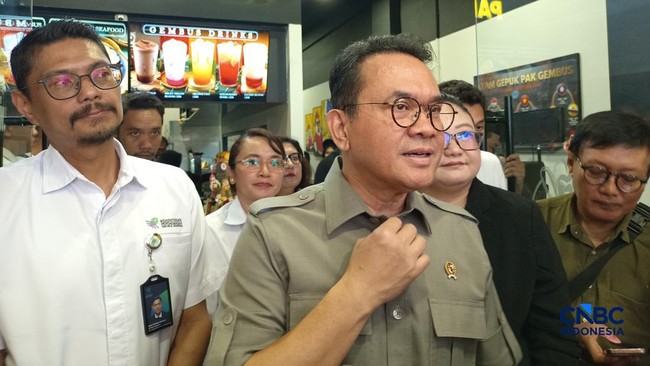
Jakarta, CNBC Indonesia - Trade Minister Budi Santoso has opened the possibility that the distribution of the people’s cooking oil, Minyakita, will be fully handled by state-owned food enterprises such as Bulog and ID Food in the future. However, this scheme will be implemented gradually by first increasing the distribution quota, which is currently at a minimum of 35%.
The government is taking this step to ensure the selling price of Minyakita remains in accordance with the Highest Retail Price (HET) and to prevent sales practices above the stipulated price that are still found in the field.
“Minyakita’s HET has not increased to date. So what we will do, first, is to increase the distribution quota for state-owned food enterprises,” said Budi Santoso when met in Jakarta on Monday (22/6/2026).
Currently, the distribution quota for Minyakita through state-owned food enterprises is at 35%. However, the government is reviewing an increase in this quota to more than half of the total distribution. “Right now it’s a minimum of 35%. We are now reviewing to increase it. Yes, we have calculated it. It could be above 50%,” he said.
According to Budi, distribution through Bulog and ID Food is considered easier to monitor because these two SOEs directly appoint retailers in the markets. With this mechanism, retailers who sell Minyakita above the HET can be immediately removed from the distribution network.
“These state-owned food enterprises, like Bulog and ID Food, will appoint retailers in the markets. Later, if a retailer does not sell according to the HET, they will be blacklisted by Bulog. So, what is distributed by Bulog or ID Food will definitely comply with the HET,” he explained.
He explained that the price received by retailers from Bulog and ID Food has been calculated according to the applicable distribution chain regulations. Therefore, retailers still make a profit even when selling according to the HET. “Because they appoint retailers in the market, the retailers automatically have to sell according to the HET. Because Bulog sells to retailers also according to the rules. There is a calculation for D1,” said Budi.
“There is a calculation for the retailer. So, if the retailer sells according to the HET, they are actually already making a profit. So, they are not allowed to sell for more,” he continued.
Budi emphasised that strict sanctions will be imposed on retailers who violate these price rules. “If they sell for more, they will be blacklisted and will no longer be a retailer or a partner of Bulog or ID Food,” he stressed.
When asked about a statement from the Minister of Agriculture and Head of the National Food Agency, Amran Sulaiman, who mentioned that President Prabowo Subianto wants 100% of Minyakita distribution to be carried out through state-owned food enterprises, Budi did not deny the possibility. However, he stressed that the implementation cannot be done all at once. “Well, as I explained earlier,” he said.
When asked whether the entire distribution of Minyakita would eventually be carried out through Bulog and ID Food, Budi replied that the process would be gradual because some distribution is currently still handled by traders. “It will be gradual, not immediate. Because, you see, some is still distributed by traders in the market,” he said.
Meanwhile, when asked again whether the final target is for 100% of Minyakita distribution to be through state-owned food enterprises, Budi did not provide certainty. “We will see later,” he concluded.