
State Intervention: Poultry Downstreaming Aimed at Balancing Dominance of Two Industry Giants
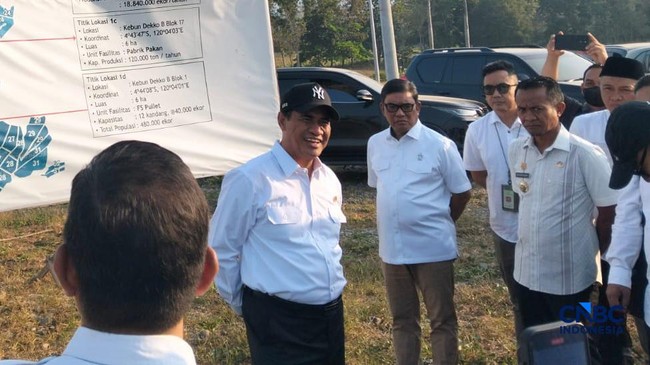
On Friday morning (25/9/2026), the usually quiet grasslands of Mappesangka Village, Bone Regency, South Sulawesi, were suddenly bustling with crowds and vehicles. At the centre of the activity was the Minister of Agriculture, Amran Sulpland, inspecting the progress of a major project in the area.
Amran, also wearing a black hat, was checking the progress of a significant project in the region, which is also his birthplace. It was once unimaginable that this area would host a poultry farm and factory as part of the Integrated Poultry Downstreaming (HAT) programme, utilising 22 hectares of PTPN I land in the Regional 8 Camming Plantation.
“In accordance with President Prabowo’s directives, the HAT programme is scheduled to be operational by 1 July next year (2027). This is one of the President’s key priorities for us,” Amran Sulaiman stated in an official release on Sunday (27/9/2026).
The Integrated Poultry Downstreaming project in Mappesangka Village is just one of five locations across Indonesia. Other sites include East Java (Malang Regency), Gorontaly (North Gorontalo Regency), Lampung (South Lampung Regency), East Kalimantan (Penajam Paser Regency), and West Nusa Tenggara (Sumbawa Regency).
Amran noted that an initial budget of Rp 2.2 trillion has been prepared from a total of Rp 17 trillion to support this programme across various locations.
The programme is coordinated by Danantara Indonesia, through PT Rajawali Nusantara Indonesia (Persero), also known as ID FOOD, which has commenced the groundbreaking for integrated poultry industry development in six Indonesian provinces.
Normatively, the HAT programme is designed to support four of President Prabowo’s main pillars: food self-sufficiency, the Free Nutritious Meal (MBG) programme, energy security, and industrial downstreaming. In addition to providing animal protein sources, the development is expected to drive the economy in rural communities and create new employment opportunities.
However, this government move is not occurring in a vacuum, as the Indonesian poultry sector has long been dominated by private players, specifically two major giants: PT Charoen Pokphand Indonesia Tbk (CPIN) and PT Japfa Comfeed Indonesia Tbk (JPFA). Their business spans the entire poultry value chain, from feed production, breeding, and hatching to rearing, slaughtering, processing, and sales. The poultry business ecosystem is highly lucrative, with trillions of rupiah in turnover.
Both companies recorded increases in net sales throughout 2025, though their largest business lines were not always the fastest-growing.
CPIN: Feed Drives Sales
CPIN booked net sales of Rp 70.70 trillion in 2025, a 4.8% increase from Rp 67.48 trillion the previous year. Broiler chicken remains its largest business segment, contributing Rp 34.03 trillion, or approximately 48.1% of total company revenue, although this value decreased by about Rp 1.29 trillion year-on-year.
A different trend was observed in the animal feed segment. Sales in this line rose by approximately Rp 4.54 trillion to reach Rp 20.99 trillion.
In other words, while CPIN’s largest business remains broilers, feed was the biggest contributor to sales growth in 2025. Sales of day-old chicks (DOC) also increased, while processed chicken saw a decline.
CPIN’s Operational Regions
CPIN maintains operations across 21 provinces, with four located in Java and 17 outside Java. The types of facilities vary according to their operational region.
Regarding the supply chain, the presence of a feed business means CPIN operates at the early stages before chickens are reared. The company then manages breeding and hatching to produce DOCs, manages farming activities, and sells broilers and processed products. At the end of the chain, the company operates a retail store network.
The scale of its facilities is extensive, though the geographical distribution is uneven. CPIN reported a total of 147 breeding farms and 60 hatcheries. The company also reported 30 facilities categorised as a combination of slaughterhouses and/or processed food factories.
For its feed mills, CPIN reported 10 units across eight cities. Four of these cities are located outside Java: Medan in North Sumatra, Padang in West Sumatra, Bandar Lampung in Lampung, and Makassar in South Sulawesi.
JPFA: Farming Leads Sales
JPFA possesses a similar poultry business chain, but its reported scope also includes feed, aquaculture (fish and shrimp), seafood processing, and cattle fattening.
In its poultry business, the company operates from feed, breeding farms, and hatcheries through to commercial farms, slaughterhouses, cold storage, and consumer products.
JPFA’s net sales reached Rp 60.72 trillion in 2025, growing by 8.8% from Rp 55.80 trillion in 2024. Commercial farming was the largest contributor to sales outside the group, reaching Rp 24.46 trillion, or 40.3% of the total.
Source: jawawa.id (https://jawawa.id/newsitem/state-intervention-poultry-downstreaming-aimed-at-balancing-dominance-of-two-industry-giants-1790762399)
Originally published by CNBC Indonesia (https://www.cnbcindonesia.com/research/20260928164746-128-771522/negara-hadir-hilirisasi-ayam-cara-imbangi-dominasi-2-raksasa-unggas), translated from Indonesian