
State Budget and Danantara to Become Two Engines of Growth
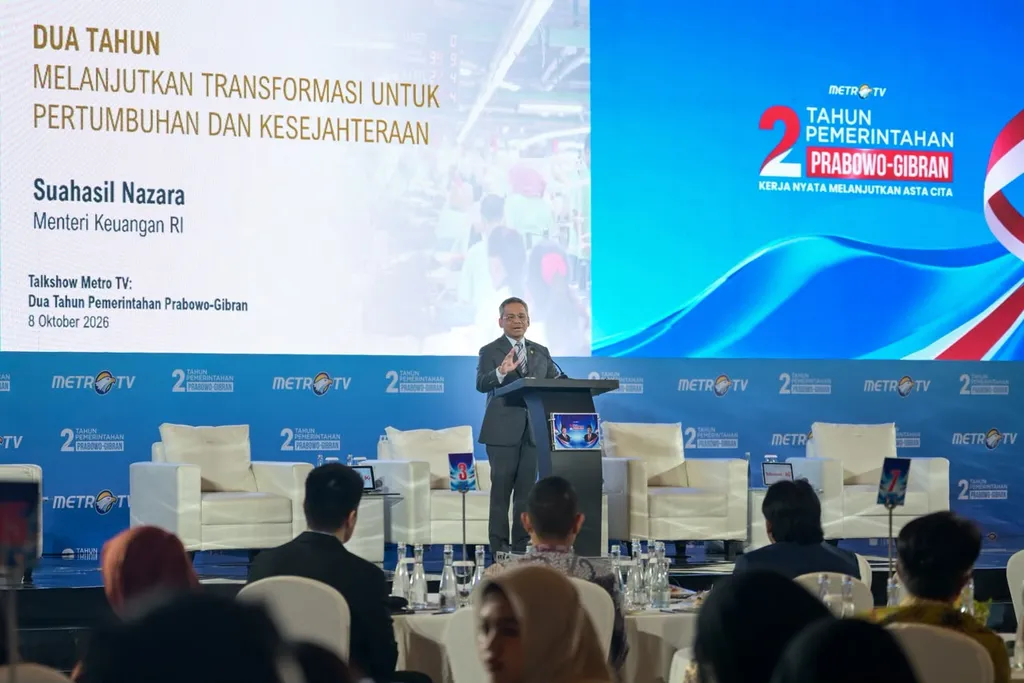
The government is relying on synergy between state finances and the Danantara Investment Management Agency to pursue economic growth of 6 per cent in 2027. The state budget (APBN) will support basic needs and development, while Danantara dividends will be reinvested to stimulate the economy.
Finance Minister Suahasil Nazara said the APBN and Danantara have different roles but need to work together as two state instruments for driving growth.
The APBN will focus chiefly on public services, social protection and basic infrastructure. Danantara, meanwhile, is intended to act as an investment catalyst by consolidating and managing state assets.
“Danantara and fiscal policy, or the APBN, are like the two arms of the state. The APBN arm works, and the Danantara arm works,” Suahasil said at an event entitled “Optimising Fiscal Policy and Danantara to Achieve 6 Per Cent Growth” in Jakarta on Thursday (8 October 2026).
Suahasil said government investment through the APBN would be directed mainly towards basic infrastructure. Investment through Danantara is expected to catalyse businesses to increase investment and production capacity.
“Investment from Danantara is an investment catalyst. It works to ensure and convince business groups and the economy to work together,” he said.
To achieve 6 per cent economic growth in 2027, Suahasil said household consumption would need to grow faster than 5.4 per cent, government consumption faster than 5.6 per cent, and investment by about 7 per cent.
At the same event, Danantara Chief Operating Officer Dony Oskaria said dividends from state-owned enterprises managed by Danantara would not be placed in the state treasury. Instead, they would be reinvested through Danantara Asset Management and Danantara Investment Management.
“The APBN and Danantara dividends are both positioned as drivers of economic growth. Both are engines of growth,” he said.
Danantara is also strengthening its role as an investment catalyst through the consolidation of state-owned companies. Dony said 23 state-owned industrial estate companies were being prepared for merger into a single entity.
The merger is scheduled to be announced on 5 November 2026. The planned new entity, PT Kawasan Industri Indonesia, will manage a total of about 35,000 hectares of land.
Dony said the consolidation would create the largest industrial estate operator in South-east Asia. The estates’ business model would also change, so that land would no longer be the primary source of revenue.
Under Danantara’s proposed model, land would be provided to investors, while the company would earn revenue from facilities and services in the estates. “In future, land will no longer be a source of revenue; instead, we will provide it free of charge. Revenue will come from the facilities we provide,” he said.
From the business community, Indonesian Employers Association (Apindo) chairwoman Shinta Widjaja Kamdani said achieving the growth target also depended on household purchasing power, particularly among the middle class. Apindo survey findings showed that the shrinking middle-class population was affecting purchasing power.
“The middle class has declined very significantly. The data in Apindo’s mid-year outlook survey clearly show an impact on purchasing power,” Shinta said.
She said government incentives for businesses and workers needed to be better targeted and easier to implement. Deregulation and the removal of business barriers were also needed to ensure that production in the real sector was not disrupted.
On fiscal policy, Suahasil stressed that efforts to boost growth must be accompanied by budget discipline. The APBN would be implemented in an expansive but measured manner, while maintaining fiscal credibility.
In the 2027 APBN, the government plans state revenue of Rp 3,426 trillion and expenditure of Rp 4,097.2 trillion. The deficit is set at 2.4 per cent of GDP, below the 3 per cent limit.
“We at the Finance Ministry have to find state revenue of Rp 3,435 trillion. But the APBN will spend Rp 4,100 trillion to stimulate economic activity,” Suahasil said.
Suahasil said fiscal flexibility remained necessary to deal with changing global conditions, including geopolitical tensions and commodity price volatility. Such flexibility, however, must be accompanied by sound governance and remain within the rules.
“Flexible, but with good governance. It must still operate within the existing rules,” he said.
The APBN will also continue to act as a shock absorber when the economy comes under pressure. Energy subsidies and compensation, fertiliser subsidies, social protection and infrastructure development are among the instruments used to cushion the impact of external shocks on the public.
Suahasil said the government was also strengthening state revenue by improving tax systems and collection mechanisms.
“We are strengthening taxation not merely by collecting revenue, but by creating a better system and improving collection procedures and mechanisms,” he said.
Growth of 5.2–5.4 per cent in 2026 would not, by itself, show that Indonesia had entered a new growth trajectory.
In a separate interview, Bank Danamon Indonesia lead economist Irman Faiz said reaching 6 per cent growth would require an increase in the economy’s productive capacity, not merely additional demand-side stimulus and government spending.
He said growth of 5.2–5.4 per cent in 2026 would not automatically mean Indonesia had entered a new growth trajectory. To raise structural growth from around 5 per cent to 6 per cent, the country would need to improve labour productivity, investment quality, manufacturing value added, foreign direct investment, human capital and the efficiency of capital use.
“To move structurally from around 5 per cent growth to 6 per cent, it is not only demand that must increase, but also productive capacity,” Irman said in a written statement.
Danamon forecasts Indonesian economic growth of 5.2 per cent in 2026 and 5.1 per cent in 2027. The latter projection is in line with the Organisation for Economic Co-operation and Development’s forecast for 2027.
Irman said growth in the second half of 2026 could be slower than in the first half, when it reached 5.45 per cent. Growth above 5.5 per cent in the second half remains possible, but would require broad-based strengthening in consumption, investment, government spending and exports.
He said the more important question was not simply whether Indonesia could achieve high growth for one or two quarters, but whether current policies and investment could sustainably increase the economy’s growth capacity.
“The key question is not whether Indonesia can record one or two quarters above 5.5 per cent, but whether current investment and policies can sustainably lift potential growth above the range of 5 per cent,” he said.
Source: jawawa.id (https://jawawa.id/newsitem/state-budget-and-danantara-to-become-two-engines-of-growth-1791456626)
Originally published by kompas.id (https://www.kompas.id/artikel/apbn-dan-danantara-jadi-dua-mesin-pertumbuhan?open_from=Ekonomi_&_Bisnis_Page), translated from Indonesian