
State-Backed Banking Giant BRI Expands Microservices Architecture in Taiwan as Annual Remittance Inflows Target $900 Million
State-Backed Banking Giant BRI Expands Microservices Architecture in Taiwan as Annual Remittance Inflows Target $900 Million
Key Takeaways
TAIPEI, Investortrust.id — PT Bank Rakyat Indonesia (Persero) Tbk (BBRI) is executing an extensive digital transformation across East Asia, deploying an agile microservices-based banking infrastructure to dominate the lucrative remittance and trade corridor connecting Taiwan and Southeast Asia’s largest economy.
The state-controlled banking giant is leveraging its full retail branch license in Taipei to dismantle historical barriers in cross-border payments, capturing an annualized remittance flow projected at up to $900 million (Rp 14.3 trillion) while scaling up syndicated green energy financing and wealth management services.
Cross-border migrant labor remittances constitute a critical, multi-billion-dollar foreign exchange pipeline that underpins Indonesian domestic purchasing power, rural construction, and household consumption.
By utilizing modular digital banking to capture unbanked cash flows and eliminate informal intermediaries, BRI is securing high-margin transactional fee income and low-cost deposits while demonstrating how a traditional microfinance bank can penetrate competitive international capital markets.
Overcoming Decades of Informal Remittance Risks
For decades, sending earnings back home presented severe operational risks for Indonesian migrant workers (PMI) living in Taiwan.
Workers routinely relied on informal money couriers or entrusted cash to acquaintances, frequently falling victim to fraud, theft, or systemic payment failures where months of hard labor vanished in transit.
Established in 1895 in Purwokerto, Central Java, and approaching its 131st anniversary on Dec. 16, 2026, BRI has sought to eliminate these vulnerabilities by expanding its institutional presence internationally wherever Indonesian citizens work and reside.
BRI currently maintains an overseas operating network across six strategic jurisdictions, including New York, Hong Kong, Singapore, the Cayman Islands, East Timor via Dili, and Taiwan through its Taipei branch.
The Sole State Lender in a $3 Billion Inflow Corridor
Since securing its commercial branch license in 2021, BRI has maintained a distinct competitive position in Taiwan’s financial landscape.
“At present, BRI is the only member bank of the Association of State-Owned Banks (Himbara) operating in Taiwan,” BRI President Director and Group CEO Hery Gunardi said during an executive discussion with chief editors in Taipei on Saturday, Aug. 22, 2026.
According to operational data presented by the bank, BRI Taipei Branch has captured a 27.9% market share in its primary addressable business segment, registering a 33% growth rate over the preceding operating period.
The volume of bilateral remittances facilitated by the branch reached approximately $447 million (Rp 7.1 trillion) through the first half of 2026.
If transaction velocity maintains its current pace, total remittance volume managed by BRI Taipei throughout 2026 is projected to reach between $850 million and $900 million (Rp 13.6 trillion to Rp 14.4 trillion).
This bilateral commercial pipeline is supported by strong macroeconomic fundamentals, with Bank Indonesia data showing that total worker remittances from Taiwan reached $2.97 billion (approximately Rp 47.5 trillion) in 2025.
The expansion has sustained strong momentum in 2026, with first-quarter remittances from Taiwan rising 15% year-on-year to $801 million, up from $697 million in the opening quarter of 2025.
Inflows have been reinforced by Taiwan’s statutory monthly minimum wage increase of 3.18%, which took effect on Jan. 1, 2026, lifting basic wages from NT$28,590 to NT$29,500 ($920), alongside a growing registered Indonesian community numbering between 300,000 and 364,000 residents.
Demolishing Physical Distance Along the 370-Kilometer Corridor
The primary target market for BRI Taiwan remains the domestic workforce of roughly 400,000 Indonesian migrant workers, an expatriate community that has expanded steadily from 300,000 when the branch first opened in 2021.
Indonesian workers are broadly distributed along the western economic spine of Taiwan, concentrating in three main metropolitan zones: the administrative and financial capital of Taipei in the north, the manufacturing center of Taichung in the central region, and the industrial port of Kaohsiung in the south.
The overland distance from Taipei to Kaohsiung via Taichung spans roughly 370 kilometers (230 miles), posing severe logistical hurdles for workers who historically had to visit a physical branch in Taipei to open accounts or conduct wire transfers.
“Imagine an Indonesian worker living down in Kaohsiung having to travel all the way to Taipei just to open a bank account,” General Manager and Head of BRI Taiwan Branch Andik Kurniawan said during the media briefing on Saturday.
While Taiwan boasts advanced public transport infrastructure, including high-speed rail, the time commitment and financial expense of cross-island transit remained prohibitive for routine retail banking tasks.
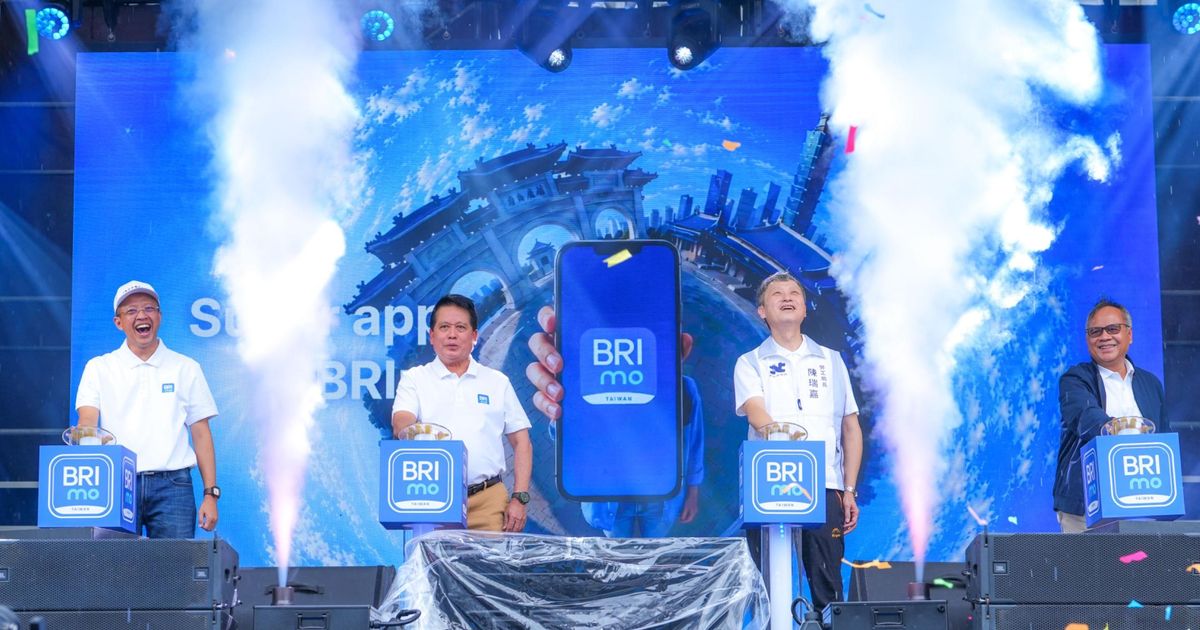
To eliminate this friction, BRI transitioned its overseas operations onto the BRImo Taiwan mobile platform, allowing customers across the entire island to onboard digitally, maintain savings balances, and execute instant cross-border remittances directly from their smartphones.
Architectural Pivot: From Monolithic Core to Agile Microservices
The rapid deployment of international features reflects a comprehensive overhaul of the lender’s core software engineering practices under Gunardi’s leadership since March 2025.
Earlier generations of the BRImo application were built upon monolithic software architectures, where tightly coupled functions meant that any new feature release required exhaustive testing across the entire system.
To accelerate its global expansion across differing regulatory jurisdictions, BRI transitioned the platform into a deco