
Startups Remain Engines of Digital Economic Growth Amid Governance Challenges
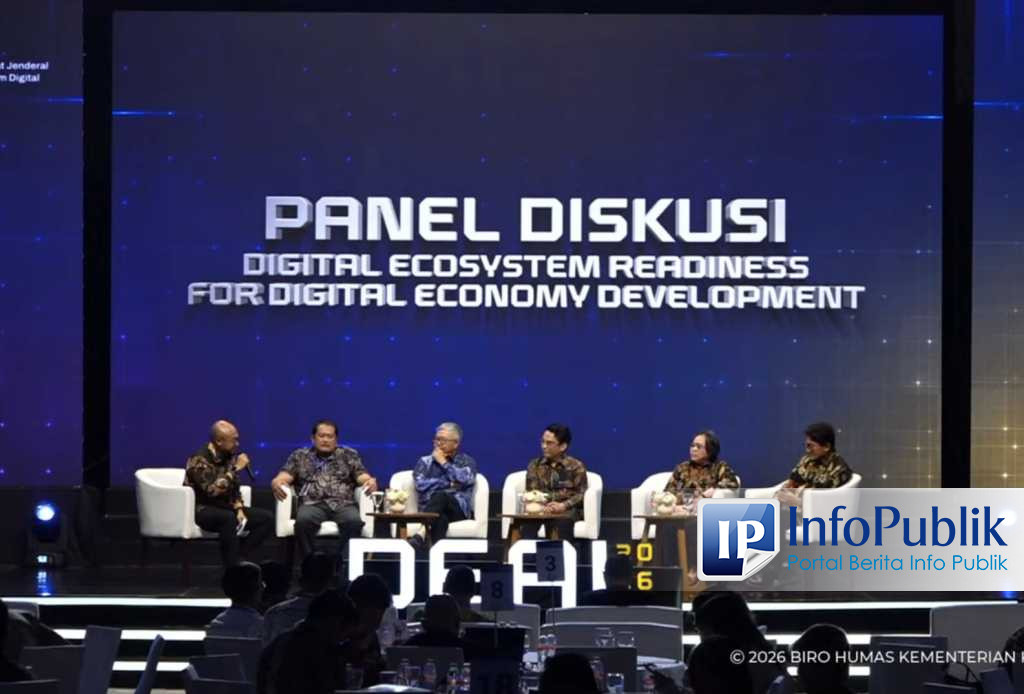
Jakarta, InfoPublik — The Ministry of Communication and Digital Affairs (Kemkomdigi) has affirmed that developing digital startups remains a crucial strategy for driving national economic growth, creating employment, and capitalising on Indonesia’s demographic dividend.
Director of Digital Ecosystem Development at Kemkomdigi, Sonny Hendra Sudaryana, stated that the information and communication technology (ICT) sector has shown a steadily increasing contribution to the national economy over the past decade.
“Ten years ago, the ICT sector contributed around 3.5 per cent to the gross domestic product (GDP). By 2025, its contribution had risen to approximately 5.4 per cent. This forms the foundation of all current discussions regarding the digital economy,” Sonny said during the Digital Ecosystem Alignment (DEAL) 2026 discussion session in Jakarta on Tuesday (23/6/2026).
According to him, the growth of Indonesia’s digital economy holds a value far greater than the direct contribution of the ICT sector. Various studies indicate that the value of Indonesia’s digital economy has reached around USD 100 billion and continues to show a positive growth trend.
However, Sonny noted that Indonesia still faces a major challenge because a large portion of the digital economy’s value is not yet fully retained domestically. He revealed that around 73 to 80 per cent of the digital economy’s value still flows out of Indonesia, particularly in the digital services sector and global platforms that dominate public consumption.
“We still face the challenge of how to create greater added value domestically so that the benefits of the digital economy can be felt more widely by the Indonesian people,” he said.
In addition, Sonny highlighted the high consumption of digital content that has not yet provided optimal economic benefits. One of the ongoing challenges is the widespread distribution of illegal content, which reduces the potential revenue of the creative industry and the national digital economy.
In the context of startup development, Sonny sees Indonesia as having significant assets in the form of a demographic dividend and a dominance of tech-savvy young generations. According to him, more than half of Indonesia’s population is in the productive age group with a high level of digital technology adoption. This condition serves as a major source of energy for the growth of technology-based startups.
Indonesia also once attracted the attention of global investors when it successfully produced several unicorn-status startups during the first wave of national startup development. Despite this, Sonny cautioned that a startup’s success cannot be measured solely by its growth speed and the amount of funding it obtains.
He noted that many startups face challenges in corporate governance and accountability, especially when they receive large investments at a very young company age. “Often, founders who are still very young must manage substantial amounts of investment with high growth demands. This is where governance and accountability challenges become very important,” he said.
Therefore, Kemkomdigi is encouraging a balance between innovation, business growth, and strengthening corporate governance so that startups can develop sustainably. Sonny stressed that improving the quality of human resources among startup founders is a shared agenda that must be pursued.
According to him, developing the startup ecosystem cannot be the sole responsibility of the government but requires close collaboration between universities, the business community, innovation communities, and the government. “We need collaboration from three sectors—academia, business, and government—to prepare founders to have better quality, capacity, and leadership,” he said.
On the other hand, Sonny also highlighted a shift in national investment patterns that are increasingly directed towards capital-intensive sectors. This trend has impacted the ability of investment to create jobs. Based on data he presented, an investment of Rp1 trillion in 2013 was able to create around 4,500 jobs. However, last year, the same investment value only generated approximately 1,400 jobs.
This means the ability of investment to absorb labour has declined by up to 76 per cent over more than a decade. This phenomenon indicates a structural shift in the economy from labour-intensive sectors to capital-intensive ones, heavily influenced by technological development and digitalisation.
Nevertheless, Sonny believes the digital sector possesses unique characteristics that can create a much broader economic impact compared to the number of direct jobs it absorbs. For example, a modern data centre can operate with a relatively small workforce. On the other hand, platform-based digital companies can create a massive ripple effect on job creation and business development for the public.
He cited national technology companies such as Gojek, which have opened economic opportunities for millions of driver partners while helping millions of micro and small enterprises enter the digital ecosystem. “Startups have the power to create jobs and empower MSMEs on a very large scale. That is why we continue to see startups as one of Indonesia’s engines of growth,” he asserted.
According to Sonny, the role of startups will become increasingly important in facing employment pressures that arise as the population grows.