
Starting in Grobogan, Deputy Agriculture Minister Alim Accelerates National Soybean Development
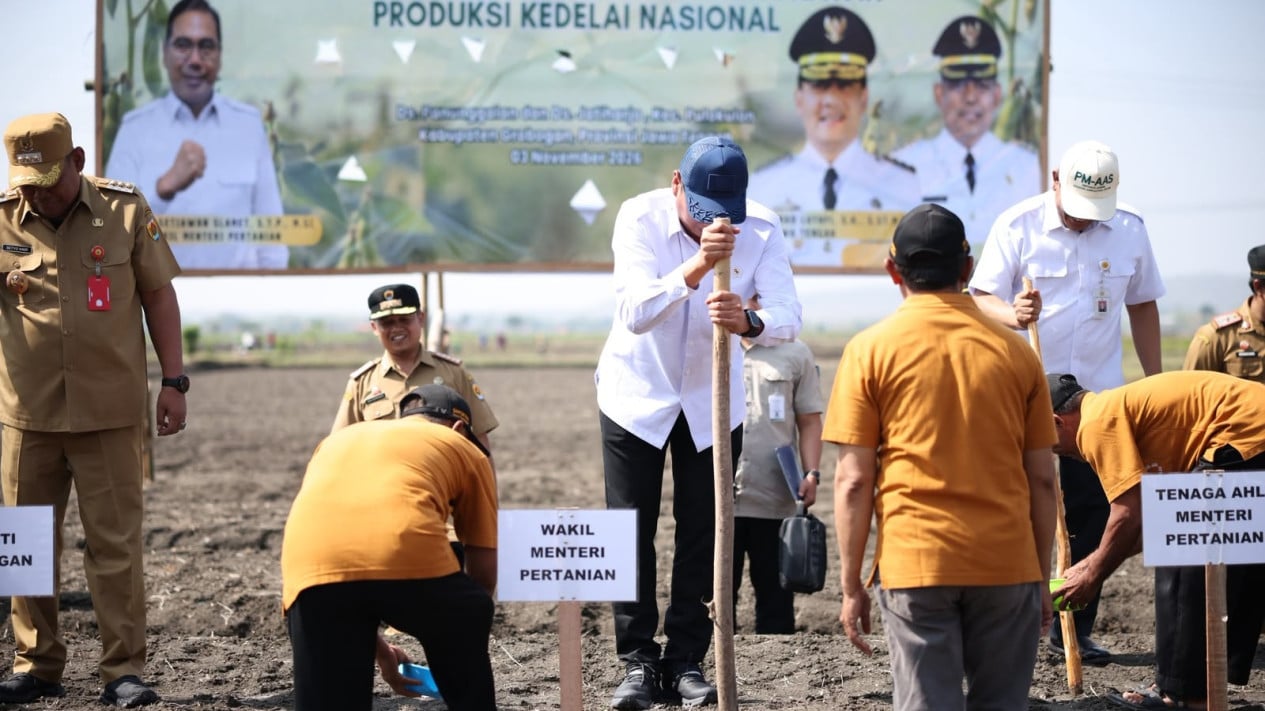
Jakarta – The Agriculture Ministry is accelerating efforts to increase national soybean production in collaboration with Gadjah Mada University (UGM) in Grobogan Regency, Central Java.
The collaboration is intended to improve productivity, optimise planting patterns and strengthen national soybean production as part of efforts to reduce dependence on imports.
Deputy Agriculture Minister Alim Setiawan Slamet said soybean development required cooperation between the government, universities, local administrations and business partners. The partnership is expected to strengthen production from upstream to downstream through the adoption of technology and support for farmers.
“Most Indonesians, of course, consume tempeh and tofu. Soybeans are one of our main sources of protein. That is why we are working to carry out the instructions of the President and the Agriculture Minister to reduce dependence on imports by increasing soybean production nationally,” Deputy Minister Alim said in Jatiharjo village, Pulokulon district, Grobogan Regency, on Tuesday (3 November).
He said Grobogan had been chosen as the starting point because of its long history as one of the country’s soybean-producing centres. Productivity there is also relatively higher than the national average, giving the area potential to serve as a model for increasing production.
Deputy Minister Alim said the government was targeting soybean development through an assistance programme covering 50,000 hectares this year. Assuming yields of three tonnes per hectare, the programme could produce around 150,000 tonnes of soybeans.
“If we can achieve productivity of three tonnes per hectare, even 50,000 hectares could potentially yield 150,000 tonnes. This is what we want to drive through faster planting, the application of technology and support for farmers,” he said.
National soybean yields currently stand at around 1.6–1.8 tonnes per hectare. Raising productivity is therefore a key priority, alongside making better use of land through more effective planting patterns.
Deputy Minister Alim stressed that increasing soybean production did not require opening new farmland, particularly if that could reduce the area planted with rice. Optimising planting patterns is one possible approach, including intercropping or crop rotation with other commodities such as maize.
Source: jawawa.id (https://jawawa.id/newsitem/starting-in-grobogan-deputy-agriculture-minister-alim-accelerates-national-soybean-development-1793854289)
Originally published by VIVA.co.id (https://www.viva.co.id/bisnis/1941205-dimulai-dari-grobogan-wamentan-alim-kebut-pengembangan-kedelai-nasional), translated from Indonesian