
Star Gaia20ehk Reveals Traces of Giant Planetary Collision
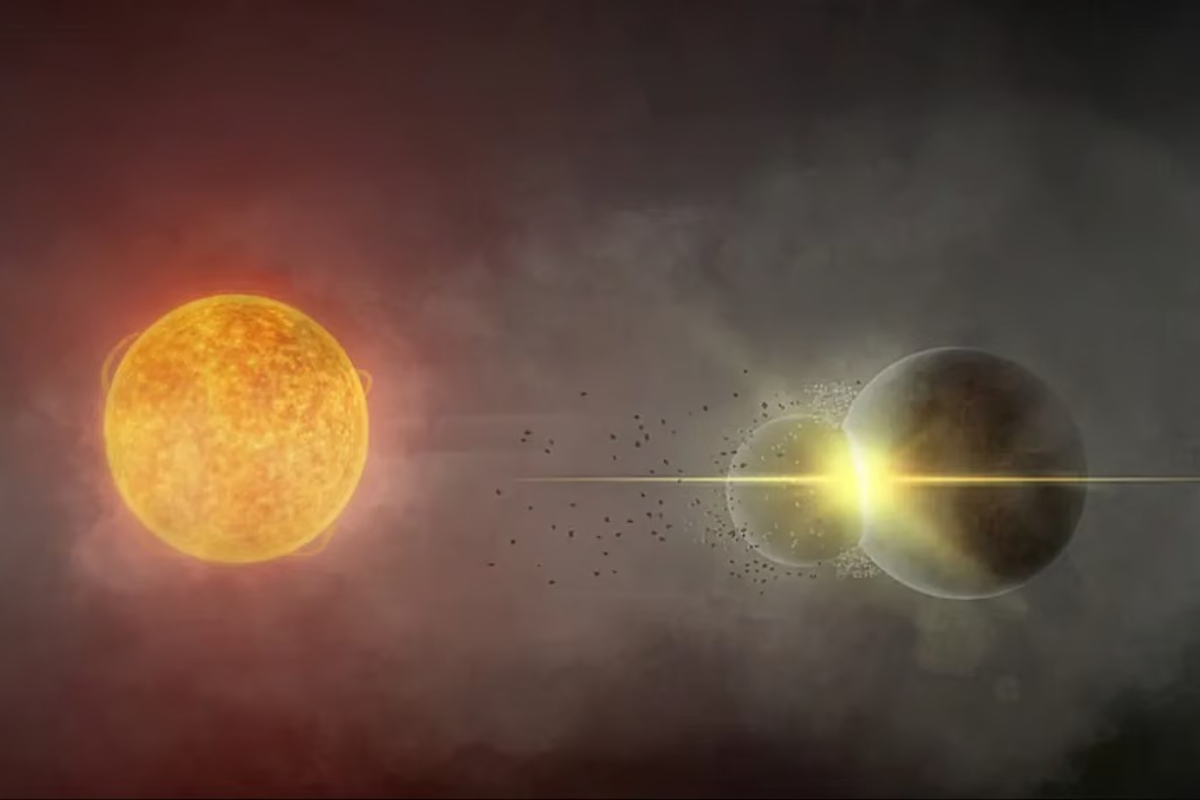
Astronomers have discovered rare signs of a colossal collision believed to have involved two young planets in a star system located 11,000 light-years from Earth. Anastasios Tzanidakis, from the University of Washington, was examining archival telescope observations from 2020 when he noticed that the light from the star Gaia20ehk, near the Puppis constellation, had changed dramatically. For years, its brightness level had been stable. However, beginning around 2016, the star exhibited three dimming events, and by 2021 its behaviour became far more erratic. “Stars like our Sun don’t do that,” Tzanidakis said in a university statement. The researchers suggest that a large amount of dust and rocky debris is passing in front of the star as it orbits the system. This debris was produced by a recent collision between planetesimals, the primordial bodies that can grow into full-sized planets. The unique light pattern of Gaia20ehk provided strong evidence: in visual wavelengths, the star grew dimmer and more irregular, but it brightened in infrared observations because the dust is warm. This consistent, contradictory behaviour over more than four years indicates the presence of newly formed circumstellar dust. Scientists estimate the dust temperature to be around 627 degrees Celsius, with a conservative mass estimate of 400 quintillion kilogrammes. The dust cloud orbits at a distance of 1.1 astronomical units, making this event highly relevant for studying rocky planet formation. The team believes the messy collision resembles the giant impact that formed Earth’s Moon 4.5 billion years ago. Planet formation is expected to be inherently chaotic; in young solar systems, growing planetary bodies can collide, merge, shatter, or be flung into different orbits. While such impacts are thought to play a major role in building rocky planets, observing them directly is difficult and time-consuming, requiring precise geometry for the debris to pass between the star and Earth. Although alternative theories like comet destruction or tidal disruption were considered, the researchers concluded that a planetesimal collision remnant scenario best fits the scientific evidence. Follow-up monitoring with the James Webb Space Telescope is expected to help measure the temperature and composition of the warm dust more precisely, strengthening the impact interpretation. The study by Tzanidakis and James R. A. Davenport was published on 11 March 2026 in The Astrophysical Journal Letters.