
Stalemate in Iran War: Six Major Threats Now Haunting Trump
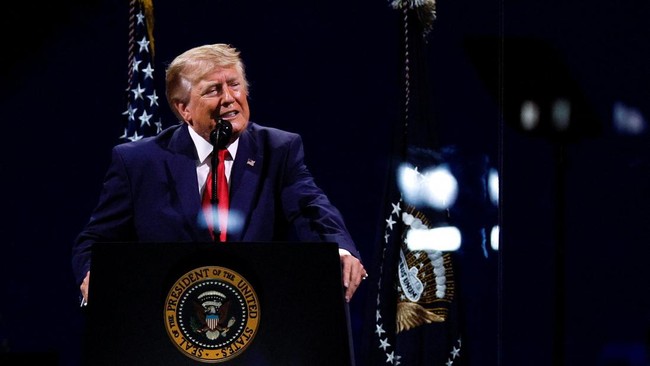
The war between the United States and Iran is potentially reaching a new turning point after a three-month ceasefire collapsed. The renewed fighting this month shows no signs of a strategic advantage for either side. “US military operations are currently in a holding pattern after two consecutive weeks of night-time strikes,” a Pentagon source told CNN on Sunday (26/7/2026) local time. Amid this conflict stalemate, a wave of doubt is emerging from within America’s own support base. Here is an analysis of six crucial questions regarding the future of the Iran war, citing CNN’s analysis:
Even Republican figures who initially supported the fighting are now openly questioning the war’s duration. Fox News host Laura Ingraham and House Speaker Mike Johnson have stressed the importance of resolving the conflict before the upcoming November midterm elections. “Time is running out for President Trump to exit this war before voters head to the polls. Republicans cannot allow this to become an endless distraction,” Ingraham said. Senator Bill Cassidy of Louisiana also noted that Trump had an opportunity to achieve his initial objectives and end the war, but that resolution has yet to materialise. The main problem is that there are no easy options for Trump to end the conflict. Iran has rejected peace proposals, while new US military threats have failed to shake Tehran’s position. Trump has publicly dismissed this domestic political pressure, insisting that the dynamics of the midterm elections will not influence his strategic decisions.
President Trump is openly anxious that the first US military casualties since March—four soldiers killed since the renewed strikes began—could erode public support. The total number of US troops killed now stands at 18. “The families of the fallen and the soldiers who died fundamentally support this war effort,” Trump claimed without providing supporting evidence. A Reuters/Ipsos poll indicates that 42% of Republican voters and 53% of independent voters say US military casualties make them more opposed to the war. The Pentagon is also quietly coding data on an additional 140 wounded soldiers, bringing the total number of wounded to over 600. The impact of these death tolls is significant, given that the US public had already begun opposing the war months ago before any casualties occurred. The surge in fuel prices has become a strong reason for citizens to reject the war. With the public increasingly failing to understand the war’s purpose, the rising number of fallen soldiers could further complicate Trump’s political position at home.
Trump has so far refrained from large-scale military escalation, but the current deadlock could push him to choose that option over a humiliating withdrawal. One choice is to strike critical Iranian infrastructure, despite the risk of it being classified as a war crime. Another option is to seize strategic territory such as Kharg Island or areas around the Strait of Hormuz, the centre of Iran’s oil supply. However, this step would require deploying ground troops, a move opposed by 68% of Americans according to a CNN poll. “I am currently considering a massive strike, bigger than anything before,” Trump said in an interview with Axios. The temporary halt in strikes last weekend was reportedly to allow room for diplomacy. However, Vice President JD Vance and Chairman of the Joint Chiefs of Staff General Dan Caine are said to be concerned about military escalation and the dwindling stockpile of US ammunition.
One of the most worrying developments is the action of Houthi militias in Yemen, who announced a blockade of the Bab al-Mandeb Strait and began attacking Saudi Arabian ships in the Red Sea. This route is the main shortcut to the Strait of Hormuz, and the disruption is worsening the global oil market. World crude oil prices have soared past US$100 per barrel for the first time since last May. Meanwhile, the average petrol price in the United States has surged beyond US$4 per gallon. “The spike in petrol prices above $4 per gallon will make it difficult for Trump to defend the war argument before the public and his allies,” the CNN analysis stated.
Trump previously promised ambitious goals, demanding Iran’s “unconditional surrender” and the permanent prevention of nuclear weapons possession. However, these targets have been drastically lowered, judging by the points of the now-collapsed memorandum of understanding (MoU). The question now is whether Trump is willing to accept a lower compromise to pull the US out of the war. He might accept the reopening of the Strait of Hormuz without a complete nuclear deal. “Iran has essentially been denuclearised, and its activities are sufficiently monitored from space,” Trump argued recently. He also hinted that the closure of the Strait of Hormuz is not the main issue.