
Stability Edition 225: Redesigning the Financial Industry
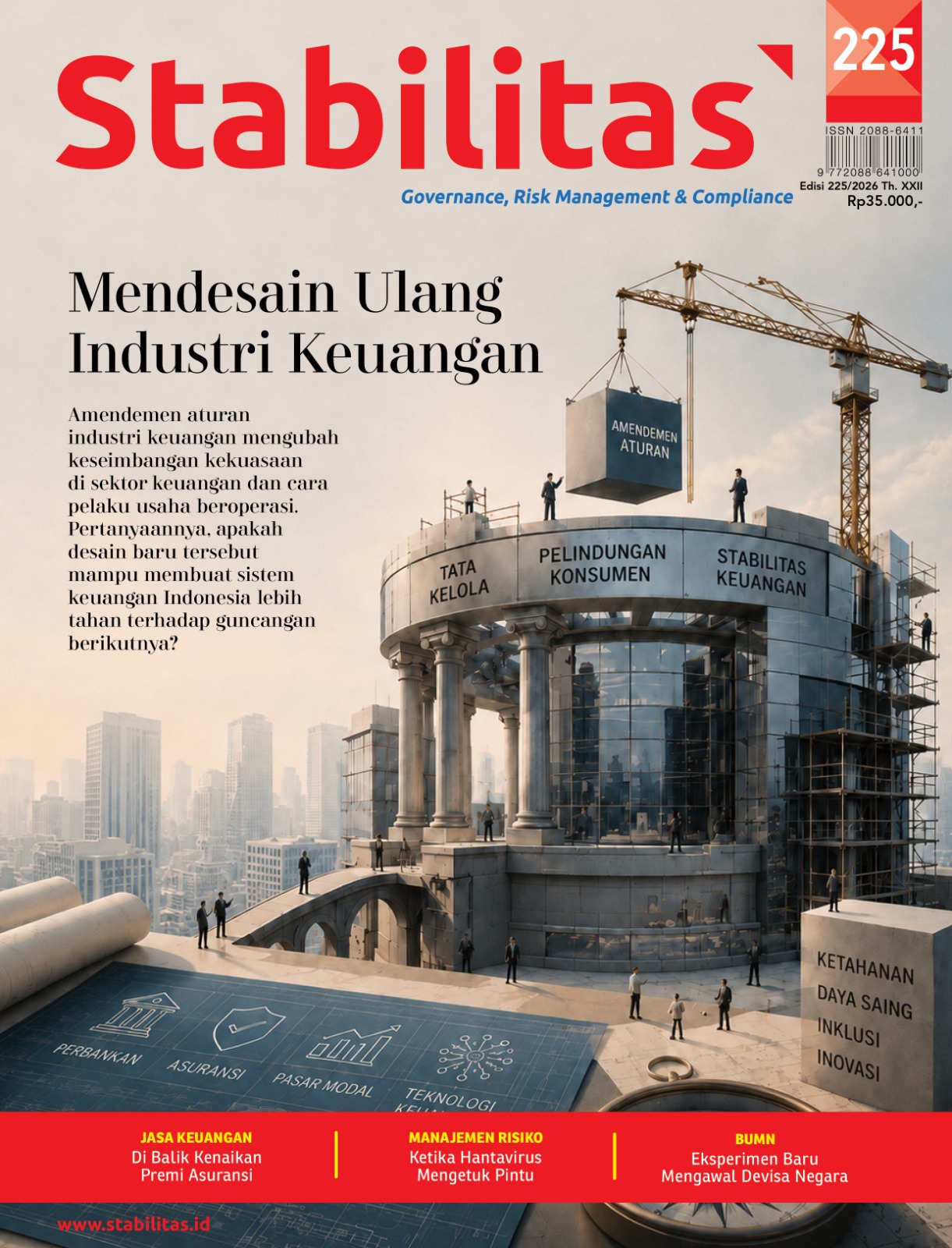
Three years after being enacted as the foundation for national financial sector reform, Law Number 4 of 2023 on the Development and Strengthening of the Financial Sector (UU P2SK) is entering a new phase. The Government, alongside the House of Representatives (DPR), has issued several changes and developments realised through amendments officially published on 4 June 20lar, marking another significant shift following the 2023 legislation.
Just as the OJK Law previously transformed the face of financial sector supervision by separating supervisory functions from Bank Indonesia, the amendments to the UU P2SK have the potential to alter the balance of power among Indonesia’s financial regulators. These changes concern not only the division of authority between Bank Indonesia, the OJK, the Deposit Insurance Corporation (LPS), the Ministry of Finance, and newly formed institutions, but also how the state supervises financial innovation, digital assets, financial conglomerates, and consumer protection.
For the banking industry, these changes are more than mere regulatory adjustments. They will determine how banks obtain business licences, develop products, manage risks, build financial conglomerates, and navigate resolution mechanisms during crises.
One of the most notable agendas is the emergence of the concept of a New Indonesian Financial Centre. This concept does not merely refer to the development of a business district or a financial transaction hub, but rather an ecosystem designed to be a new node for banking activities, capital markets, investment management, fintech companies, digital assets, and carbon trading.
If realised, this new financial centre has the potential to reshape the competitive landscape of the national financial services industry. Banks will no longer compete solely on gathering funds and distributing credit, but will also race to build integrated financial service ecosystems connecting banking, investment, digital payments, wealth management, and digital assets within a single platform.
In this main report, we aim to present this theme. The first section provides a broad overview of these regulations, emphasising that the UU P2SK amendments are not merely regulatory revisions, but a redesign of the architecture of Indonesia’s financial system.
The following section discusses in detail the new division of authority among regulators following the UU P2SK amendments. This includes changes related to the duties and mandates of the OJK, the role of Bank Indonesia, the evolution of the LPS function, and the relationship between regulators within the Financial System Stability Committee (KSSK). The unique idea of the President to include Danantara within the KSSK will also be discussed.
Furthermore, the report examines how Indonesia is building a new financial hub and who stands to benefit most. It emphasises the concept of the New Financial Centre, the required infrastructure, and the opportunities available to national banks. Additionally, it compares the competitiveness of this financial centre against Singapore, Kuala Lumpur, and Hong Kong, alongside a discussion on the future of the wealth management industry.
Other sections will address the impact of the law on the banking sector and how banks must adapt their business strategies. Discussions will revolve around digital banking services, embedded finance, and the utilisation of AI in banking products, services, and systems. The report also asks whether this law could drive consolidation and transform the landscape of digital banks.
In addition to the main reports, we also present articles from our regular sections focusing on risk management, governance, and compliance.