
Spotlight on the Dismissal of Finance Minister Purbaya Yudhi Sadewa
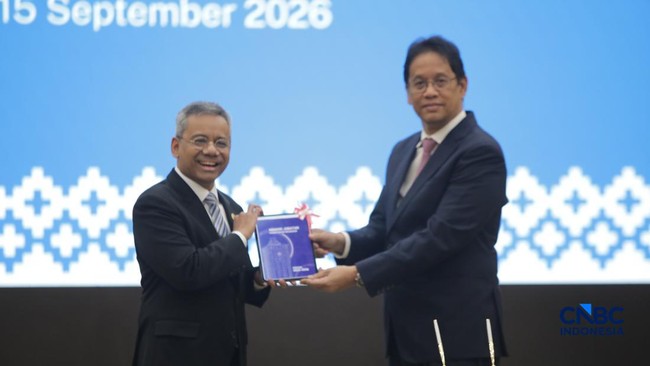
Note: This article reflects the personal opinion of the author and does not represent the views of the CNBCIndonesia.com editorial team.
On Monday, 14 September 2026, Finance Minister Purbaya Yudhi Sadewa was still carrying out his state duties as usual. He attended a working meeting with Committee IV of the Regional Representative Council (DPD RI) to discuss the 2027 State Budget Bill and the Financial Memorandum, including the implementation of the 2025-2045 National Long-Term Development Plan and its alignment with the 2025-2029 National Medium-Term Development Plan. There was no visible sign that, mere hours later, his tenure as Finance Minister would end.
That moment soon spread widely on social media. In a number of circulating videos, Purbaya appears to receive a phone call whilst attending the meeting at the DPD. The meeting was briefly halted, and Purbaya then left the room.
The contents of that phone call remain unknown to the public. Shortly afterwards, news of the reshuffle was announced: President Prabowo Subianto dismissed Purbaya and appointed Deputy Finance Minister Suahasil Nazara as his replacement.
Replacing a minister is, of course, the president’s prerogative. However, Purbaya’s dismissal leaves behind a more serious problem than a mere change of officials. When a Finance Minister is still seated in an official state meeting and is then dismissed on the same day without warning, the public has the right to see how that authority was exercised.
The issue is not simply whether the president has the power to dismiss a minister, but whether that prerogative was exercised with propriety and with governance standards that can be accounted for.
Prerogative Is Not a Blank Cheque
Constitutionally, the president’s position is indeed strong. Article 4 paragraph (1) of the 1945 Constitution of the Republic of Indonesia affirms that the President holds the power of government in accordance with the Constitution. More specifically, Article 17 paragraph (2) states that state ministers are appointed and dismissed by the President. This means that both the appointment and dismissal of ministers fall within the President’s authority and do not require the approval of the House of Representatives (DPR).
However, that authority does not exist in a vacuum. Law Number 39 of 2008 on State Ministries, as amended by Law Number 61 of 2024, positions ministers as assistants to the president in administering government based on good and democratic governance.
Indeed, Article 24 paragraph (2) of the State Ministries Law regulates the grounds for dismissing a minister, including “other reasons determined by the President”. This norm certainly provides broad discretion, but it should not be read as a blank cheque for the President to exercise his authority without considering propriety, rationality, and the interests of good government.
This is precisely why Purbaya’s dismissal deserves scrutiny. What is being questioned is not the president’s authority to replace the Finance Minister, but the manner in which that authority was used. In a state governed by the rule of law, public authority is not merely about who holds power, but also about how that power is exercised.
A dismissal carried out so abruptly, whilst the minister concerned was still performing his official duties, deserves to be examined from the perspective of propriety and governance. The President may replace ministers, but the exercise of that authority must remain accountable as an act of government.
Learning from Other Countries
Australia, Canada, and New Zealand can serve as mirrors. In Australia, ministerial changes take place within the tradition of responsible government, which emphasises ministers’ accountability. Canada recognises the principle of ministerial responsibility, both individually and collectively, to Parliament.
In New Zealand, ministerial dismissals are likewise placed within a framework of constitutional convention and governmental accountability. All three have constitutional systems different from Indonesia’s, but they demonstrate one important point: ministerial changes are never merely a matter of formal authority.
This comparison is not meant to suggest that Indonesia should imitate other countries. Indonesia’s Constitution has its own construction. Nevertheless, these practices show that propriety is an inseparable part of how governmental power is exercised.
Ministers may be replaced whenever the president deems it necessary, but the process still has a public dimension. There is continuity of government to be maintained, the responsibilities of office to be respected, and public trust that must not be ignored.
In Purbaya’s case, these dimensions become all the more significant. He was still attending an official meeting with the DPD RI when news of his dismissal was announced. Videos of him receiving a phone call and leaving the meeting room have circulated widely. The contents of that call are not known and therefore should not be the basis for speculation.
However, the abrupt manner of the change warrants evaluation. The authority to replace state officials is indeed important, but the way it is exercised also reflects how a government respects propriety.
Regulating Propriety
The problem is that Indonesian law has yet to provide sufficiently clear standards on how the president’s authority to dismiss ministers should be used. Article 24 paragraph (2) of the State Ministries Law does grant the President the authority to dismiss ministers, including for “other reasons determined by the President”.
This formulation provides broad discretion. Yet broad discretion should not mean the absence of standards. Consideration should be given to regulation that distinguishes dismissals on ordinary political or administrative grounds from situations demanding immediate action.
Going forward, legislation on the presidency or state ministries could set out the principle that a minister’s dismissal is carried out after weighing the reasons, the continuity of government, and the public interest. Such a provision need not oblige the president always to seek approval from another institution.
In urgent circumstances, the president could still dismiss a minister immediately, for instance when a minister is caught in the act of committing corruption, narcotics offences, or other conduct that demonstrably disrupts the functioning of government.
However, such urgent circumstances should be explained and accounted for after the decision is taken. Such a model preserves the President’s room for manoeuvre whilst preventing the prerogative from being used carelessly.
Purbaya’s dismissal need not be judged unlawful simply because it happened abruptly. There is no sufficient basis to draw such a conclusion. Yet precisely because the president wields such broad authority, standards of propriety in its use become all the more important.
The President has the right to replace ministers, but the public also has the right to know that such a change arises from accountable governmental deliberation, not merely a sudden decision. The prerogative may belong to the president, but propriety is, in truth, an obligation of power.
Source: jawawa.id (https://jawawa.id/newsitem/spotlight-on-the-dismissal-of-finance-minister-purbaya-yudhi-sadewa-1789469572)
Originally published by CNBC Indonesia (https://www.cnbcindonesia.com/opini/20260915160641-14-768130/menyoroti-pergantian-menteri-keuangan-purbaya-yudhi-sadewa), translated from Indonesian