
SPMB in Mimika Regency Runs Successfully, Academic Test Scores Help Students Enter Dream Schools
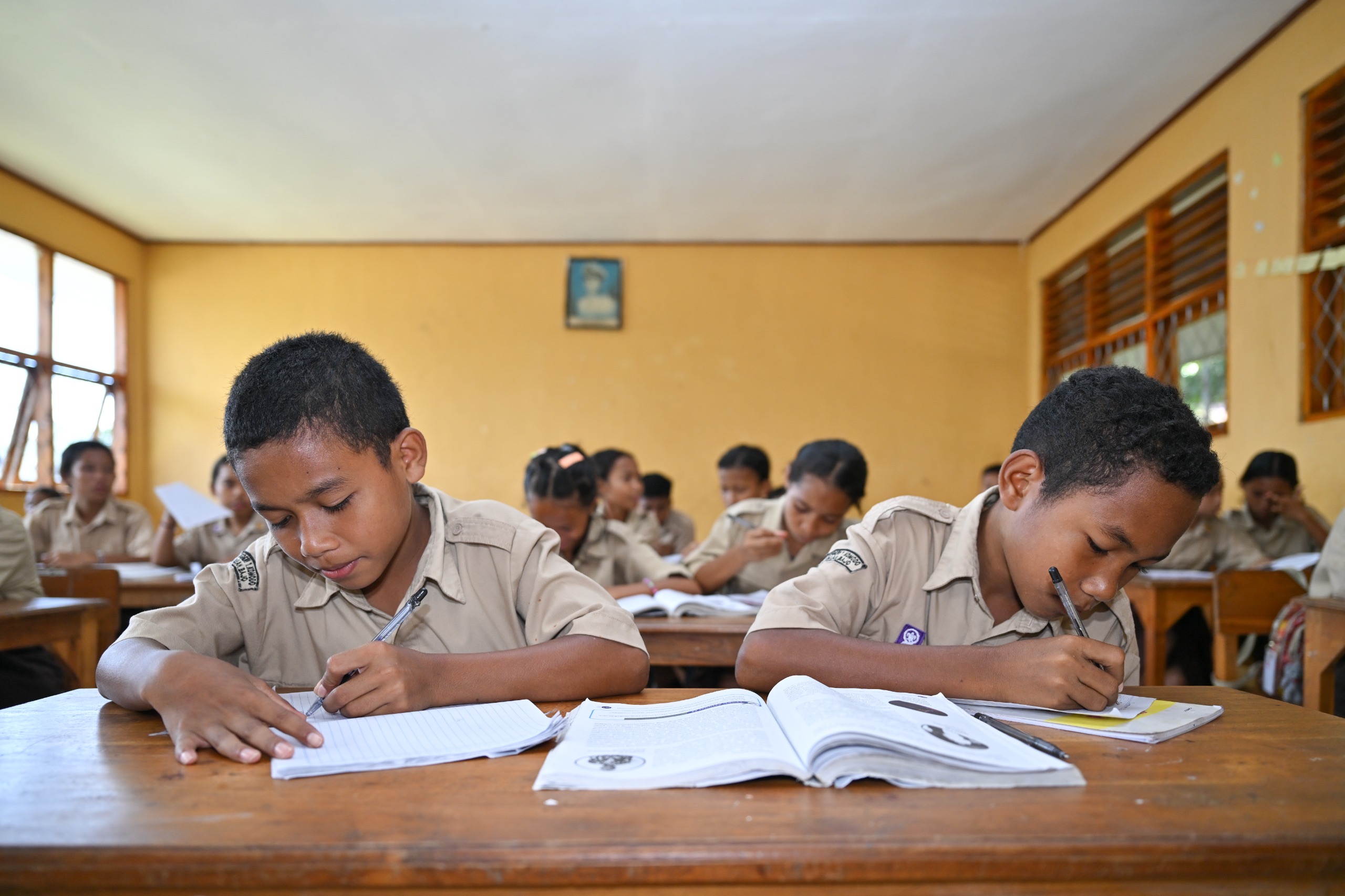
The implementation of the New Student Admission System (SPMB) in Mimika Regency, Central Papua Province, has proceeded successfully, safely, and in accordance with regulations. Based on monitoring by the Papua Province Education Quality Assurance Agency (BPMP), the SPMB in Mimika Regency produced interesting stories, one of which was that the Academic Competency Test (TKA) scores enabled many students to enter their dream schools.
This success story was shared by the Chair of the SMP Negeri 2 Mimika Committee, Pesta P. Pandiangan. According to her, every prospective student’s file was immediately verified by the committee. If requirements were found to be inconsistent with the technical guidelines, the file was returned to the applicant for immediate correction.
‘For the zoning pathway, the verification process ran relatively smoothly and the community accepted the applicable provisions. Meanwhile, for the affirmation, achievement, and mutation pathways, the process was carried out more carefully by involving the education office so that all decisions were truly in accordance with the rules,’ Pesta explained.
She also recounted an interesting experience during the SPMB process. A prospective student registered through the achievement pathway by bringing several competition certificates. After verification, the committee found that the certificates only showed participation status, not as a competition winner, and therefore did not meet the requirements for the achievement pathway.
However, after checking the Academic Competency Test (TKA) scores, the prospective student was found to have an average TKA score above 80. Based on the applicable provisions, this academic score became the basis for the student’s acceptance through the achievement pathway. ‘The student’s parents did not even expect that their child’s TKA score would be the main factor that got them accepted into their dream school,’ Pesta explained.
A similar experience was felt directly by one of the prospective students’ parents, Julius P. Saragih. For the 2026/2027 academic year, he registered his child through the achievement pathway based on TKA scores. ‘The TKA score really helped our child. The achievement pathway is not only determined by competition achievements, but also academic ability. If we had used the domicile pathway, our child would most likely not have been accepted because we are outside the designated area,’ said Julius.
At the senior high school level, a story of good practice in the SPMB implementation was also shared by the Principal of SMA Negeri 1 Mimika, Nona Yeniy Gogani. She said that during the SPMB process, no significant problems were found. All issues were resolved through good coordination between the school, the community, and the education office.
According to her, open communication was the main key to the successful implementation of the SPMB. Furthermore, the role of the education office was also very important in ensuring that all schools remained within the established regulatory corridor.
‘Starting from the education office as the supervisor to the schools as the implementers, we always built good coordination. All parties carried out their duties according to the technical guidelines and provided humanistic explanations to the community, so that when prospective students were not accepted, parents could understand the reasons given by the school,’ said Nona.
In line with this SPMB success, the Head of the Senior High School Division at the Mimika Regency Education Office, Nius Wenda, explained that the Mimika Regency Government had taken various strategic steps before the SPMB implementation began. One month before the SPMB, the education office together with all schools mapped out densely populated areas to determine the targets for socialisation.
He explained that this effort also involved local media, school social media, and various communication channels so that the community understood the SPMB mechanism from the outset. This step, according to him, successfully minimised the potential for misunderstandings between the community and schools.
‘I always emphasise to all schools to adhere strictly to the technical guidelines. Do not try to play around behind the admission process. Integrity, fairness, objectivity, and non-discriminatory service must be the main principles in every stage of the SPMB,’ Nius stressed.