
Speed of Argo Bromo Anggrek Train During Bekasi Timur Collision Revealed
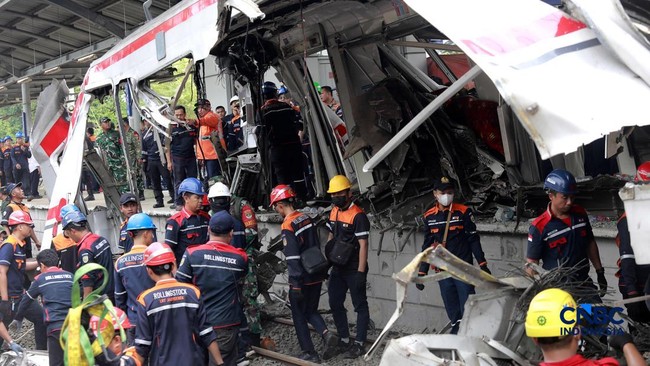
The National Transportation Safety Committee (KNKT) has finally revealed the final speed of the Argo Bromo Anggrek train (KA 4B) at the time it collided with the KRL TM60/00 (KA 5568A) at Bekasi Timur Station on 27 April 2026. According to the KNKT report, the last recorded speed was 53 km/h at 20:52:09, just three seconds before the collision occurred at 20:52:12.
As cited from KNKT documents on Monday (5/10/2026), the driver gradually applied the service brake from minimum reduction to full service, followed by the application of the emergency brake. The braking performed by the driver utilised only the pneumatic brake or friction brake.
The service brake phase lasted for 37 seconds, beginning at 20:51:16 when the train was 1,341 m (km 28+600) from the final stopping point after the collision (km 28+941), or 1,315 m from the point of impact with KA 5568A (km 28+915). At the start, the throttle was at T7, brake pipe (BP) pressure was 71 psi, traction motor current was 168 A, and speed was 108 km/h. This phase ended at 20:51:53 when the train was at a distance of 322 m (km 28+641), with the throttle at T4, BP pressure at 49 psi, traction motor current at 144 A, and speed at 79 km/h.
Based on recorded communications between the East PPKP (Train Dispatcher) and the Assistant Driver of KA 4B, information regarding a collision on the downstream track at Bekasi Timur was received between 20:51:06 and 20:51:18. Upon receiving this information, the driver began braking by operating the automatic brake lever to the minimum reduction position for 9 seconds, from 20:51:18 to 20:51:27. This action was marked by a decrease in BP pressure of 6 psi, from 71 psi to 65 psi.
The position of the locomotive’s independent brake was ‘bail-off’, indicated by the brake cylinder (BC) pressure remaining at 0 psi and the IBS showing ‘Rel’. This condition indicates that braking was only applied to the train consist via the automatic brake, while the locomotive brake was not applied.
“At 20:51:33, the Assistant Driver of KA 4B informed the East PPKP that Signal B104 showed a red aspect. Shortly thereafter, at 20:51:34, the Driver of KA 4B moved the automatic brake lever to the full service position and maintained it until 20:51:43. During this period, the train moved from a distance of 863 m (km 28+078) to 611 m (km 28+333), while the throttle position was gradually reduced from T7 to T5. Simultaneously, the BP air pressure experienced a significant drop from 62 psi to 49 psi within 9 seconds. A BP pressure of 49 psi indicates that full service braking had been fully established,” the KNKT wrote.
When the Driver of KA 4B moved the automatic brake lever to full service, a rise in air pressure in the locomotive’s BC was recorded from approximately 3 psi to a peak of 8 psi, before gradually dropping to 0 psi within about 5 seconds.
Based on the recorded data, there are indications that the Driver then operated a ‘bail-off’ to discharge air from the locomotive’s brake cylinder. This is evidenced by the gradual decrease in BC pressure from 8 psi to 0 psi at 20:51:41.
During the same period, the train’s speed decreased from 105 km/h to 95 km/h, while the locomotive’s traction motor current dropped from 168 A to 136 A. The bail-off action during full service braking was likely performed by the Driver of KA 4B to prevent sudden braking from the locomotive and to minimise the risk of impact between the train carriages behind the locomotive. Between 20:51:43 and 20:51:55, at a distance of 611 m (km 28+078) to 322 m (km 28+619), the Driver maintained braking at the full service position.
This was indicated by the BP air pressure remaining at 49 psi for 13 seconds. At a distance of 344 m (km 28+545), the Driver reduced the throttle position from T5 to T4.
The emergency brake phase lasted for 25 seconds, from 20:51:56 to 20:52:21. The emergency brake was activated at km 28+588, approximately 275 m before KA 4B struck KA 5568A at km 28+915.
After the collision, KA 4B continued to move for 26 m and finally stopped at km 28+941. The emergency brake was activated when the train’s speed had dropped to 78 km/h. This action was taken by the driver as a last resort to stop the train after seeing the rear carriages of KA 5568A.
While emergency braking was still in progress, at 20:52:03, at a distance of 163 m, with the throttle at idle, BP pressure at 0 psi, BC pressure at 70 psi, locomotive traction motor current at 0 A, and speed at 65 km/h, the Driver of KA 4B activated the independent brake, which is a braking system that directs pressurized air directly from the reservoir to the pressure piston inside the locomotive’s BC and operates separately from the train’s brakes.
“The collision between KA 4B and KA 5568A at St. Bekasi Timur occurred at 20:52:12 at km 28+915 and stopped at km 28+941, with the throttle position at off, BP air pressure at 0 psi, BC air pressure at 73 psi, locomotive traction motor current at 0 A, and at a speed of 40 km/h,” the KNKT stated.
Source: jawawa.id (https://jawawa.id/newsitem/speed-of-argo-bromo-anggrek-train-during-bekasi-timur-collision-revealed-1791186898)
Originally published by CNBC Indonesia (https://www.cnbcindonesia.com/news/20261005130908-4-773362/segini-kecepatan-ka-argo-bromo-anggrek-saat-tabrak-krl-di-bekasi-timur), translated from Indonesian