
Sparking Division, Trump Cloaks US War Ambitions in Religious Rhetoric
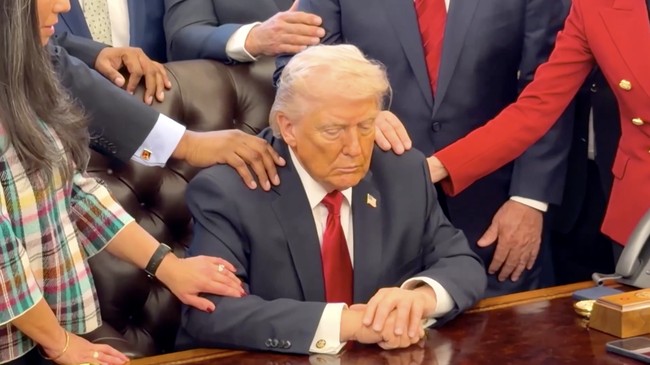
US President Donald Trump continues to use Christian rhetoric to rally support from his core voter base. This messaging is not only delivered by Trump but also reinforced by evangelical leaders who portray the conflict as a battle between good and evil.
Trump, who announced a two-week ceasefire on Tuesday (7 April 2026), faces difficulties in convincing US citizens to support the war. The conflict has triggered a surge in energy prices, killed US military personnel as well as Iranian civilians, and further eroded his standing among voters.
In recent days, Trump has repeatedly used religious language. He described the rescue of a downed US pilot in Iran as an “Easter miracle” and implied that the US and Israeli attacks have God’s blessing.
According to Reuters, US Defence Secretary Pete Hegseth went even further by quoting scripture to justify the use of “extraordinary violence” against enemies he deems “unworthy of mercy.”
This message is echoed by several conservative Christian leaders, from influential figures close to Trump like Texas pastor Robert Jeffress to preachers in small towns. They emphasise the biblical significance of the modern state of Israel, which many evangelicals link to prophecies about the second coming of Jesus Christ.
Evangelical pastor and Trump supporter Jackson Lahmeyer, who is running for US Congress, told his congregation in Tulsa, Oklahoma, that war is typically a battle between good and evil, and the conflict with Iran is no exception.
“There are evil people out there, and if you don’t confront them, they will confront you,” he said. “Good and evil, that’s the Bible story. The good news is that in the end, good always wins.”
White evangelical voters are one of Trump’s strongest support bases. More than 80% of this group voted for him in the 2024 election.
This political reality is seen as the reason Trump and his cabinet members are increasingly using a religious framework in the conflict.
“Look at Trump’s position in the polls and realise that he only has a little more than a third of the public on his side. Much of that constituency consists of white evangelical Christians,” said Jim Guth, a political science professor at Furman University who researches the relationship between religion and politics in the US.
The White House did not respond to questions about Trump’s use of Christian rhetoric. However, spokesperson Taylor Rogers stated that the president has taken firm steps “to eliminate the threat from this terrorist regime, which will protect the American people for generations to come.”
Experts note that previous US presidents have also used religious language during wars. However, the Trump administration’s explicit and forceful use of language to justify violence in religious terms is considered different.
“This is the same language as the Crusades in the Middle Ages. You know, we have to stop the infidels, we have to defeat the evil ones,” said John Fea, a history professor at Messiah University. “We haven’t seen anything like this in American history.”
This religious messaging has also drawn criticism from some Democrats and progressive Christian leaders who view the use of religion to justify the unpopular five-week war as a misguided step. The war has killed 13 US military personnel and thousands of Iranian civilians.
Meanwhile, speaking in St Peter’s Square on Palm Sunday, which opens Holy Week for around 1.4 billion Catholics, Pope Leo called the conflict “horrific” and said the name of Jesus should not be used to spread war.
Progressive evangelical pastor Doug Pagitt criticised the government for using a “very specific Christian narrative” to maintain evangelical support and preserve the “Make America Great Again” (MAGA) coalition.
“What they’re saying is that Trump is on God’s side. You can sleep easy,” he said. “Because without the Christian coalition, the MAGA support base would be very divided.”
According to a Reuters/Ipsos poll released last week, 60% of respondents oppose the US military strikes on Iran. The survey shows a sharp divide, with 74% of Republican voters supporting the war, while only 22% of Democratic voters agree.
Prominent evangelical figure Franklin Graham praised the strikes on Iran in biblical terms and compared Trump to the biblical figure of Esther, the Jewish queen believed to have been raised by God to save her people from destruction in ancient Persia, the region now known as Iran.
A similar message was delivered by Ken Peters, leader of Patriot Church in Tennessee, to his congregation. He hopes the war will result in an “Iran that is pro-Israel and pro-America,” a statement met with applause according to video recordings.
“We see Trump as a man of this world used by God to help us,” he said, while expressing support for the use of a religious framework in the war.
Hegseth also used overtly religious language. He compared the rescue of the US pilot in Iran to the resurrection of Jesus on Easter Sunday.
“A pilot is reborn, everyone comes home whole, a nation rejoices,” he said. “God is good.”
Pentagon spokesperson Kingsley Wilson said that wartime leaders have long used Christian faith, citing US President Franklin D. Roosevelt who distributed Bibles to troops during World War II.
“Secretary Hegseth, along with millions of Americans, is a proud Christian. Encouraging Americans to pray for our troops is not controversial.”