
Spain’s High-Speed Rail Network Under Scrutiny After Fatal Collision
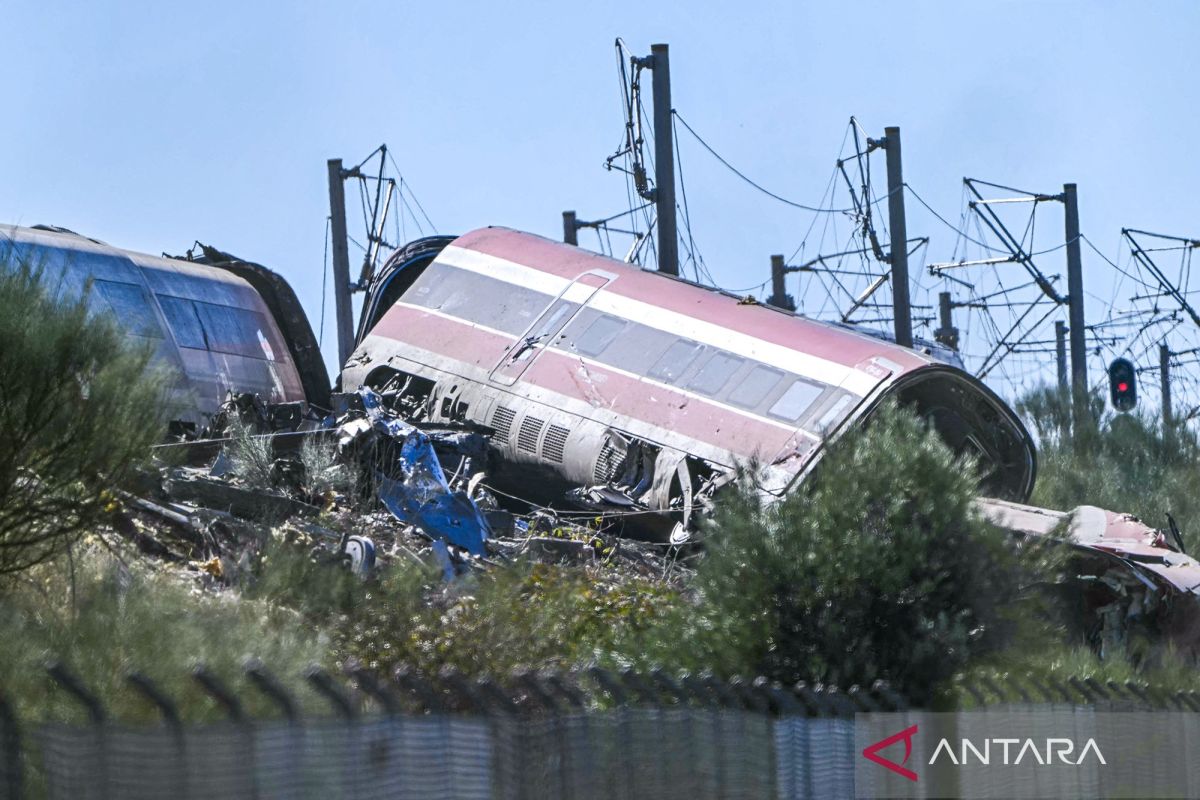
London (ANTARA) – Spain’s high-speed rail network has come under scrutiny after a fatal accident on Wednesday killed at least 68 people and injured dozens more.
Leaked audio obtained by broadcaster RTVE shows a train controller at state rail infrastructure operator Adif instructing a train driver to disconnect the malfunctioning LZB safety system and continue at speeds of up to 200 kilometres per hour.
“Disconnect and reconnect the LZB, then continue under BSL protection at normal speed,” the controller told the driver at 08:36 local time.
A few minutes later, the driver of a high-speed Iryo train reported that the train could not continue. “I’ve lost transmission and stopped at the Urda entry signal,” the driver said.
The government has suggested that human error may have caused one train to enter a track already occupied by another.
However, RTVE, citing several sources, has questioned that timeline and reported that the Iryo train had not received permission to move before the collision.
The collision between a moving train and a stationary one occurred in central Spain, about 140 kilometres south of Madrid, between Mora and Orgaz.
A train travelling from Madrid to Seville struck an Iryo high-speed train that was stationary. Several carriages consequently slid down an embankment beside the track.
The Iryo train, carrying 147 passengers, had stopped on the track after a computer-system failure.
Transport Minister Oscar Puente said a system malfunction and human error were among the possible causes of the accident.
Survivors described a horrifying scene in which they were thrown into the air and trapped among the wreckage, with some having to break windows to escape.
The tragedy has highlighted vulnerabilities on the Madrid–Seville line, which began operating in 1992. The line still relies on the older LZB system rather than the more modern European Rail Traffic Management System (ERTMS) safety technology.
The crash was the second fatal incident on the same line in the past nine months, following an accident near Cordoba in January that killed 46 people.