
Spain’s Deadliest Train Crash in 13 Years Kills 68
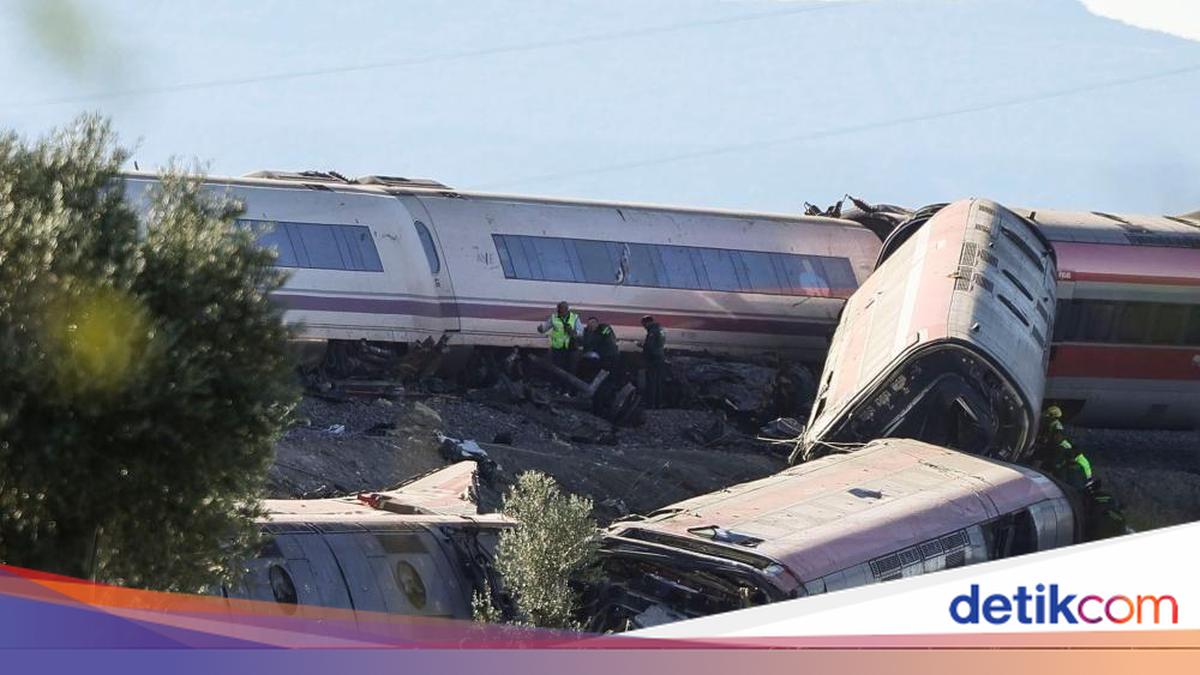
At least 68 people were killed and dozens more injured in a high-speed train crash in central Spain.
The accident happened on Wednesday morning when a train travelling from Madrid to Seville collided with another train stopped on the track. The force of the impact caused several carriages to overturn and fall down an embankment beside the line.
Spain’s transport minister said the crash was triggered by a combination of computer-system failure and human error. It is one of the worst rail accidents in modern European history and Spain’s deadliest train disaster in 13 years.
Survivors described a terrifying scene. They said passengers were thrown into the air on impact, trapped amid the wreckage and forced to break windows to escape.
The crash occurred shortly after 9am local time, about 140km south of Madrid. The train that had stopped on the track, operated by private company Iryo, was carrying 147 passengers.
Transport Minister Óscar Puente said the train had been forced to stop because of a computer-system fault. When the system failed, operational control was transferred to a 24-hour control centre in Madrid. The centre then made what Puente called an “inexplicable” decision to order the train to move again without imposing a speed restriction.
Iryo said its train was “hit from behind” by another train operated by state-owned rail company Renfe, which was carrying 397 passengers.
Salvador Arriza, 62, who was on the Renfe train, said the impact was “extremely violent”. Passengers began breaking windows to escape, he told Reuters, adding that “some people couldn’t move because they were trapped between damaged seats”.
One carriage was reported to have caught fire. Passengers described a distressing scene, with injured people trapped, crying and covered in blood, while others were buried beneath the wreckage. Photographs from the scene showed a long piece of rail piercing the roof of one carriage.
‘The impact was so terrible, I was thrown into the air’
Tangui Binier, 22, was travelling on the Iryo train. He told the BBC that “suitcases started flying and people were screaming” when the train finally came to a halt after the collision.
He said thick smoke and confusion immediately engulfed the scene. When he got off the train, he saw a shocking sight. “I saw the train completely overturned,” he said.
“It was very difficult to witness,” Binier said. He added that his father had helped with the evacuation, carrying a girl with a broken hip out of the wreckage.
He said he had also seen bodies and people with very severe injuries at the scene. “I don’t know if I’ll ever recover from this experience,” he said.
Antonio Jiménez Barca, a Spanish journalist working for the newspaper El País, was walking towards the café carriage on the Renfe train when the collision happened.
“I felt as if I’d been pushed from behind, as though I’d been thrown to the floor,” he said. “I hit my head very hard … I was covered in blood. People were on top of me. One person had an arm injury and another had a head injury.”
Another passenger, 46-year-old Sebastián Herrero, told the newspaper El Mundo that he saw “many people with broken noses and broken arms”.
“The impact was terrible, absolutely terrible,” he said. He added that he had been “thrown into the air for about four or five seconds”, which felt like a lifetime.
Many passengers said they remained in shock after the crash. One passenger broke down in tears during an interview with a local television station as he recalled a woman dying in his arms.
“Her body was already very cold and there was nobody with her,” he said. The programme’s presenter also began to cry during the interview.
Dozens of ambulances were sent to the scene, and a helicopter was used to evacuate the most seriously injured. Spain’s Civil Guard said DNA samples from victims’ families would be needed to help identify some of the bodies.
‘All Spain is in mourning’
“All Spain is in mourning,” Prime Minister Pedro Sánchez said during a visit to the crash site. “Many lives have been shattered, many families torn apart. The grief is profound.”
Spain was still recovering from a high-speed train disaster near Córdoba in January, in which 46 people died. That crash happened on the same rail line, although much farther south.
Wednesday’s crash was the country’s deadliest since 2013, when 80 people died in a train accident on the outskirts of Santiago de Compostela, in north-western Spain.
“The Spanish people deserve to know what is happening with the country’s infrastructure,” said Alberto Núñez Feijóo, leader of the main opposition People’s Party.
Spanish trade union CSIF called on the transport minister to resign. It accused him of making a traffic controller a “scapegoat” by blaming human error in the control room instead of “taking responsibility” for the incident.
Prime Minister Sánchez and several other Spanish politicians cancelled all their public engagements on Wednesday, including campaign events ahead of parliamentary elections scheduled for next month.
Sánchez said it was unacceptable for Spain to suffer two major train accidents in one year. He pledged a full investigation into the cause and said authorities would establish whether negligence had played a part.
“It is unacceptable for Spain to have two serious train accidents in one year,” he said. He added that any failures in the safety system would be dealt with “with the utmost firmness”.
How did the crash happen?
Shortly before 8.30am local time (7.30am GMT) on Wednesday, two high-speed trains were travelling south from Madrid towards Seville. One, operated by state-owned Renfe, was carrying 397 passengers. Ahead of it on the same track was an Iryo train with 147 passengers.
A reported fault in the automatic signalling system, involving a computer failure, forced trains to stop on the affected track. Then, in what Spain’s transport minister described as an almost impossible event, the Renfe train was mistakenly ordered to continue.
It struck the rear of the train ahead between Mora and Orgaz, about 140km south of Madrid.
Broken arms, crushed noses and rail through a train roof
Some passengers had been asleep, others had started their working day by opening their laptops, while some were scrolling on their phones.
Their journey had been interrupted by an announcement that there was congestion on the line. For some passengers the disruption lasted only a few minutes, while others had to wait longer.
Binier was in the front carriage of the Iryo train, carriage number eight. His father was in carriage seven. Their train was one of six ordered to stop at 8.30am. A few minutes later, “the train started moving fast”, Binier told the BBC, “and then it suddenly stopped”.
Confused, he looked out of the window and saw “the cables on the left-hand side fall down, and then there was a lot of smoke behind us”.
Spanish journalist Roberto Gómez was half asleep on the Renfe high-speed train, which had earlier stopped more than 25km from the train Binier was on.
Gómez said the stop was brief. A few minutes later the train began moving again, and the collision happened soon afterwards. He did not know that at 8.36am his train had been ordered to continue. About 17 minutes later, an event the transport minister called “truly hard to believe” took place.
“The impact was terrifying,” Gómez told Onda Cero radio. “You can imagine, the carriage was completely destroyed. All the suitcases were scattered around the damaged carriage.”
Gómez suffered minor injuries. He said another passenger fell on top of him and had a deep cut to the head.
“We were able to help people who had suffered severe blows to the chest and ribs,” he said.
‘There was a piece of rail through the roof of the carriage’
Rafael Barceló was in one of the most badly damaged carriages. A bruise on his forehead marked him as one of the fortunate survivors. He was having a coffee when the collision happened and said he “felt a very strong impact”.
“We were all thrown into the air,” he told Reuters at the crash site. “I’m relatively all right, but my friend is in a much worse condition.”
“I was in carriage number seven, which had the most casualties and was the most badly damaged. I counted at least eight victims in that carriage,” he said, still visibly shaken.
Even in the carriages furthest from the point of impact on the Renfe train, “everything was completely destroyed. Seats came loose, and most passengers sitting facing the direction of travel were thrown into the air,” Arriza said.
“It was truly devastating,” he said, describing how some people were “trapped between the seats”. After managing to get out of the carriage, he saw the extent of the devastation at the scene.
“What caught my attention most was a piece of rail that had pierced the roof of one of the carriages. I think it may have helped stop the train, or at least reduce its speed and momentum,” he said.
Herrero was on the train that was hit from behind. He said the impact was so strong that it threw him into the seat in front.
“The impact was terrible, absolutely terrible,” he said. “After we fell, many people had broken noses and broken arms … We started seeing smoke everywhere.”
Herrero described panic in the carriage just after the collision, as passengers tried to understand what had happened and help the injured.
After the initial impact, passengers in Binier’s carriage debated whether it was safe to leave the train. They were concerned about electrical cables lying around the tracks. Some also feared a second collision with another train and decided to get out.
“We didn’t know what had really happened until we stepped off the train. That was when we saw the evidence of what had taken place. We saw another train behind ours and our train completely overturned, with its rear covered in debris,” he told the BBC.
“When I got off the train, I was in shock, completely disbelieving. People were in danger; it was very difficult to see. There were bodies, there were severed limbs. I don’t know if I’ll ever recover from that experience.”
But, he said, adrenaline soon took over, and those who were not injured began trying to help the victims. His father was among them: Binier said he “managed to carry a girl to safety despite her broken hip”.
Local residents soon began arriving, followed by police officers and ambulance crews from the Civil Guard.
“I was truly one of the luckiest people. I feel very fortunate, while I saw others who weren’t so lucky, and I saw it all from very close by. Sometimes you just ask yourself, ‘Why me?’” he said.