
South Korea's Trust in Indonesia Remains Intact
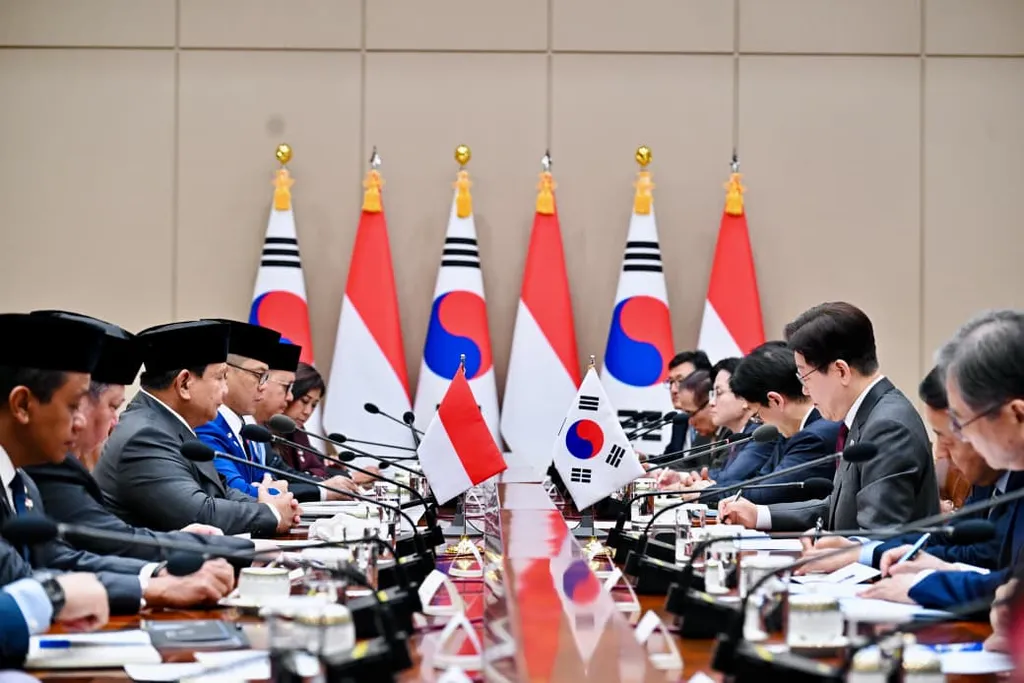
After being established in 1973, diplomatic relations between Indonesia and South Korea have reached a new chapter amid global uncertainty. The two countries agreed to cooperate at the level of a special comprehensive strategic partnership this year. The elevation of bilateral ties is supported by optimism from the South Korean business community.
Last April, Indonesian President Prabowo Subianto and South Korean President Lee Jae Myung smiled broadly in Seoul. The two leaders agreed to bring the relationship to the level of a special comprehensive strategic partnership. The agreement was marked by the exchange of 10 government-to-government memoranda of understanding and 17 business-to-business MoUs with an investment value reaching USD 10.2 billion (Rp 173 trillion). The agreements and commitments cover a number of fields, namely politics; economy; education, culture, and people-to-people exchanges; as well as technology and artificial intelligence (AI).
Two months on, Indonesian Ambassador to Seoul Cecep Herawan said both countries plan to establish a mechanism jointly chaired by their respective foreign ministers. This mechanism will also have derivatives such as a task force. “This task force will oversee all aspects of cooperation across all pillars. We are currently working on it together because it must proceed jointly to facilitate the cooperation process between the two countries, particularly in the economic field,” Cecep said during the Indonesian Next Generation Journalist Network on Korea event by the Foreign Policy Community of Indonesia (FPCI) and the Korea Foundation in Seoul on Tuesday (9/6/2026).
Economic partnership between Indonesia and South Korea has been growing stronger. According to data from the Indonesian Embassy in Seoul, South Korean investment in Indonesia amounted to USD 11.5 billion during 2021-2025, while bilateral trade was valued at USD 18 billion in 2025. Seoul is Indonesia’s largest foreign investor and its seventh-largest trading partner. Cecep added that, as the name suggests, the current level of partnership is very special. Indonesia could be said to be the only foreign country currently engaged in relations with Korea at this level.
“Of course, we all hope this is not just a change of name or title in a diplomatic relationship, but also reflects the depth of trust and the breadth of cooperation that we need to continue building together between Indonesia and Korea,” Cecep said. For Cecep, Indonesia and South Korea complement each other. Jakarta possesses abundant natural resources and a youthful population, while Seoul has advantages in technology and information. Therefore, he identified three priority focuses for future cooperation: energy, AI and cutting-edge technology, and human resource development. “When these three areas are strengthened, the Indonesia-Korea relationship will not only become more strategic but also more relevant in addressing global challenges,” Cecep stated.
Although the world is overshadowed by uncertainty, Cecep also finds that South Korean businesses maintain a fairly positive attitude towards Indonesia. So far, no major issues have significantly disrupted them. “Questions or requests for clarification from them certainly exist. However, we already have sufficiently good data and information so that communication with South Korean business actors has been going well so far,” Cecep said. He added that South Korean businesses do not consider just one factor in doing business, such as domestic factors in the destination country. Businesspeople also take the global situation into account when realising business commitments.
“The investment realisation target of USD 10.2 billion includes some that can be realised quickly, while others are still pending. For example, PT Krakatau Posco, which plans a phase II investment to produce specialised steel for the automotive sector, is currently in quite intensive discussions,” Cecep said. Separately, Deputy Director-General for ASEAN and Southeast Asian Affairs at the South Korean Ministry of Foreign Affairs, Jung Ga-yeon, conveyed that the special comprehensive strategic partnership reflects the highest level of trust and strategic resolve from both countries. Seoul and Jakarta both want to advance a mutually beneficial partnership in an era of increasing global uncertainty.
“Through this momentum, Korea and Indonesia will continue to work closely together to deliver tangible benefits to our people by expanding cooperation in various sectors, including the defence industry, supply chains, energy, digital technology and AI, as well as the cultural and creative industries,” Jung said. According to Jung, a strong partnership between South Korea and Indonesia can serve as a bridge for broader Korea-ASEAN cooperation. “Seoul seeks to be a contributor to dreams and hopes, a foundation for growth and innovation, and a partner for peace and stability,” she said.
Meanwhile, at the National Assembly in Seoul, parliamentarian and Chair of the Korea-Indonesia Friendship Committee, Kim Gi-hyeon, believes South Korea will be a country that promotes mutually reciprocal synergistic growth. However, he highlighted the recent shrinking cooperation between the two countries. “The trade value between Korea and Indonesia reached USD 25.5 billion in 2020 and has since declined. Additionally, there are more certification provisions in Indonesia that increase non-tariff barriers, making it difficult for Korean companies to enter the Indonesian market, and the removal of electric vehicle incentives has made Hyundai hesitant to make additional investments,” Kim said.
Source: jawawa.id (https://jawawa.id/newsitem/south-koreas-trust-in-indonesia-remains-intact-1781661015)
Originally published by kompas.id (https://www.kompas.id/artikel/kepercayaan-korea-selatan-terhadap-indonesia-tetap-terjaga), translated from Indonesian