
South Korea's Largest Mall Collapsed After Boss Refused Repairs, Killing 502
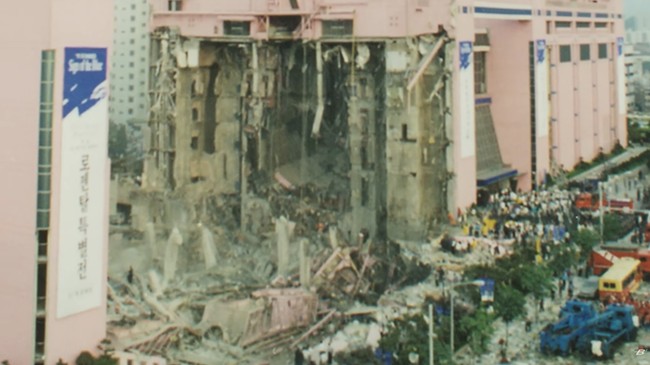
South Korea’s largest shopping mall, the Sampoong Department Store, collapsed simply because its owner refused to repair the building despite large cracks appearing in various corners of the structure. As a result, 1,500 visitors were buried and 502 people lost their lives.
The incident occurred on 29 June 1995, exactly 31 years ago today. According to The Guardian, the management of Sampoong Department Store had actually known the building was in danger since three months prior. In April 1995, signs of damage had already appeared.
Long cracks were clearly visible on the roof and the walls of the fifth floor. However, instead of conducting a thorough inspection, management merely moved shops from that floor to lower levels. Operations on the other four floors continued as usual.
The situation reached a breaking point on 29 June 1995. On that day, cracks widened further and spread to the fourth floor. Once again, rather than closing the operations of the busy mall, management only closed the fourth floor and turned off the air conditioning throughout the building. The reason was that they did not want to lose profits from the high volume of transactions occurring that day.
Ironically, after becoming aware of the issues, several top executives chose to leave the building, while thousands of employees continued to work, serving the incoming visitors. The staff were unaware of the extent of the structural damage and only felt the atmosphere becoming increasingly hot due to the deactivated air conditioning.
Finally, at around 5:50 pm local time, the sound of cracking and rumbling began to emanate from within the building. Visitors panicked and ran towards the exits. Danger alarms were sounded, but it was already too late.
“From across the shop, a sound like a subway train entering a station could be heard, and when we heard that, people began running back and forth. Suddenly, a piece of concrete fell on my head and I lost consciousness,” said survivor Park Seung-Hyun, as quoted by BBC International.
Seven minutes later, the building collapsed in just about 20 seconds, burying more than 1,500 people under the rubble. According to Britannica, rescue teams eventually managed to evacuate 937 injured victims and discovered 502 deceased individuals. Six others were never found.
In an investigative report by The Guardian, the root cause of this tragedy was found to have emerged during the building’s construction in 1987. The land where Sampoong stood was a former landfill, deemed insufficiently stable to support a large shopping centre.
The original contractor had actually warned of the risks of building on such land and proposed an apartment project with a stronger concrete structure. However, the owner of Sampoong, Lee Joon, rejected the proposal and insisted on the construction of a shopping centre.
When the contractor refused to follow his design due to safety concerns, Lee Joon chose to dismiss them and replaced them with another contractor willing to carry out his wishes.
The investigation later concluded that the collapse of Sampoong was caused by a combination of poor construction planning and management negligence in maintaining building safety. The court eventually sentenced Lee Joon to 10 years in prison and his son, Lee Han-Sang, to seven years in prison.