
South Korea Unveils 'Seven Major SEED' Strategy to Challenge US and China in Advanced Tech
South Korea has launched an ambitious technology strategy centred on seven major projects, ranging from nuclear energy and quantum computing to space technology and biotechnology.
The move is intended to create new economic growth engines outside the semiconductor and artificial intelligence (AI) industries.
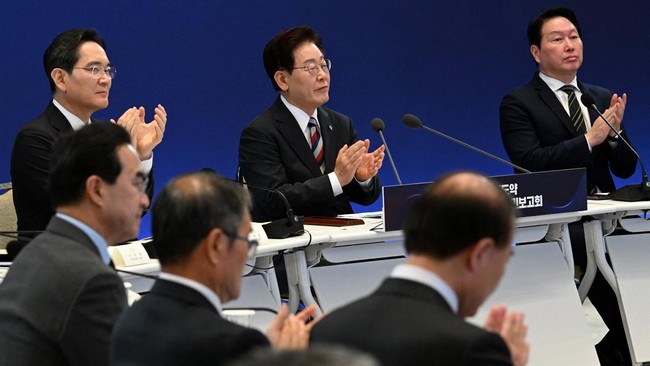
The programme, named “Seven Major SEED”, was announced at a meeting at the Blue House led directly by President Lee Jae-myung. The move could position South Korea as a strong new player in the advanced technology race between the United States and China.
The government is targeting the commercialisation of domestically produced small modular reactors (SMRs) by 2035, a Moon landing by 2030, the development of a domestic 100-qubit quantum computer by 2029, and the commercialisation of brain-computer interface products by 2035.
Lee said South Korea must capitalise on the momentum of the semiconductor industry boom and the rapid development of AI to prepare new sources of growth before these technologies become truly dominant.
“The seven SEED projects we discussed today will become the next generation’s growth engines and key national strategic assets,” Lee said, as quoted by Reuters on Thursday (13/8/2026).
Science Minister Bae Kyung-hoon explained that the initiative includes SMRs, fusion energy, next-generation renewable energy, quantum technology, space and aviation, advanced biotechnology, and strategic mineral and material supply chains.
The government launched the strategy amid the challenges of a shrinking working-age population and slowing potential economic growth. At the same time, South Korea is also seeking to excel in new technologies that are increasingly seen as vital to economic competitiveness and national security.
“We will help these seeds grow and build a South Korea that no one can match in the next 10 or 20 years,” Bae said.
In the energy sector, the government is targeting the commercialisation of domestically produced SMRs by 2035 and the start of construction of non-light water SMRs in the 2030s. South Korea will also pursue fusion energy-based power plants by the late 2030s.
The renewable energy component includes the development of ultra-efficient solar cells, advanced offshore wind turbine technology, hydrogen production systems, and AI-based power grid technology.
In the quantum field, the government is targeting the development of a domestic 100-qubit quantum processor equipped with error correction by 2029. South Korea also aims to become a world-leading country in quantum chip manufacturing by 2035.
Meanwhile, the space programme includes a Moon landing mission in 2030, a second Moon landing mission in 2032, and the construction of a fully independent low-orbit satellite communications network by 2035.
The government will also develop space data centre technology and support the participation of South Korean companies in next-generation commercial aircraft programmes.
In the biotechnology sector, the government is targeting the construction of AI-bio infrastructure by 2030 and the commercialisation of brain-computer interface products by 2035. The programme will also support AI-based drug discovery, autonomous laboratories, and advanced gene and cell therapies.
In the supply chain sector, the government will expand domestic processing and recycling of strategic minerals, increase national reserves, diversify supply sources, and invest 10 trillion won in material, component, and equipment technology by 2030.
The government will also form a joint public-private task force to accelerate commercialisation through regulatory reform.
“Whether we become leaders who enjoy limitless opportunities or merely followers who face the risk of being left behind all depends on our choices,” he said.
Source: jawawa.id (https://jawawa.id/newsitem/south-korea-unveils-seven-major-seed-strategy-to-challenge-us-and-china-in-advanced-tech-1786611118)
Originally published by CNBC Indonesia (https://www.cnbcindonesia.com/tech/20260813123321-37-758915/amerika-china-minggir-dulu-negara-ini-bersiap-jadi-nomor-satu), translated from Indonesian