
South Korea Erupts: 35-Hour Blockade Prompts Presidential Call for Investigation
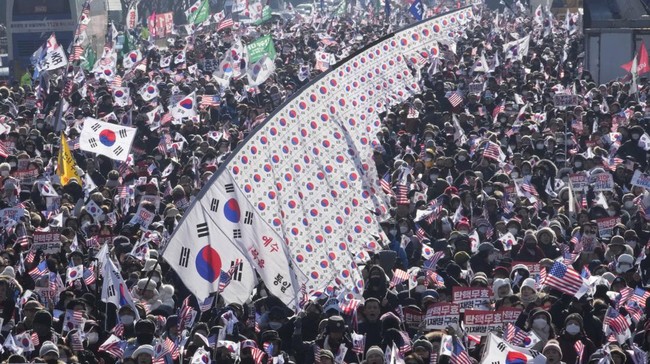
Tumult erupted in South Korea as police forcibly dispersed protesters in Seoul on Friday (5/6/2026). The crowd was demonstrating over a shortage of ballot papers and had staged a blockade lasting 35 hours since Thursday. Citing AFP and local media Yonhap, more than 1,000 demonstrators initially gathered outside a polling station in Jamsil 7-dong, Seoul. The protesters carried posters demanding a halt to the vote count and the annulment of the election, whilst attempting to block the removal of at least two ballot boxes. As a result of the action, South Korean state broadcaster KBS reported that election officials were forced to hold out inside the polling station until Friday morning for their safety. Police were also involved in physical altercations with demonstrators blocking the entrance to the polling station, where some protesters shouted and tried to resist as they were arrested. “Is this truly a country governed by the rule of law?” shouted one man amid the moment police officers ordered the demonstrators to clear the road. Authorities confirmed that the ballot boxes containing approximately 2,000 ballot papers had been secured and successfully transferred to a vote-counting centre. Over this embarrassing incident, the National Election Commission (NEC) was forced to issue an apology after 14 polling stations in Seoul ran out of ballot papers on Wednesday. This unprecedented error was blamed on the commission’s failure to anticipate voter turnout levels. Some polling stations even remained open until 10 p.m. local time to give citizens the opportunity to cast their votes, but the step did little to quell criticism of the commission’s handling of the election. South Korea held local elections on 3 June, but citizens were not voting for the President. Instead, they were electing governors, mayors, regional heads, as well as a number of regional council members and parliamentary members in by-elections. The election was widely viewed as an early test for the first year of President Lee Jae Myung’s term. He assumed power after months of political turmoil triggered by his predecessor, former President Yoon Suk Yeol’s declaration of martial law. Lee’s ruling Democratic Party of Korea won most regions, although it lost the highly prestigious contest for the Seoul mayoralty. The party managed to sweep most seats. Meanwhile, regarding the ballot paper shortage, Lee requested a thorough investigation. “This is a weakness that is difficult to accept,” Lee stated firmly in his strong condemnation of the technical negligence.