
South Kalimantan Moves Towards Self-Sufficiency in Red and White Meat
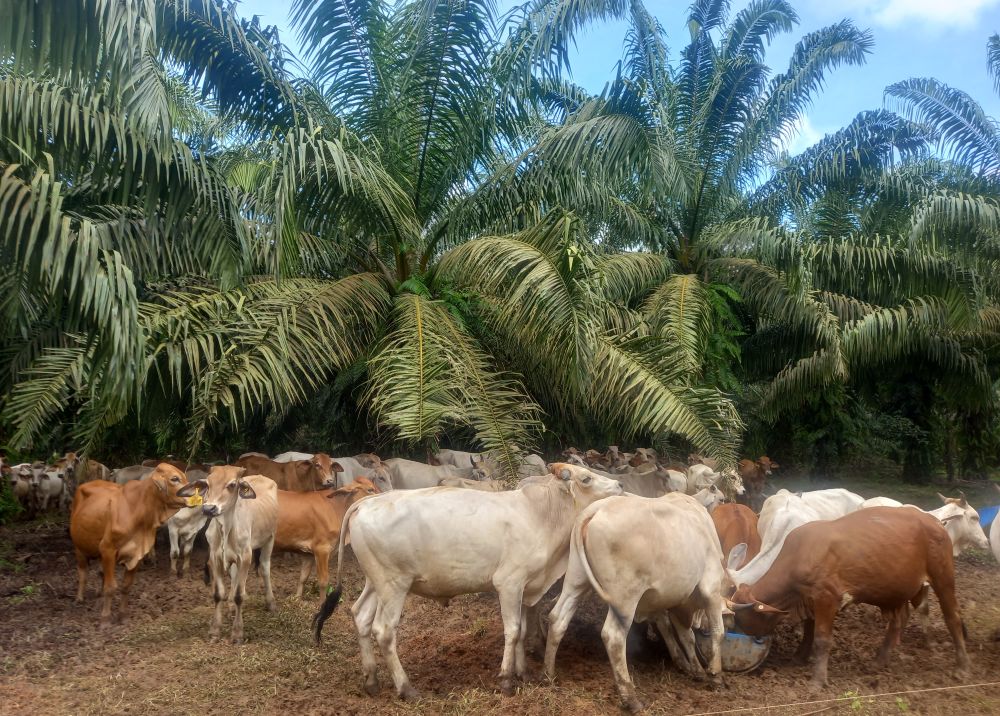
In one corner of a vast oil palm plantation spanning thousands of hectares, hundreds of Brahman cross cattle graze on wild grass growing beneath the dense palm fronds. From a distance, several herdsmen in wide-brimmed hats keep watch, ensuring the herd remains safe. The cattle are contained within designated areas by low-voltage electric fencing, which prevents them from straying too far while facilitating supervision. Beyond relying on wild grass, the animals also receive supplementary feed and vitamins periodically to ensure healthy growth.
This is the reality of cattle breeding under the SISKA KU INTIP programme, an acronym for the Integrated Palm Oil and Cattle System Based on Core-Plasma Livestock Partnership. The initiative, located in Satui District, Tanah Bumbu Regency, South Kalimantan, is run by PT Buana Karya Bhakti (BKB). “The cattle population here has reached 1,500, up from 300 when the programme began. We market around 200 bulls annually, particularly for Eid al-Adha, while the females are retained for breeding,” said Ranch Manager Wahyu Darsono during a visit by Deputy Coordinating Minister for Food Affairs Hanif Faisol Nurofiq.
The model is seen as mutually beneficial. The grass under the palm canopy serves as natural feed, while the cattle help keep the plantation clean, reducing maintenance costs. Furthermore, cattle dung acts as organic fertiliser, enhancing soil fertility. The company also allows local farmers to graze their livestock in the plantation area on a scheduled basis. PT Buana Karya Bhakti operates a 6,449-hectare oil palm plantation and a crude palm oil mill. “We are not only developing breeding but also cattle fattening. We plan to build a slaughterhouse equipped with cold storage so we can market frozen meat more widely,” Wahyu added, noting that the company has explored marketing cooperation with the state logistics agency, Perum Bulog.
Deputy Coordinating Minister for Food Affairs Hanif Faisol Nurofiq assessed that the palm oil-cattle integration model deserves to be a national role model for achieving meat self-sufficiency. “This integration has great potential to strengthen national animal protein security. This model looks simple but can actually be a solution to increase the national cattle population,” he stated. He highlighted that with Indonesia’s oil palm plantations covering more than 17 million hectares, the integration model could potentially support around 1.3 million cattle. This potential is critical given that national beef demand reaches approximately 800,000 tonnes per year, while domestic production is only about 400,000 tonnes, with the shortfall met through imports from countries like Brazil, Australia, India, and New Zealand. “If this model can be expanded nationally, domestic meat needs can be met, thereby reducing dependence on imports,” he emphasised, adding that livestock development must adapt to Indonesia’s tropical characteristics rather than simply copying systems from savannah countries.
South Kalimantan’s Plantation and Livestock Agency Head, Suparmi, described SISKA KU INTIP as a regional innovation that integrates oil palm plantations with cattle farming through community partnerships. The programme is projected to be a pathway to meat self-sufficiency, supporting the food needs of the Kalimantan region and the new capital city, Nusantara. The model has now grown to 26 clusters across South Kalimantan, involving 13 plantation companies with a total cattle population exceeding 4,000. The province’s current cattle population stands at around 180,000, while annual meat demand is approximately 7,135 tonnes, equivalent to 57,000 cattle. To sustainably meet this demand, the population needs to reach over 260,000. The provincial government is targeting meat self-sufficiency by 2029 by preparing 257,000 hectares of oil palm plantation area for the programme.
South Kalimantan’s commitment extends beyond beef. The province has long developed duck farming through the SITI HAWA LARI programme (Integrated Duck System in Swamp and Dry Land). During a visit to a cluster in Mahang Baru Village, Hulu Sungai Tengah Regency, the deputy minister noted that this programme further strengthens the region’s readiness to support the national food, energy, and water security agenda. “South Kalimantan has great potential as a national supplier of animal protein, both red and white meat, thereby reducing import dependency,” he said.
Source: jawawa.id (https://jawawa.id/newsitem/south-kalimantan-moves-towards-self-sufficiency-in-red-and-white-meat-1786121472)
Originally published by Media Indonesia (https://mediaindonesia.com/nusantara/919553/kalsel-menuju-swasembada-daging-merah-putih-), translated from Indonesian