
South Kalimantan Forest Fire Haze So Thick, Police Hold Istisqa Prayer for Rain
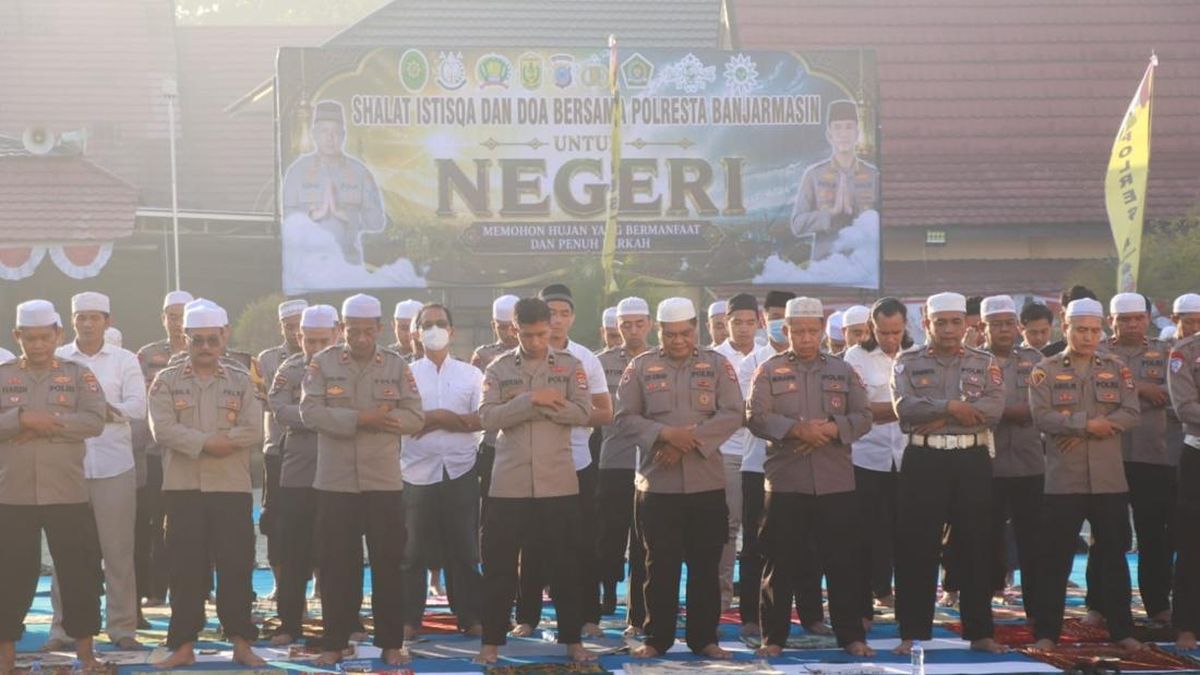
Haze from forest and land fires (karhutla) remains thick in several areas of South Kalimantan such as Banjarbaru and Banjarmasin, especially in the morning.
In response, the Banjarmasin City Police held an Istisqa prayer. Worshippers prayed for rain to fall soon in South Kalimantan so that no more forest and land fires would leave behind haze.
“Outwardly and inwardly we ask for Allah’s help so that beneficial and blessed rain is sent down,” said Banjarmasin Police Chief, Senior Commissioner Riza Muttaqin, on Wednesday (19/8), as quoted from detikKalimantan.
Riza said the Istisqa prayer was held as one of the efforts in response to the drought and forest and land fires that have struck several areas in South Kalimantan almost every day. His office is also carrying out basic education for the public regarding the current situation.
“Besides heavenly efforts, we also continue to carry out efforts on the ground such as forest and land fire education and including helping distribute clean water to affected areas,” said Riza.
Currently, in South Kalimantan, especially in Banjarbaru and the border of Tanah Laut, forest and land fires occur quite frequently. As a result, haze covers nearby areas such as Banjarmasin, Banjarbaru, Banjar Regency, Tanah Laut and Tanah Bumbu.
The thick haze disrupts visibility for motorists and causes sore throats. Besides at the Banjarmasin City Police, Istisqa prayers were also held at the open field of the Banjarbaru Mobile Brigade, and at several other police stations across South Kalimantan.
Quoting from Antara, the South Kalimantan Provincial Government is also wetting protected forest areas on Jalan Makmur, Banjarbaru using four pump units operated for 24 hours to maintain land moisture in order to prevent forest and land fires.
The Head of the Irrigation and Raw Water Section of the South Kalimantan Provincial Public Works and Spatial Planning Agency, Herry Ade Permana, in Banjarbaru on Tuesday (18/8), said water from the irrigation network and drainage channels is channelled towards the protected forest area, then relayed by Forestry Agency officers to wet areas that need it.
He said the wetting of forest and land fire-prone areas has actually been carried out since May 2026 through the opening of the water control gate at BRK 9 Cinde Alus with a discharge of around 0.47 cubic metres per second to maintain water supply towards the Guntung Damar area up to around Syamsudin Noor Airport.
The latest monitoring results, he said, show the area up to the end of Guntung Damar is still wet, including the ring one area around Syamsudin Noor Airport which is an indicator that water supply through continuous wetting is still able to maintain the moisture of the area ahead of the peak of the dry season.
He said water control in the area has also been carried out since several years earlier through the construction of a number of control gates or tabet on the channel network around the protected forest which are now being used again to support wetting during the dry season.
“We prepare infrastructure and water discharge for wetting. That is what has been the involvement of the Public Works and Spatial Planning Agency in handling forest and land fires,” said Herry.
Meanwhile, the Meteorology, Climatology and Geophysics Agency (BMKG) reminded the public to be aware of air quality in Banjarbaru which reached the Hazardous or very unhealthy category due to the high concentration of fine particulate matter PM2.5 on Wednesday morning.
Quoting from Antara, the Head of the BMKG South Kalimantan Class I Climatology Station, Klaus Johannes Apoh Damanik, said the PM2.5 concentration in Banjarbaru reached 389.4 micrograms per cubic metre at 07.00 Wita and entered the Hazardous category, far exceeding the threshold of 250.5 micrograms per cubic metre for that category.
PM2.5 concentrations began to increase since the early hours and air conditions worsened to extreme levels in the morning, along with dry atmospheric conditions and no rain in the South Kalimantan region during the 24-hour observation period.
Johannes said the air quality condition needs to be a concern for the public, especially because the concentration of fine particulate matter has reached a level that could potentially endanger health. He said BMKG monitors the increase in PM2.5 concentration in relation to forest and land fire smoke conditions around the affected areas, while dry conditions cause particulates and smoke to linger more easily in the air.
BMKG classifies air quality based on PM2.5 concentration as Good at 0-15.5 micrograms per cubic metre, Moderate at 15.6-55.4 micrograms per cubic metre, Unhealthy at 55.5-150.4 micrograms per cubic metre, and Very Unhealthy at 150.5-250.4 micrograms per cubic metre.
PM2.5 concentrations above 250.5 micrograms per cubic metre fall into the Hazardous category, so the figure of 389.4 micrograms per cubic metre recorded in Banjarbaru shows air quality is far above the threshold for that category.
Johannes said dry conditions were also observed throughout South Kalimantan based on rainfall monitoring at the South Kalimantan Class I Climatology Station from 18 August at 07.00 Wita to 19 August 2026.
BMKG urged the public, especially those active outdoors, to always use standard masks and reduce direct exposure to outside air when PM2.5 concentrations are at high levels to reduce the risk of exposure to fine particulates.