
South Jakarta District Court Hears Criminal Law Expert Explain Offence Elements in Alleged Extortion Case Involving Businessman
University of Indonesia (UI) criminal law expert Dr Flora Dianti said that a person has the right to collect a debt. However, the act may become a criminal matter if it involves coercion, extortion or threats that cause another party to hand over goods or money out of fear.
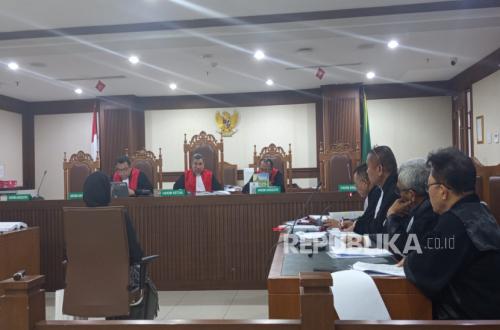
Flora gave evidence as an expert witness at the continuing trial of Bangun Paulus Tudungta, who is charged in an alleged extortion case, at the Central Jakarta District Court on Wednesday (21 October 2026).
During the hearing, Flora explained the elements of Articles 482 and 483 of Law No. 1 of 2023 on the Criminal Code, under which the public prosecutor has charged the defendant. The two articles cover extortion and threats.
She said the first element was the intention to benefit oneself or another person, with different methods involved. Article 482 concerns the use of violence or threats of violence.
Article 483, meanwhile, concerns threats to disclose a secret or to defame someone, with the aim of making that person hand over goods. The core of Articles 482 and 483 is coercion.
“The crime takes the form of someone being forced,” Flora said.
Flora stressed that a person has the right to collect a debt, but that right cannot be used to justify extortion or threats against the person being pursued for payment.
In her view, debt collection should be carried out without violence, threats or coercion. If those elements are present, the collection may become a criminal offence because it constitutes an abuse of rights.
“Basically, when collecting a debt, you should simply collect the debt; there is no need for coercion, threats or extortion. But if there are threats and extortion of money, that amounts to an abuse of rights,” Flora said in response to a prosecutor’s question about demanding a sum greater than the amount claimed as a debt.
Flora said a person may still pursue debt collection through proper legal channels. By contrast, using violence, threats of violence or defamation in the process may bring the conduct into the criminal sphere.
Flora also explained that a threat does not always have to be made explicitly or through a direct statement. It may be assessed from a series of conversations, written communications or gestures, while taking account of the objective circumstances and context of the incident.
“A threat makes the victim feel afraid. That fear ultimately makes the victim willing to hand over goods, so there is a causal link. Of course, that fear must be assessed in light of the threat,” she said.
According to Flora, fear and coercion are important in determining whether goods or money were handed over voluntarily or under pressure.
“If it is voluntary, there is no threat, fear or coercion, and it is therefore considered voluntary or not unlawful. To determine when it becomes an unlawful act, we return to the elements of Articles 482 and 483 of the Criminal Code, which include coercion, extortion and threats,” she said.
Flora also responded to the prosecutor’s question about a person reporting another party to law enforcement authorities in connection with a sum of money.
Source: jawawa.id (https://jawawa.id/newsitem/south-jakarta-district-court-hears-criminal-law-expert-explain-offence-elements-in-alleged-extortion-case-1792691510)
Originally published by Republika (https://daerah.republika.co.id/berita/tna679320/pn-jaksel-hadirkan-saksi-ahli-pidana-jelaskan-unsur-pidana-di-sidang-dugaan-pemerasan-pengusaha), translated from Indonesian