
Sophisticated! Pleret Bantul Creates Modern Farming, Watering and Fertilising Crops Assisted by AI
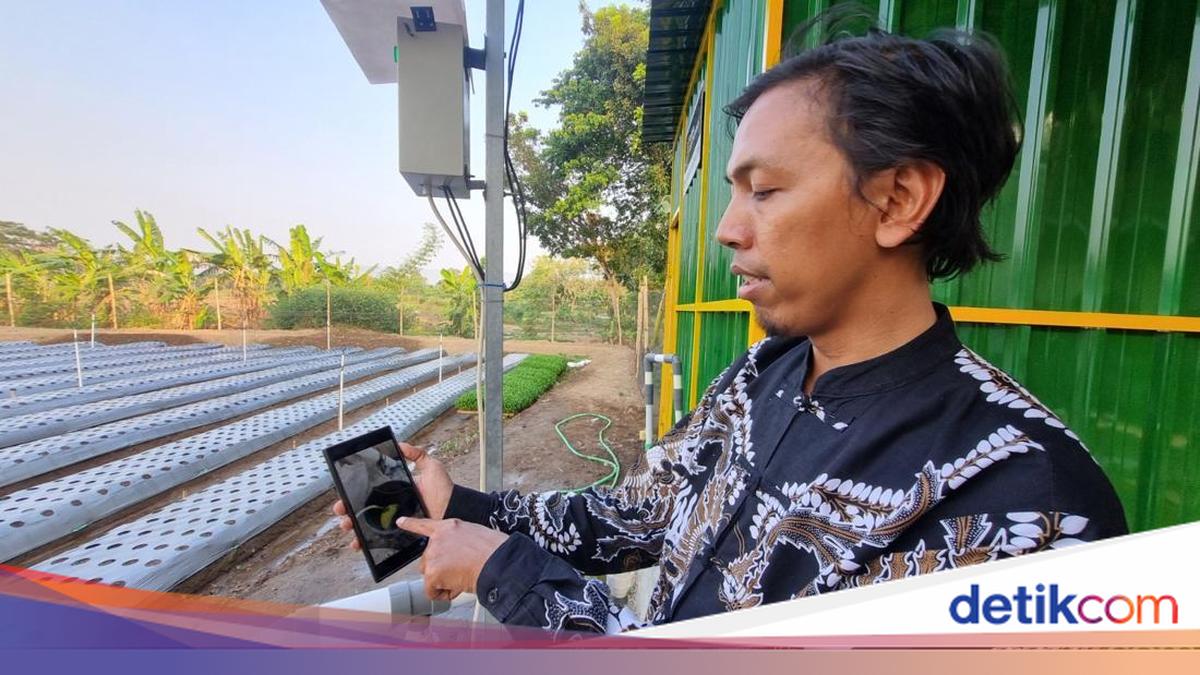
Kalurahan Pleret, Bantul, is utilising artificial intelligence (AI) and the internet to manage agricultural land. Farmers will no longer need to water and fertilise crops manually as this will be done automatically through a concept known as the internet of things (IoT).
Observations on Thursday (20/8/2026) showed raised beds of soil arranged neatly on the surface of the land at Banyu Kencono, Pleret. There are three blocks on the site. Each bed has a pipe extending upwards for crop watering, while at the bottom of the bed there is a pipe channelled into the soil. There is also a well that serves as the water source for crop irrigation, and solar cells are installed at the front of the land.
Lurah Pleret, Taufiq Kamal, explained that he initially interacted frequently with the combined farmers’ group (Gapoktan) in Pleret. It turned out that many young people were not interested in the agricultural sector and joining the Gapoktan. “Then the older farmers complained about the profits from farming. At that time I invited them to plant organic crops, and I even took them to Kulon Progo. But in the end no one was interested,” said Taufiq when met in Pleret, Bantul, on Thursday (20/8) afternoon.
Taufiq then invited the farmers in the Pleret Gapoktan to grow vegetables, but this was rejected. Taufiq recalled that at the time the farmers considered growing vegetables to be more troublesome in terms of maintenance. From there, Taufiq visited agricultural land in Central Java. Based on that visit, Taufiq assessed that the agricultural land in Pleret could be used for growing vegetables.
“Then we just budgeted it in the planning, we conceptualised what is called IoT-based integrated farming,” he said. It should be noted that IoT is a concept where various physical objects are equipped with sensors and the internet so that they can be interconnected, collect data, and be controlled remotely without continuous human assistance.
“So, we started this year with the planning on half a hectare of land, that is TKD, and yesterday (19/8) was the first planting,” he said. He acknowledged the importance of proving that this IoT-based farming concept is successful. Because if it succeeds, people, especially farmers in Pleret, will be interested.
“Yesterday’s activity was the first planting through our activity, the regular Gapoktan gathering. Because if it is only theory it is difficult, we have to give an example first before they become interested,” he said. The first planting using this system involved bitter melon and shallots. The third block is planned for planting curly red chillies.
Taufiq accessed the special financial assistance (BKK) of Desa Mandiri Budaya as capital for financing this planting. The BKK comes from the Special Autonomy Fund (Danais). “Through the BKK Desa Mandiri Budaya. That means our independence, I tried with that because Pleret is known for food security, from the era of Sultan Agung. So, how can I not restore it like the era of Sultan Agung,” he said.
Regarding the benefits of using the IoT concept for the agricultural sector, Taufiq explained that farmers will not need to water and apply liquid fertiliser manually. With IoT, watering and fertilising can take place automatically even without the need for voice instructions.
“So with IoT, crop maintenance can be completed by utilising technology. The reason it can water automatically is because we have installed sensors on the land, so if the soil is moist, dry or the pH is not suitable, it immediately waters automatically,” he said. Technically, the sensors installed on the agricultural land will send data via the internet, because WiFi is installed on the land. The data is then processed continuously, resulting in actions such as watering or applying liquid fertiliser.
“We also integrate it with artificial intelligence, so the artificial intelligence just needs to be given knowledge. So there is no need to say please turn on the water, water the crops, because that knowledge already exists,” he said. In addition, the IoT that Taufiq uses is not in the form of an application but a web platform, which contains a dashboard.
“So the whole concept is internet-based, utilising technology for crop maintenance and farmers can become bosses because they only need to monitor,” Taufiq continued. Regarding the cost, Taufiq admitted it is not small. The funds required reach tens of millions of rupiah.
“Around Rp 67 million for the equipment, that is complete with solar cells and so on. That means it is a fairly long-term investment,” he said. Regarding how many farmers have utilised the IoT concept in farming, Taufiq said none yet. This is because it is all new, started by Taufiq this year with the first planting yesterday.
“Well, the example is from us, our own effort, we will try it first. Yesterday we also launched it together with the Gapoktan. So later if they see the results they will definitely be interested,” he said. If farmers in Pleret adopt the IoT concept in farming in the future, it is not impossible that the agricultural land in Pleret could become a tourist destination. Even if the concept succeeds, BUMKal could sell it and increase the income of Kalurahan Pleret.
Meanwhile, IoT technician Saifudin added that the reason for using solar cells is to avoid dependence on PLN, considering the electricity required for IoT-based farming is substantial. “This needs 1.5 kilowatts of electricity, so we chose to use solar cells which are free,” said Saifudin. In addition, the well was built to maintain water quality for crop irrigation. According to Saifudin, groundwater has good quality for watering crops. “Besides that, it also reduces expenditure,” he said.
He explained that there are sensors buried in the soil. Their purpose is to check humidity and weather temperature. “Sensors are planted in the soil, those sensors monitor air humidity, soil, and weather, especially temperature. So if it rains, there is no watering,” he said.
Source: jawawa.id (https://jawawa.id/newsitem/sophisticated-pleret-bantul-creates-modern-farming-watering-and-fertilising-crops-assisted-by-ai-1787233984)
Originally published by detikJogja (https://www.detik.com/jogja/berita/d-8627623/canggih-pleret-bantul-bikin-pertanian-modern-siram-pupuk-tanaman-dibantu-ai), translated from Indonesian