
Son of Rental Boss, Victim of Military Shooting, Testifies in Military Court Lawsuit
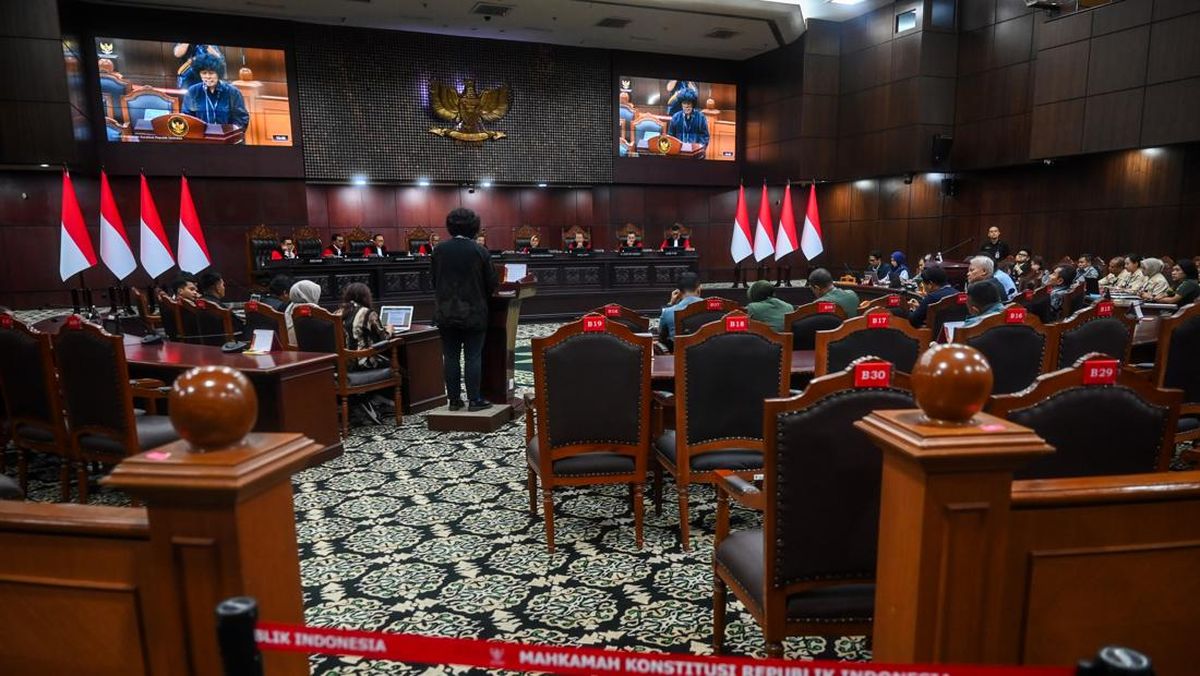
The Constitutional Court (MK) held the seventh hearing of the judicial review of Law Number 31 of 1997 on Military Justice (Military Justice Law) on Tuesday (28/4).
According to the MK website, in Application Number 260/PUU-XXIII/2025, the court heard statements from Expert Witnesses and the President’s Witnesses, namely Lalu Muhammad Hayyanul Haq (Legal Expert from Mataram University) and Agus Surono (Legal Expert from Pancasila University).
The court also heard testimony from Rizky Agam Syahputra, the son of the rental boss in Tangerang who was shot by TNI AL personnel, as well as from Dimas Bagus Arya, Coordinator of the KontraS Working Body.
Rizky Agam Syahputra, the biological son of the late Ilyas Abdul Rahman, recounted the shooting incident by rogue TNI AL personnel during the trial.
On 1 January 2025, Rizky said, Ajat Supriyatna rented a Brio car from CV Makmur Jaya Rental Mobil, owned by his father. Then, on 2 January 2025, the witness and his father, along with the rental team, pursued the rented vehicle.
When the vehicle was successfully intercepted, his father questioned the driver, and it turned out the car had been transferred to rogue TNI AL personnel.
His father then asked the rogue TNI AL personnel where he got the car from, but the soldier pointed a pistol and shot the witness’s father. After the shooting, the rental car was driven away by the group of TNI AL soldiers.
“My father was shot. I took my father to Balaraja Hospital, but on the way, my father passed away. After the incident, I, along with my legal representative and the team, went to Puspomal to file a report,” Rizky recounted.
“When I and the other witnesses filed the report, it was received well by the investigator without any complications, examined humanely, and with good service,” he added.
In this case, previously on 25 March 2025, Chief Petty Officer Bambang Apri Atmojo and Sergeant Akbar Adli were sentenced to life imprisonment by the Jakarta Military Court panel of judges. Sergeant Rafsin Hermawan was sentenced to 4 years in prison. They were also dismissed from military service.
However, in October 2025, the Supreme Court (MA) overturned the life sentences for Bambang and Adli, reducing them to 15 years in prison and ordering restitution to the two victim families. Meanwhile, Rafsin’s sentence was reduced to 3 years in prison.
President’s Expert Testimony
This judicial review of the Military Justice Law was requested by Lenny Damanik and Eva Meliani Br. Pasaribu.
Regarding the judicial review of Article 9 paragraph 1 insofar as criminal acts under Article 43 paragraph (3) and Article 127 of the Military Justice Law, Hayyanul explained that from a systems theory perspective, military justice is a manifestation of functional differentiation in the legal system that operates autonomously to maintain the effectiveness of the defence, security, integrity, and sustainability of national life and statehood.
Therefore, according to him, forcing the transfer of military court jurisdiction to general courts could potentially cause systemic dysfunction.
On that basis, he views military courts as special institutional instruments that function to maintain the integrity, discipline, and identity of the organisation. Additionally, military courts function to control and regulate every violation of military discipline, military crimes, and general crimes that clearly contradict the soldier’s oath.
According to him, theoretically in law, the existence of military courts has an explicit constitutional basis in the 1945 Constitution.
“Its existence and function as a form of accountability mechanism, not impunity, is a recognition of functional differentiation in the legal system that has developed and integrated into the independent judicial power system,” his statement quoted from the MK website.
According to Hayyan, the existence of military courts does not contradict the constitution and is not a legal anomaly. This special military jurisdiction is a logical consequence of the command system and not a violation of the principle of equality before the law.
“Our task is to continue pushing for progressive and constructive reform, through increasing transparency or openness in military court trials on a limited basis, as long as it does not contradict the principle of operational secrecy for national interests, and does not eliminate the military’s core function,” Hayyan explained.
On the same occasion, Agus Surono explained that the trial process in military courts is also monitored and supervised by the Supreme Court Supervisory Body (Bawas MA) and the Judicial Commission (KY).
Thus, he continued, it is the same as general courts which also receive supervision from both institutions. He then said that if there are deviations in the trial process within military courts, this will become the object of examination by both institutions.
“Considering the position of military courts within the Judicial Power under the Supreme Court, the guarantee of objectivity and transparency in trials of crimes adjudicated in military courts can still be supervised by the Supreme Court’s internal supervisors and externally by the Judicial Commission,” Agus clarified.
Source: jawawa.id (https://jawawa.id/newsitem/son-of-rental-boss-victim-of-military-shooting-testifies-in-military-court-lawsuit-1777398677)
Originally published by CNN Indonesia (https://www.cnnindonesia.com/nasional/20260428200529-12-1353181/anak-bos-rental-korban-tentara-jadi-saksi-gugatan-peradilan-militer), translated from Indonesian